
I. Introduction
Yucca primarily grows in the desert regions of the southwestern United States and northern Mexico. Its extract, rich in saponins, polyphenols, resveratrol, and other active ingredients, is widely used as a feed additive, in food and health care products, and in daily chemicals and related industries.
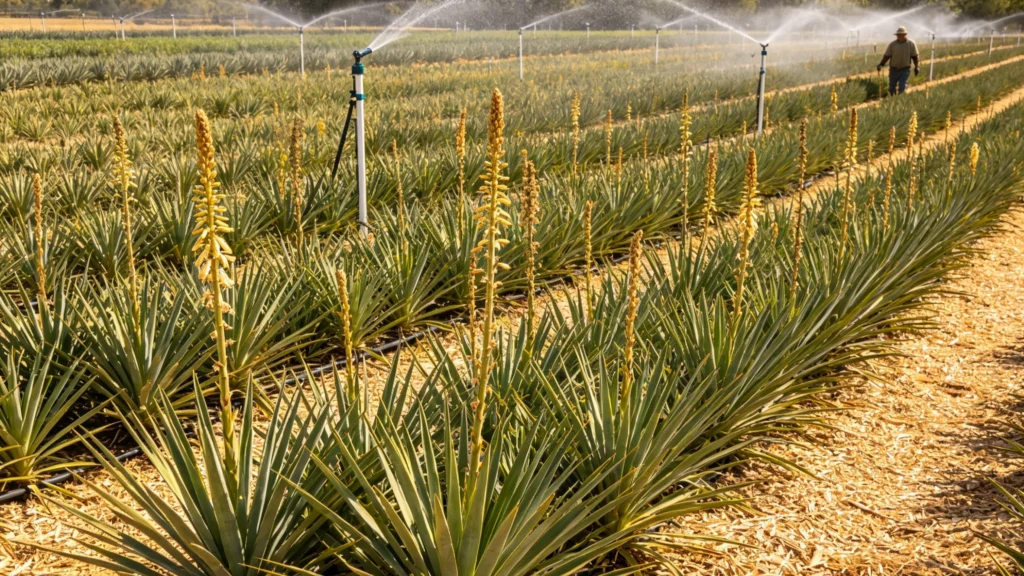
In China, yucca is primarily introduced and cultivated rather than native. It is grown in regions with suitable climates, ranging from southern North China to the Yangtze River Basin and South China, including Hainan and Yunnan.
In recent years, China’s policy of antibiotic replacement in livestock breeding and the growth of the pet economy have driven rapid market expansion for yucca extract as a natural deodorant and intestinal health regulator. Consequently, large-scale cultivation has increased in many regions, improving quality and output, and significantly transforming the industry’s production pattern.
II. Current Production Status of Yucca Extract in China
As of May 2026, China is the world’s largest producer and exporter of Yucca Schidigera Extract.
2.1 Raw Materials of Yucca Saponin
Domestic cultivation in China is dominated by Yucca gloriosa, primarily found in South China (Guangdong, Guangxi, Fujian), East China (Jiangsu, Zhejiang, Shanghai, Shandong), Central China (Hubei, Hunan, Henan), and Southwest China (Yunnan). Most of this yucca is used for landscaping due to its low saponin content (3–8%), scattered supply, and inconsistent quality, making it suitable only for low-end feed-grade products or blending.
Over 90% of commercial Yucca Saponin raw materials are Yucca schidigera, sourced from the US–Mexico border region (northern Mexico, southwestern US), with a saponin content of 12–18%. This is the primary source for high purity Yucca Saponin.
2.2 Production Capacity and Regional Distribution: Focused on South China and East China, high concentration
Total capacity in 2025 is estimated at 4,000–6,000 tons per year (on a powder basis), with actual output in 2024 at approximately 3,800 tons. China is a leading global producer and exporter of yucca extract, accounting for a significant share of global output.
Regional distribution:
South China (Guangdong, Guangxi, Fujian): Core production areas include Zhaoqing, Wuzhou, and Zhangzhou, which are close to ports and import channels. Key enterprises: Shenzhen Jayoo Bioengineering Co., Ltd., Guangxi Zhongheng Group.
-East China (Shandong, Jiangsu, Zhejiang): This region is technology-intensive and highly automated. Key enterprises: Chenguang Biotech Group (Shandong), Shaanxi Huike.
Central China (Henan, Hubei): This region offers cost advantages. Key enterprise: Xiangyang Kangrun Biology.
Southwest China (Yunnan): Produces small volumes of organic and niche products.
Industry concentration (estimated): The top five enterprises (CR5) account for approximately 44% of market share, while the top three (CR3) hold about 29%, resulting in a structure of one leading enterprise, two strong competitors, and several small-to-medium clusters.
III. Product Structure: Feed grade dominant, high-end proportion rising
– Feed grade (≈70%):
– Powder: 5%, 8%, 10% saponins (North American standard), light yellow/brown, for deodorization and digestion promotion in livestock and poultry. Price: 8–15 RMB/kg.
– Liquid: 4% saponins, fully water soluble, for drinking water addition. Price: 12–20 RMB/kg.
– Pet grade (≈15%, fastest growth):
Contains 15–30% saponins, is fully water-soluble, has a low odor, and does not precipitate. Used in cat and dog food, deodorant sprays, and water additives. Price: 25–50 RMB/kg. Key producers: Jayoo Biology, Shandong Huachang.
– Food/pharmaceutical grade (≈10%):
Contains 50–98% saponins, is a white powder with no solvent residue, and low heavy metal content. Used in functional foods, health products, toothpaste, and mouthwash. Price: 80–300 RMB/kg. Key producers: Xi’an Lvtian, Shaanxi Huike.
– Organic/customized grade (≈5%):
Certified organic in the EU and US, pesticide-free, and non-GMO. Used in high-end cosmetics and premium pet food, with a price premium of two to three times. Key producer: Yunnan Pu’er industrial cluster.
IV. Production Capacity Analysis
– 2020: About 2,000–2,500 tons; global share 20–25%. Mainly feed grade; operating rate ~65%; many SMEs; severe price competition.
– 2021: About 2,500–3,000 tons; +25% YoY. Leading enterprises expanded capacity, launched pet grade products in small batches, and saw exports grow rapidly.
– 2022: About 3,000–3,500 tons; +20% YoY. Driven by breeding and the pet economy, a fully water soluble high saponin (15%+) capacity came online.
– 2023: About 3,500–4,000 tons; +15% YoY. Industry consolidation accelerated, small factories eliminated due to stricter environmental rules; CR5 ~40%, exports >50%.
– 2024: About 4,000–4,500 tons; +10% YoY. Growth slowed, structure optimized; 70% new capacity pet/food grade, feed grade operating rate dropped to 55%.
– 2025: About 4,500–5,500 tons; +12% YoY. Global share 30–40%, concentration increased (CR5 ~44%), high end capacity (30%+ saponins, organic) in short supply.
Outlook (2026–2030)
– Capacity expansion and structural upgrading: Seventy percent of new capacity will target high-value-added pet and food-grade products. Leading enterprises are expected to expand and merge, with CR5 projected to exceed 50%.
– Accelerated raw material localization: Large-scale pilot cultivation of high-saponin yucca is underway in Guangdong, Guangxi, and Yunnan, with a goal of achieving 30% self-sufficiency by 2030.
– Technological breakthroughs and improved certification: Adoption of low-temperature extraction, membrane separation, and enzymatic hydrolysis is increasing. A national standard is expected in 2027, with outdated capacity to be phased out.
– Market diversification: The pet sector is growing at 20–30% annually, with functional foods, daily chemicals, and aquaculture emerging as new growth drivers. Exports are shifting toward high-end and branded products, reducing reliance on low-end OEM .
V. Industry Challenges and Opportunities
5.1 Challenges
– Raw material dependence: The industry remains highly reliant on imports, leading to high costs and instability. Raw material prices have doubled in certain years.
– Low-end price competition: Numerous small factories compete by offering low-content (below 10%) or compound products at reduced prices, disrupting the market.
– Lagging regulations: While industry standard NY/T 3318 2018 supports feed use, the absence of national food safety standards (GB) for health and food applications creates barriers to approval and registration of high-end capacity.
5.2 Opportunities
– Pet economy boom: There is strong demand for high-purity, fully water-soluble, low-odor yucca extract for deodorization, urinary health, and functional pet food, which is driving high-end product upgrades.
– Biomanufacturing breakthrough: Domestic enterprises are developing synthetic biology and fermentation technologies for yucca saponin production, which may reduce import dependence and improve cost structure.
– RCEP export advantage: Tariff reductions under RCEP have enabled rapid expansion of Chinese yucca extract into Southeast Asian markets such as Vietnam and Thailand, creating new outlets for surplus capacity.
VI. Conclusion
China’s yucca extract industry is at a pivotal stage, with high dependence on imported raw materials, increasing concentration in production among leading enterprises, and ongoing structural capacity expansion. In the coming years, as price competition in the feed sector peaks and high-end demand in the pet and food sectors rises, competition will shift from scale expansion to securing raw material supply, advancing high-purity extraction technology, and driving application innovation.