Abstract
Both astaxanthin and zeaxanthin belong to the carotenoid family, yet each dominates its respective fields of antioxidation and eye health.
This report comprehensively compares the core differences between the two major raw materials in terms of chemical structure, biological functions, and market landscape, providing decision-making references for formula developers, raw material purchasers, and brand owners in the health product industry.
Whether you focus on astaxanthin, known as the “King of Antioxidants,” or zeaxanthin, hailed as the “Macular Guardian”, you can find scientific and practical insights here.
Introduction: Why Compare Astaxanthin vs Zeaxanthin?
In the functional raw materials market, carotenoids have always been among the most promising growth areas.
Among them, astaxanthin is renowned as the “King of Antioxidants” for its powerful antioxidant capacity, while zeaxanthin holds a leading position as an eye health raw material due to its specific protective effect on the macular region of the retina.
Although belonging to the same family, they differ completely in chemical nature, functional positioning, market strategy, and commercial value.
Centering on “Astaxanthin vs Zeaxanthin”, this paper dissects the two ingredients from fundamental properties to commercial layout, helping stakeholders gain a full picture of the two industry tracks.
Basic Comparison: Structure & Functions
Fundamental Product Attributes
Chemical Structure: What Does an Extra Ketone Group Determine?
Astaxanthin (C₄₀H₅₂O₄): Its key functional groups are hydroxyl (-OH) and ketone (=O). It exists in three isomeric forms: levorotatory, dextrorotatory, and racemic. Natural sources are dominated by levorotatory (3S,3’S) configuration with the highest activity. Its structural advantage lies in the ketone groups at both ends, enabling it to cross cell membranes and exert two-way antioxidant protection.
Zeaxanthin (C₄₀H₅₆O₂): Contains only hydroxyl (-OH) groups and is an isomer of lutein, with configurations such as (3R,3′R) and (3R,3′S). Its structural advantage lies in the large conjugated system comprising 11 double bonds, which enables specific absorption of blue light.
Core Summary: The extra ketone group endows astaxanthin with stronger polarity and antioxidant activity, while zeaxanthin acts as a natural “blue light filter” relying on its conjugated double bond system.
Source & Production Process: Which Has Higher Costs?
Astaxanthin: Natural extraction (mainstream) uses cultivation of Haematococcus pluvialis under stress to induce accumulation, followed by supercritical CO₂ extraction. The fermentation method uses Phaffia rhodozyma fermentation at a lower cost than algal sources, mostly in racemic configuration. Chemical synthesis has the lowest cost, only 1/5 to 1/10 of natural astaxanthin. Synthetic astaxanthin is not approved for use in food/health products in China and is permitted only as a feed additive.
Zeaxanthin: Marigold extraction is the mainstream, achieved via solvent extraction and saponification from marigold petals, with sufficient raw material supply, mature craftsmanship, and low costs. Synthetic zeaxanthin is allowed as a food supplement in the EU with mandatory labeling requirements.
Cost Comparison: The unit cost of natural astaxanthin is generally 3 to 10 times that of zeaxanthin, directly determining their end-product pricing and market positioning.
Physical Properties, Stability & Dosage Form Adaptation
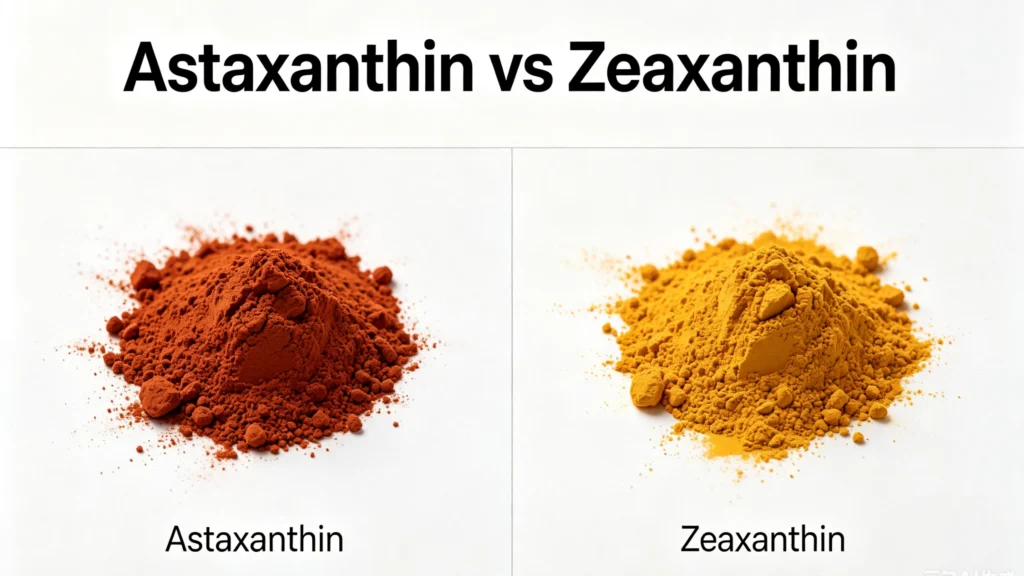
Astaxanthin: Dark red to purplish-red powder, liposoluble, extremely sensitive to light, heat, and oxygen; esterified form offers higher stability. Main dosage forms include soft capsules, microcapsule powder, nanoemulsion, and liposomes. Stabilization solutions: microencapsulation, preferential use of esterified astaxanthin, nitrogen-filled packaging.
Zeaxanthin: Yellow to orange-yellow crystal or powder, liposoluble, sensitive to light (especially ultraviolet rays), heat, and oxygen, prone to isomerization and degradation under light exposure. Main dosage forms include soft capsules (5:1 compound with lutein), microcapsule powder, and tablets. Stabilization solutions: microencapsulation, liposome encapsulation, light-proof packaging.
Compatibility & Formulation Synergy: The Optimal Partner Selection
Astaxanthin: A versatile ingredient compatible with Omega-3 (DHA/EPA), vitamin C/E, collagen, and more, covering formula directions of antioxidation, sports nutrition, and oral beauty. It forms complementary effects with lutein/zeaxanthin in eye health products.
Zeaxanthin: Highly specialized with lutein as its classic synergist. The AREDS2 study established the golden ratio of 5:1 (10mg lutein + 2mg zeaxanthin daily). High-end formulas add Meso-zeaxanthin to cover the central macular area. It can also combine with beta-carotene, zinc, and vitamin C/E to form comprehensive eye care formulations.
Biological Functional Characteristics
Core Efficacy Positioning
Astaxanthin: Positioned as an all-round potent antioxidant, covering anti-aging, post-exercise recovery, skin protection, cardiovascular care, and synergistic eye health support, building a full-body antioxidant network.
Zeaxanthin: Positioned as a dedicated eye health protective factor, focusing on prevention of age-related macular degeneration (AMD), blue light filtration, and visual function maintenance, acting as a precise shield for the retinal macula.
Quantitative Comparison of Antioxidant Capacity
Astaxanthin: In in vitro chemical systems (e.g., ORAC, singlet oxygen quenching assays), its antioxidant activity is dozens to hundreds of times that of vitamin E (literature reports range from 14 to 1000 times due to different detection methods), and 2 to 10 times that of lutein, zeaxanthin, and beta-carotene. The gap narrows in in vivo physiological environments but remains significantly superior to most carotenoids.
Zeaxanthin: Although its overall antioxidant capacity is weaker than that of astaxanthin, its specific enrichment concentration in the retina can reach approximately 1000 times that in plasma. Such targeted antioxidant capacity cannot be measured merely by in vitro data.
Mechanism of Action Differences
Astaxanthin: Inserts across cell membranes to quench free radicals and singlet oxygen, activates the Nrf2 pathway, and inhibits the NF-κB inflammatory pathway to achieve systemic full-body protection.
Zeaxanthin: Binds to specific transport proteins and highly accumulates in the macular area, acting as an endogenous sunglasses to absorb high-energy blue light, quench singlet oxygen, and protect retinal pigment epithelial cells.
Zeaxanthin vs. Astaxanthin: Which Is Stronger for Eye Protection?
They work through different pathways.
Zeaxanthin stays only in the retinal layer of the eye; its protective capacity is limited to the superficial inner surface of the eyeball. It lacks strong penetration and cannot reach the deep fundus or the ocular blood vessels. Its primary role is guarding surface-level adaptability.
Astaxanthin circulates throughout the entire body, penetrating into the deepest layers of the eye. It is highly lipophilic, crosses the blood-eye barrier, and reaches the fundus blood vessels, optic nerve, lens, and deep ocular tissues, providing deep-level anti-inflammatory effects and radical scavenging.
The Core Reason for the Difference in Eye Protection
The disparity in antioxidant capacity is enormous. Astaxanthin’s antioxidant power is 20 times that of lutein, 550 times that of vitamin E, and 6,000 times that of vitamin C. Zeaxanthin primarily addresses superficial issues: dry eyes, soreness and swelling, fatigue from screen time, and mild blue light damage.
Astaxanthin targets deep-rooted problems: insufficient blood supply to the fundus, optic nerve fatigue, internal aging of the eyeball, discomfort from elevated intraocular pressure, and eye damage from staying up late.
The Simplest Analogy
Zeaxanthin = a sun umbrella for the eyes; Astaxanthin = a repair serum for the inner eye.
Commercial Comparison: From Application to Procurement
Application Scenarios & Product Implementation
Core Application Scenario Comparison
Health Products: Astaxanthin for anti-aging capsules, sports recovery supplements, and oral beauty products; zeaxanthin as the core ingredient of eye health formulas such as lutein & zeaxanthin soft capsules.
Food & Beverages: Astaxanthin for functional drinks and solid beverages utilizing its natural red pigment; zeaxanthin for eye-protective gummy candies and functional dairy products with yellow coloring and eye health claims.
Cosmetics: Astaxanthin is applied in anti-aging serums and sun repair masks with a dosage of 0.01% to 0.1%; zeaxanthin is rarely used directly.
Feed Industry: Astaxanthin is added to feed for salmon, shrimp, crab, and ornamental fish for pigmentation and nutrition; zeaxanthin is used in poultry feed for coloring purposes.
Key Recommendations for Industrial Formulation & Technology
Astaxanthin Formulation Guidelines: Prefer natural levorotatory astaxanthin (Haematococcus pluvialis source) for health products; synthetic astaxanthin is limited to feed use. Soft capsules are recommended to be compounded with MCT oil or linseed oil, with vitamin E added as a stabilizer; microcapsule powder is suitable for hard capsules and solid beverages. For stability, prioritize astaxanthin esters and microencapsulation technology, adopting aluminum foil or brown glass nitrogen-filled packaging. China regulatory limit: daily intake of Haematococcus pluvialis-derived astaxanthin ≤ 12mg.
Zeaxanthin Formulation Guidelines: Strictly follow the 5:1 golden ratio of lutein to zeaxanthin; high-end formulas add extra Meso-zeaxanthin to cover the central macular area. Soft capsules remain the optimal dosage form; microencapsulated taste-masked gummies or chewable tablets are recommended for the children’s market. PEG-modified nano-liposomes or plant protein-based microcapsules can significantly enhance water dispersibility and photothermal stability. China regulatory limit: (3R,3’R)-zeaxanthin ≤ 4mg/day, Meso-zeaxanthin (3R,3’S) ≤ 8mg/day.
Technological Iteration Trends
Astaxanthin: Focus on improving bioavailability via cis-isomer enrichment technology and extracellular vesicle delivery; meanwhile, break through low-cost biosynthesis through strain optimization.
Zeaxanthin: Deep development and industrialization of Meso-zeaxanthin, upgrading microencapsulation and green extraction technology are the two core breakthrough directions.
Comprehensive Market: Scale, Pattern & Cost
Market Size & Growth Potential
Astaxanthin: Global market size reached approximately USD 1.97 billion in 2025 (including synthetic products), among which natural astaxanthin accounted for about USD 670 million and synthetic astaxanthin accounted for USD 1.3 billion. Natural astaxanthin maintains a CAGR of 12%–15%, with the overall market at 8%–9%. Core driving forces include oral beauty, sports nutrition, and the boom in natural antioxidants.
Zeaxanthin: Global individual market size ranged from USD 35 million to 65 million in 2024; the combined market with lutein reached USD 400 million. It maintains a 6%–9% CAGR, with high growth certainty driven by rigid demand in eye health. Core drivers: population aging, increased exposure to blue light from screens, and clinical endorsement of the AREDS2 formula.
Key Insight: The astaxanthin market has higher volume and a more diversified range of applications, with natural astaxanthin as a high-growth segment in the future; zeaxanthin shows strong demand in the eye health industry.
Industry Compliance & Certification Thresholds
Astaxanthin: In China, only Haematococcus pluvialis is approved as a novel food raw material; astaxanthin monomer itself is not a directly compliant raw material and requires strict regulation in formula design and health claim labeling. Natural astaxanthin is highly recognized in Europe and America, though most health claims are rejected; synthetic astaxanthin is prohibited for food use.
Zeaxanthin: Relatively clear regulatory status, widely applied in food supplements as a co-extracted component of marigold extract. Globally, JECFA set a group ADI of “not specified” for lutein and zeaxanthin after evaluation in 2020, indicating good safety at conventional dosages; EFSA proposed a reference value of 1 mg/kg bw/day.
Compliance Reminder: Both ingredients require official Blue Hat certification to enter the health product channel in China.
Supplier Landscape
Astaxanthin: China is the global production hub of natural astaxanthin, accounting for 40% of global output. The synthetic market is highly concentrated in BASF, DSM, and NHU. Integrated industrial chain enterprises of natural astaxanthin are developing rapidly.
Zeaxanthin: Upstream marigold cultivation and primary processing are relatively scattered, with China and India as the core processing regions, represented by enterprises such as Yinuo Biological and Shandong Tianyin. Differentiated suppliers emerge in branding, microencapsulation, and Meso-zeaxanthin technology sectors.
Cost Structure & Procurement Price
Astaxanthin Reference Price: Natural astaxanthin (Haematococcus pluvialis-derived, pure grade) costs RMB 200,000 to 500,000 per kg; synthetic astaxanthin costs RMB 2,000 to 5,000 per kg (feed use only). Prices of terminal microencapsulated and formulated products increase by 2 to 5 times based on raw material costs. Characterized by high costs, with a price gap of dozens to hundreds of times between natural and synthetic variants.
Zeaxanthin Reference Price: 5% marigold extract: approx. RMB 57/kg; 10% marigold extract: approx. RMB 230/kg; ≥95% high-purity product: RMB 2,000–5,000/kg, with premium pricing for ultra-high purity grades. Characterized by low raw material costs, with microencapsulated products priced 1.5 to 3 times higher.
Conclusion & Action Guidelines
Astaxanthin and zeaxanthin are not competitors, but rather the “spear and shield” in functional raw material formulations.
For broad-spectrum antioxidation, oral beauty, and sports recovery: Prioritize astaxanthin to build full-body protection with its potent antioxidant capacity.
For eye health, vision protection, and AMD prevention, Zeaxanthin is essential, forming a protective macular barrier via the 5:1 golden-ratio compound formula.
For high-end comprehensive products: Combine astaxanthin with lutein/zeaxanthin to synergize broad-spectrum antioxidation and targeted eye protection, achieving a 1+1>2 formulation advantage.
Against the backdrop of sustained growth in global functional food consumption, enterprises that lead in breakthroughs in microencapsulation technology, natural-source purification, and differentiated formula development will secure long-term competitiveness in both the astaxanthin and zeaxanthin tracks.
Appendix: FAQ
Q: Can astaxanthin and zeaxanthin be taken together?
A: Yes. Both belong to the carotenoid family. Combined intake provides comprehensive protection for eye health and full-body antioxidation, while attention should be paid to the total daily carotenoid intake.
Q: Which has stronger antioxidant capacity, astaxanthin or zeaxanthin?
A: In in vitro tests, the antioxidant activity of astaxanthin is 2 to 10 times that of lutein and zeaxanthin (literature data varies by detection method). However, in the eye health field, zeaxanthin is irreplaceable for its tissue-targeting and blue-light filtering effects; the two excel in different dimensions.
Q: How do formula developers select astaxanthin and zeaxanthin raw materials?
A: Verify raw material sources and regulatory status strictly. Choose natural astaxanthin for health products and marigold-derived or compliant synthetic zeaxanthin with clear labeling. Select pre-processed raw materials, such as microencapsulation and liposomes, according to dosage-form requirements to greatly reduce the difficulty of formula development.
About Jayoobio
Shenzhen Jayoo BioTech Co., Ltd. is a China-based foreign trade company serving global markets. With years of experience in the pet health industry, we are committed to delivering high-quality, safe, and innovative raw material solutions for the international pet food and supplement sectors. Guided by our mission to “extend pets’ lifespan and enhance their quality of life,” we have become a trusted partner in the global pet health industry chain by leveraging advanced bioengineering technologies and strict quality control systems.
We have been supplying raw materials for many years and can provide you with zeaxanthin and astaxanthin. We welcome your inquiries.