
Introduction
Basic Definitions of Feed and Feed Additives
The complete animal feed system consists of two major components: basal feed and feed additives.
Basal feed serves as the main body of feed formulas, accounting for approximately 95% of the total ratio. It mainly includes bulk raw materials such as corn, soybean meal, wheat bran, grease, and fish meal, which provide essential energy and nutrients for animal growth, development, metabolism, and daily vital activities.
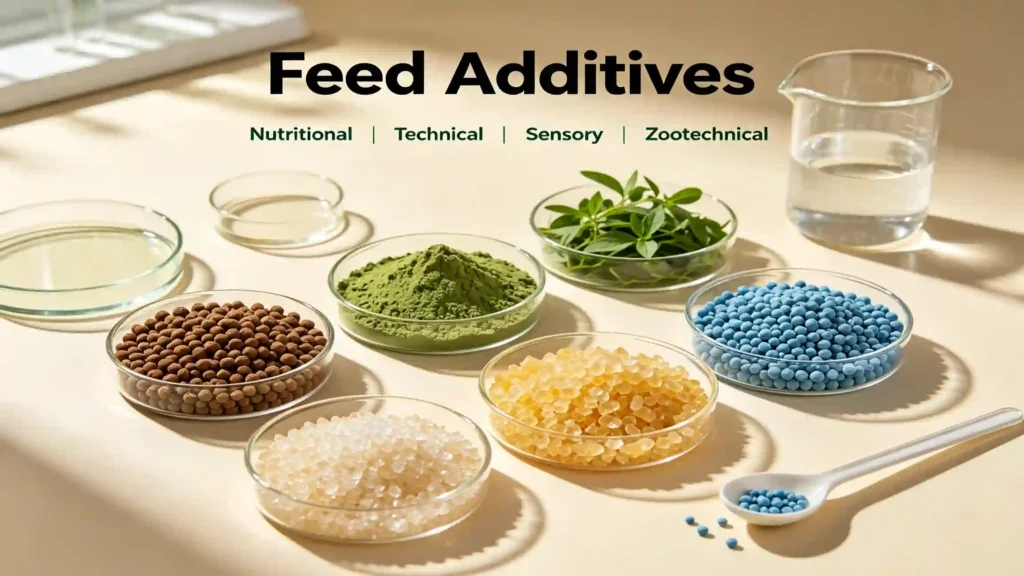
Feed additives are trace functional materials added artificially. Though they do not constitute the main part of the feed, they deliver powerful functions for supplementation and optimization. They can effectively compensate for nutritional deficiencies in basal feed, improve the physical and chemical properties of feed, regulate animal physiological health, and boost breeding production efficiency. As such, they are indispensable core raw materials for modern large-scale breeding, precision nutrition formulation, and antibiotic-free breeding systems.
Research Significance of Feed Additive Classification
Feed additives feature a wide variety of categories and complex functions. A single classification standard cannot meet the industry’s diverse production and application demands. Different classification systems are suited to various application scenarios across the feed industry chain, spanning core fields such as academic research, market supervision, precision breeding, and raw material trade.
This paper establishes a standardized, well-structured, multidimensional classification system for feed additives, clearly defining the attributes, functions, and applicable scenarios of various products. It provides theoretical support and practical references for feed formula design, standardized production, compliant operation, and refined breeding.
Systematic Classification System of Feed Additives
Combining authoritative industry standards with practical application scenarios across the entire industrial chain, this chapter identifies seven well-defined classification dimensions.
I Classification by Target of Action
Based on the core target of product effects, all feed additives are divided into two major categories: those that act primarily on the feed itself and those that act primarily on the animal organism.
1 Feed-protective additives
This type targets feed itself, acting on feed quality without directly interfering with animal physiological functions. Their core functions are to optimize the physical and chemical properties of feed, improve processing performance, and extend storage life, effectively preventing feed oxidation, mildew, caking, flavor loss, and other issues, thereby maintaining stable feed quality throughout the process.
Typical industry products include antioxidants, mold inhibitors and preservatives, anti-caking agents, pellet binders, and feed flavor improvers.
2 Animal-regulating additives
This type targets animal organisms and is the most widely used category in breeding farms. By supplementing nutrients, regulating intestinal flora, repairing mucosal barriers, enhancing immunity, and alleviating breeding stress, they comprehensively improve animal health status and growth & production performance, covering most functional additives for nutritional supplementation, intestinal conditioning, and immune enhancement.
Typical industry products include probiotics, acidifiers, compound enzyme preparations, amino acids, taurine, immune enhancers, and anti-stress preparations.
II Classification by Core Functions
Classified according to action mechanisms and practical application functions, there are four core functional categories.
1 Nutritional feed additives
They are mainly used to address nutritional deficiencies in basic diets, supplement essential nutrients required for animal growth, metabolism, and reproduction, and ensure normal physiological functions and stable growth performance in animals.
Core categories include vitamins, amino acids, and macro- and trace mineral elements such as calcium, phosphorus, zinc, copper, iron, manganese, and selenium, which are essential basic raw materials in feed formulas.
2 Sensory feed additives
They are mainly used to optimize the appearance, color, and feeding taste of feed, improve feed palatability, and effectively increase animal feed intake, and are widely applied in the livestock, poultry, aquafeed, and pet feed sectors.
They are divided into two major types: flavor & aroma enhancers and color improvers, which can be flexibly matched according to the feeding habits of different animals and feed application scenarios.
3 Zootechnical feed additives
Core functional products for modern antibiotic-free breeding systems, they directly regulate animal physiological status and production performance, serving as core alternatives to traditional growth-promoting antibiotics.
Main products include microecological preparations, organic acidifiers, exogenous compound enzyme preparations, and special anti-stress preparations. They can effectively optimize the intestinal flora of animals, repair intestinal damage, improve feed conversion rate, and significantly increase overall breeding benefits.
III Classification by Target Animal Species
There are significant differences in digestive physiology, growth characteristics, and living environments among farmed animals, and universal additives cannot meet the diverse breeding demands.
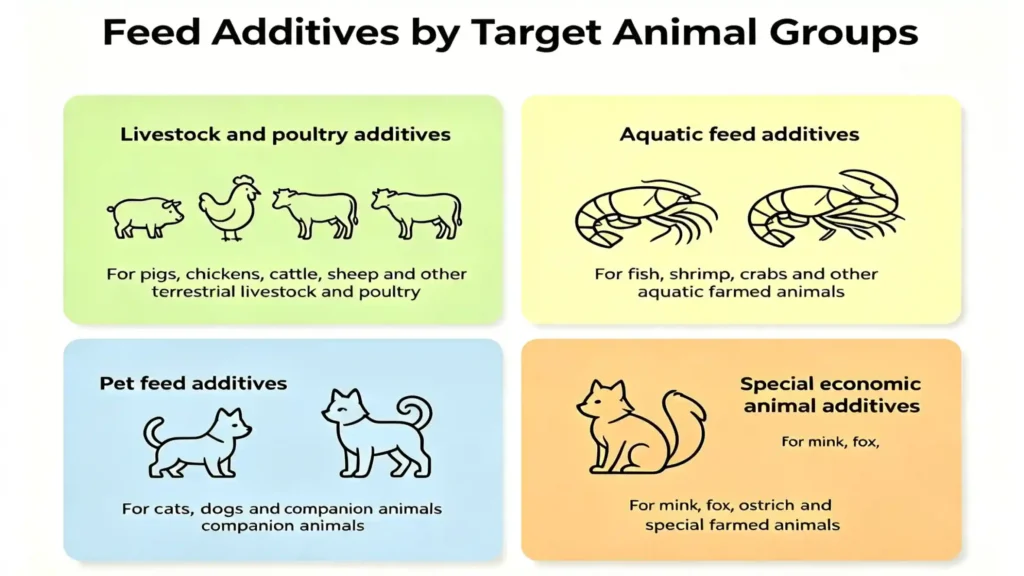
The differentiated classification based on breeding species enables targeted adaptation and precision feeding of feed additives, serving as an important basis for designing customized feed formulas in modern times. It is mainly split into four application categories:
1 Livestock and poultry feed additives
Suitable for terrestrial livestock and poultry, including pigs, chickens, ducks, cattle, and sheep. Their core functions are to promote growth, optimize meat and egg quality, and improve intestinal health, and they also include specialized products such as rumen-protected nutrients and rumen buffers for ruminants.
2 Aquatic feed additives
Designed for aquatic farmed animals such as fish, shrimp, and crabs, they feature water resistance and low loss. They focus on protecting the livers and gallbladders of aquatic animals, alleviating stress caused by the aquatic environment, preventing aquatic diseases, and enhancing the feeding-attraction effect of baits.
3 Pet feed additives
Suitable for companion animals such as cats and dogs, they take high safety, zero residue, and mild adaptability as core standards. Main functions include gastrointestinal care, visceral protection, hair beautification and skin care, and immune improvement, meeting the long-term feeding and health needs of pets. (Notably, cats cannot synthesize enough taurine to meet physiological needs, making it a mandatory nutritional raw material added in cat food formulas and an essential core ingredient for pet feed production.)
4 Special economic animal feed additives
Adapted to special farmed animals such as minks, foxes, and ostriches. They are customized to their unique physiological structures and growth habits to precisely match the specific production demands of specialized breeding.
IV Classification by Breeding Application Scenarios and Growth Stages
Based on actual breeding environments, animal growth cycles, and on-site breeding pain points, feed additives can be divided into multiple scenario-oriented products.
This classification allows precise, on-demand, and time-phased application of additives according to different growth stages, environmental changes, and breeding goals, mainly covering four practical types:
1 Daily health-care additives
Applicable to regular large-scale breeding scenarios and can be continuously added for long-term use.
Their core function is to maintain a stable balance of intestinal flora in animals, stabilize basic immune function, reduce implicit breeding losses, and ensure smooth animal growth, serving as core raw materials for basic health care in modern breeding.
2 Environmental stress protection additives
Specially used for various stress scenarios, such as seasonal temperature changes, high- and low-temperature stress, group transfer, long-distance transportation, and water quality fluctuations.
They can effectively alleviate animal stress responses, prevent reduced feed intake, decreased immunity, and stress-induced growth stagnation, and stabilize breeding production performance.
3 Auxiliary disease prevention and control additives
Applied during high-incidence disease periods and susceptible seasonal transitions. Relying on antibiotic-free breeding technology systems, they help prevent bacterial and physiological diseases by conditioning the animal’s intestinal barriers and enhancing disease resistance, effectively reducing breeding morbidity.
4 Special additives for specific growth stages
Customized for special growth phases, including young animal rearing, fattening, egg laying, and lactation, realizing precise nutrient supply and optimized production performance for animals at different growth stages.
V Classification by International Access and Compliance Supervision Level
According to legal attributes, scope of application, and supervision intensity, feed additives are divided into three categories corresponding to different administrative approval procedures, usage specifications, and market supervision requirements.
1 Non-pharmaceutical free-use additives
They refer to additive categories with no pharmacological activity, no withdrawal period requirements, and no residue risks. This type boasts high safety and a wide application scope, and can be added regularly and over the long term in all types of feed according to animal nutritional and production demands, without prior administrative approval for usage stages and dosage (though the maximum addition dosage specified by national regulations must be complied with). Main products include basic nutritional products such as vitamins, amino acids, and mineral elements, as well as pharmacologically inactive functional products such as enzyme preparations, acidifiers, and microecological preparations.
2 Non-pharmaceutical functional additives
They have no pharmacological activity but carry definite physical, chemical, or physiological regulatory functions. This category also has no withdrawal period or residue risks, yet, due to strong functional specificity, some varieties (such as mycotoxin adsorbents and specific plant extracts) must undergo functional evaluation or safety assessment before market circulation in some countries or regions. Main products include feed processing auxiliaries, sensory improvers, intestinal health regulators, and mycotoxin risk control agents, which can be used consistently across all feed production and breeding scenarios
3 Restricted pharmaceutical additives
Special additive categories with clear pharmacological activity under veterinary drug administration are used only for the prevention and treatment of animal diseases or for regulating specific physiological states. They must be used as prescribed under the guidance of veterinarians. Strict laws and regulations in all countries restrict their applicable animal species, usage stages, addition dosages, withdrawal periods, and tissue residue limits. Over-range, over-dosage, and over-term use are strictly prohibited, and abuse for growth-promotion purposes is banned. This category is the key focus of supervision for feed quality and safety.
VI Classification by Raw Material Source
Based on raw material sources and production processes, feed additives are split into five mainstream categories:
1 Plant-derived additives
Prepared by extraction and purification using natural plant materials as raw materials, they feature green safety, no drug resistance, and low residue.
Main products include plant essential oils such as thymol, carvacrol, and cinnamaldehyde, as well as herbal active raw materials with prominent antibacterial, antioxidant, and intestinal-conditioning effects, including rosemary extract, tea polyphenols, astragalus polysaccharide, yucca extract, and allicin.
2 Animal-derived additives
Derived from animal tissues, body fluids, and metabolites, they deliver high nutrient absorption rates and strong functionality.
Representative products include high-end functional raw materials such as yolk antibodies, functional plasma protein powder, and black soldier fly insect protein powder, which are widely used in livestock fattening, premium aquaculture, and high-end pet feed.
3 Microbial fermentation-derived additives
Produced through microbial fermentation, enzymatic hydrolysis, and domestication, they are the primary source of modern functional feed additives.
Main products include fermented soybean meal, enzymatically hydrolyzed yeast, nucleotides, small-molecule oligopeptides, and probiotic metabolites, which can effectively regulate animal intestinal flora, repair mucosal damage, and boost immunity.
4 Mineral-derived additives
Processed from natural mineral ores, they possess dual value as nutritional supplements and functional applications.
They cover inorganic mineral raw materials such as zinc, copper, manganese, and selenium, as well as natural mineral powders, including montmorillonite, zeolite powder, and diatomite.
5 Chemically synthesized additives
Manufactured through artificial chemical synthesis, they feature stable purity, high cost-effectiveness, and high standardization of varieties, making them the most popular basic additive category in the feed industry.
Main products include synthetic vitamins, synthetic antioxidants, artificial acidifiers, and other industrial raw materials.
VII Classification by Product Dosage Form
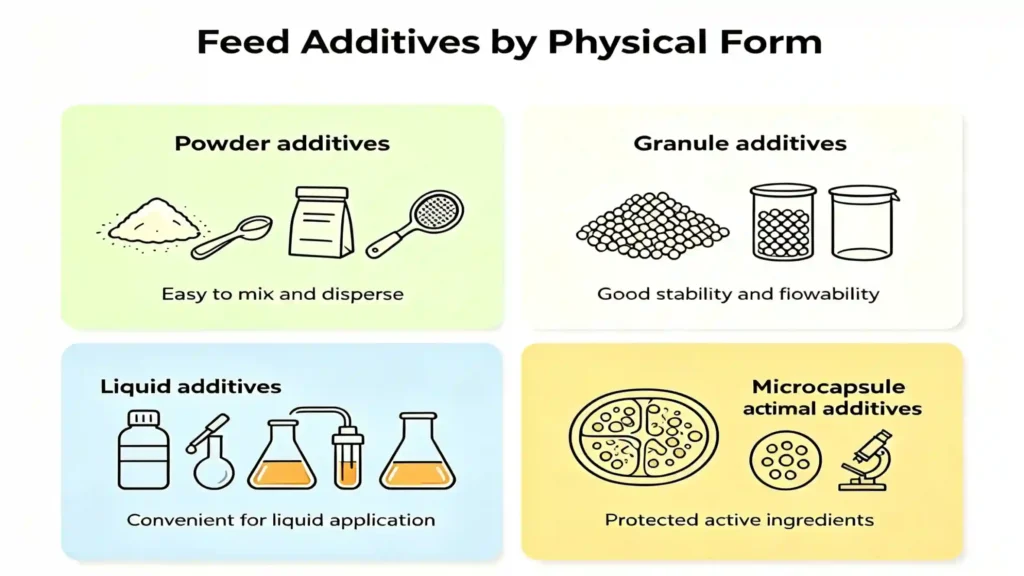
According to finished physical forms, mainstream industry additives fall into four dosage forms, matching different feed production processes and breeding application scenarios:
1 Powder additives
The universal mainstream dosage form in the industry is with fine powder, high mixing uniformity, and strong compatibility. It fits most mixing and processing technologies for compound feed, featuring low production costs and a wide range of applications. Many mainstream functional nutritional raw materials, such as amino acids and plant extracts, are supplied in standardized powder form to support large-scale feed formula processing and production.
2 Granule additives
Manufactured via professional granulation processes, they have excellent fluidity, low moisture absorption and caking tendency, and higher stability of active ingredients. They can effectively prevent powder delamination and loss, making them suitable for high-end feed formulas that require high mixing ratios and stability.
3 Liquid additives
Characterized by good water solubility, strong penetration, and fast absorption, they are suitable for specialized application methods such as feed spraying and drinking water mixing, and are primarily used in aquaculture, livestock, and poultry drinking water health care, rapid stress relief, and other refined breeding scenarios.
4 Coated slow-release additives
Processed with microcapsule coating and slow-release technologies, they are high-temperature-, acid-, and alkali-resistant, and resistant to loss during pelleting. They enable targeted release and long-term effects of active ingredients, effectively protecting heat-sensitive active components such as probiotics, enzyme preparations, and organic acids, adapting to feed production processes with high-temperature pelleting.
Conclusion
The seven classification dimensions of feed additives sorted out in this paper cover all links of the entire feed industrial chain, ranging from basic essential attributes and core function division, targeted species adaptation and scenario application division, to industrial production and market compliance classification by raw materials and dosage forms. This complete system effectively solves the problem posed by the vagueness of traditional single-classification standards. Through systematic sorting, this paper aims to help readers gain a clear understanding of the classification of feed additives.
Further Support
For more services, please feel free to contact us: www.jayoobio.com/

Obtain detailed raw material specifications and COA templates

Apply for samples

Consult regulatory compliance and formula technical support

Request an abstract of the latest market research reports
Contact Us:
Phone:+86 13130678248
Wechat:13130678248
E-mail:info@jayoobio.com 、 sales@jayoobio.com