
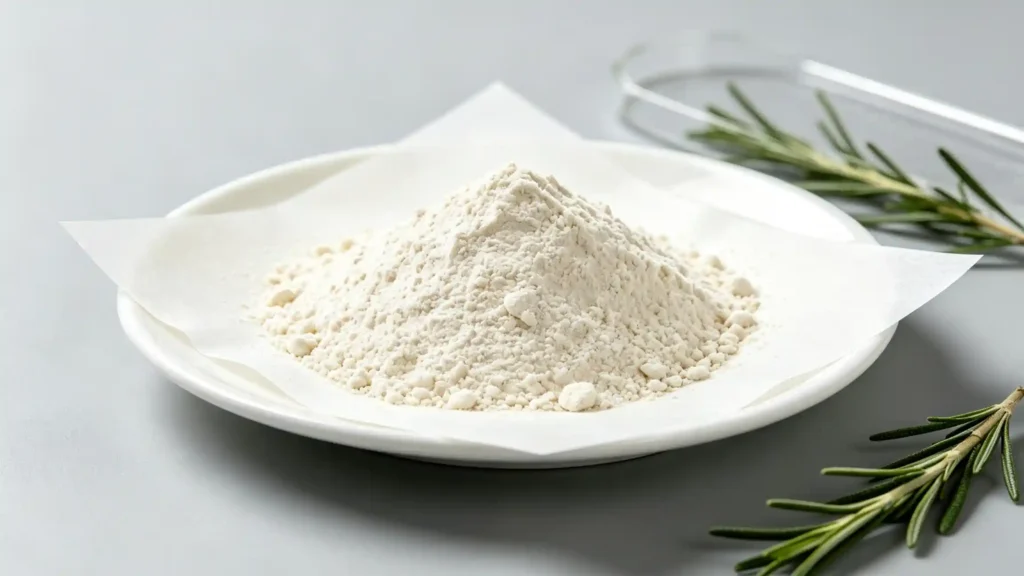
What is Rosemary Extract? Rosemary extract is a natural functional plant ingredient derived from the leaves of Rosmarinus officinalis, an herb native to the Mediterranean region. As a mainstream natural antioxidant and bacteriostatic ingredient for the global clean-label market, it is widely applied in food processing, cosmetics, feed, healthcare, and many other sectors.
Based on solubility, core molecular structures, and functional applications, commercial rosemary extract is divided into three categories: lipophilic extracts rich in carnosic acid, water-soluble extracts rich in rosmarinic acid, and rosemary essential oil. The three categories differ greatly in compliance standards, application scenarios, and market growth logic, forming a well-differentiated system of natural ingredients. A comprehensive breakdown and analysis of the three products is provided below.
Part 1. Lipophilic Rosemary Extract (Carnosic Acid Type)
1.1 Overview
Classified under EU food additive code E392, lipophilic rosemary extract is the most widely recognized natural high-temperature-resistant antioxidant in the food industry.
Manufactured from dried rosemary leaves using ethanol reflux extraction or supercritical CO₂ extraction, this product selectively enriches lipophilic diterpene-phenol-class active substances while removing water-soluble impurities.
Boasting outstanding thermal stability and lipid antioxidant capacity, it can fully replace synthetic antioxidants such as TBHQ and BHT. Compatible with all high-temperature baking, frying, and oil-processing systems, it holds a core position in the global food antioxidant market.
1.2 Molecular Structure
The signature active marker is carnosic acid (CAS: 3650-09-7), with the molecular formula C₂₀H₂₈O₄ and a molecular weight of 332.43.
Its unique tetracyclic diterpene skeleton, paired with bisphenol hydroxyl groups and hydrophobic alicyclic structures, delivers strong lipophilicity (LogP=4.31) and allows stable integration into oil systems. The carboxyl group on the molecule enables metal-ion chelation, while the rigid cyclic structure resists decomposition at high temperatures.
Carnosol, a secondary active metabolite formed by the oxidation of carnosic acid, works synergistically with carnosic acid to build a long-term regenerative antioxidant system. (Molecular structural analysis referenced in Literature [12])
1.3 Physical Properties
The dominant industrial form is yellow-brown fine powder, soluble in vegetable oil, ethanol, and acetone, yet completely insoluble in water.
Its thermal stability far exceeds that of natural antioxidants, including tea polyphenols and vitamin E.
It remains stable in neutral and weakly alkaline oil environments, with a shelf life of up to 24 months under sealed and light-proof storage conditions.
High-purity refined products are pale yellow crystalline powders with a faint odor that will not interfere with the flavor of finished products.
1.4 Core Functions
It blocks the lipid oxidation chain reaction through three antioxidant mechanisms:
First, phenolic hydroxyl groups rapidly capture free radicals, thereby terminating lipid peroxidation. Its antioxidant capacity is 3~4 times higher than BHT and BHA, with more prominent advantages in high-temperature processing scenarios;
Second, it chelates pro-oxidant metal ions such as iron and copper to fundamentally inhibit the catalytic rancidity of oils;
Third, secondary antioxidant substances are generated via self-oxidation, thereby achieving long-lasting protective effects.
It also provides auxiliary bacteriostatic activity against food-borne spoilage bacteria, including Staphylococcus aureus and Listeria monocytogenes, thereby effectively delaying meat browning and oil rancidity.
1.5 Application Scenarios
As a globally compliant, high-temperature-resistant, clean-label antioxidant, it is widely used in animal and vegetable oils, baked pastries, fried foods, nuts, quick-frozen meat products, prefabricated sausages, and other products, with a standard dosage of 0.01~0.08 g/kg.
It serves as a core antioxidant additive in livestock and pet feed, preventing oxidative degradation of raw material oils and vitamins and extending feed shelf life.
In addition, it can be used as a safe antioxidant auxiliary material for oil-based health products and soft capsules.
1.6 Production Cost
Raw materials account for 60% of total production costs, the largest expenditure item.
Industrial powder containing 20% carnosic acid produced by conventional ethanol extraction has a market reference price of 2.5\3.2 US dollars per kilogram. High-purity products with 60%\90% carnosic acid and zero solvent residues manufactured via supercritical CO₂ extraction cost 3.5\6 US dollars per kilogram. Ultra-high-purity food-grade raw materials refined by chromatography can reach 16\22 US dollars per kilogram. The comprehensive extraction recovery rate of carnosic acid is approximately 65%.
1.7 Global Regulatory Compliance
This category features a complete global compliance system with no major export barriers.
- China: Listed in GB 2760 Food Additive Standard (CNS 04.017). Oils and oil products can be used as needed in accordance with Good Manufacturing Practices (GMP); the maximum dosage for meat products is 0.3 g/kg (calculated based on the total content of carnosic acid + carnosol).
- EU: Certified as a safe food antioxidant by EFSA, with an acceptable daily intake (ADI) of 0.3 mg/kg body weight. Manufacturers must strictly follow the standard dosage limits.
- United States: Granted GRAS status by the FDA, allowing compliant addition to most food categories.
It also complies with feed additive specifications for livestock and aquatic products in China, the EU, and the United States.
1.8 Market Outlook
Driven by the global clean-label consumption upgrade and restrictions on synthetic additives such as TBHQ in multiple countries, lipophilic rosemary extract is expected to maintain steady growth at a compound annual growth rate (CAGR) of 5.3%, capturing 65% of the global rosemary extract market share in 2026.
Emerging tracks, including plant-based meat, prefabricated dishes, high-end baking, and functional oils, continue to release incremental demand.
It is expected that after the industrialization of synthetic biological fermentation technology in 2027, the production cost of high-purity carnosic acid will drop significantly, further squeezing the market space of synthetic antioxidants and offering sufficient long-term growth potential for the industry.
Part 2. Water-Soluble Rosemary Extract (Rosmarinic Acid Type)
2.1 Overview
Water-soluble rosemary extract is prepared using low-temperature water-alcohol composite extraction and membrane filtration purification, thereby precisely removing lipophilic diterpene impurities and enriching the water-soluble phenolic acid active ingredients.
Unlike lipophilic extracts focused on lipid oxidation resistance, this product offers core advantages in aqueous-phase antioxidant activity, broad-spectrum bacteriostasis, and anti-inflammatory soothing effects. It is a core, mild, functional raw material for beverages, skin care products, oral care, and dietary supplements, and is also one of the fastest-growing plant extracts in the clean beauty and clean-label beverage tracks.
2.2 Molecular Structure
The signature active marker is rosmarinic acid (CAS: 537-15-5), with the molecular formula C₁₈H₁₆O₈ and a molecular weight of 360.31.
Abundant phenolic hydroxyl and carboxyl hydrophilic groups endow the molecule with excellent water solubility, enabling rapid dispersion and efficacy in aqueous systems. Its unique conjugated double-bond structure can scavenge water-soluble free radicals, inhibit tyrosinase, and block the release of inflammatory factors, forming the structural basis for brightening, soothing, and anti-inflammatory effects. (Molecular structural analysis referenced in Literature [12])
2.3 Physical Properties
It appears as a fine, light-yellow powder, while ultra-high-purity grades at 98% present off-white crystals.
It boasts outstanding water solubility and can be fully dissolved in cold or hot water, glycerin, propylene glycol, and other aqueous solvents, forming transparent, pale-yellow solutions.
It has weak heat resistance: stable at room temperature and during short-term heating below 100°C, but continuous heating at 100°C will significantly reduce activity, making it unsuitable for high-temperature processes such as frying and baking.
The stable pH range is 4.0~7.0. Low concentrations carry a mild herbal aroma, while high concentrations deliver a slight astringent taste.
2.4 Core Functions
Three core effects: aqueous-phase antioxidant activity, broad-spectrum bacteriostatic activity, and anti-inflammatory repair.
- Scavenges active free radicals in aqueous and protein systems to delay browning and oxidation of fruit juices and plant-based beverages;
- Broadly inhibits harmful bacteria, including Escherichia coli, mold, Propionibacterium acnes, and Malassezia, with dual effects of preservation and oil control bacteriostasis;
- Suppresses inflammatory factors such as tumor necrosis factor and interleukin to relieve skin redness, sensitivity, and scalp seborrheic dermatitis; helps fade dullness and acne marks; and gently repairs the skin barrier.
2.5 Application Scenarios
- Food & Beverage: Fruit and vegetable juices, plant protein drinks, lactic acid beverages, and functional oral liquids with a standard dosage of 0.02~0.15 g/kg. It can partially replace chemical preservatives, enhancing the clean-label attributes of products.
- Cosmetics (core downstream market): Added at 0.05%~0.3% in toners, facial masks, repair essences, and soothing lotions; incorporated at 0.1%~0.5% in anti-acne, oil-control, and scalp care products to improve acne, closed comedones, dandruff, and scalp itching.
It can also be used as an oral antioxidant in solid beverages and dietary supplements.
2.6 Production Cost
The complex production process involves low-temperature extraction and membrane-separation purification, which are energy-intensive, and is paired with high wastewater treatment costs, resulting in higher overall costs than lipophilic extracts.
The raw material comprehensive utilization rate is only 40%, resulting in large raw material loss.
Industrial powder containing 20% rosmarinic acid is relatively expensive. 98% high-purity grades for cosmetics and health care products undergo further purification and command a much higher selling price than ordinary industrial raw materials.
2.7 Global Regulatory Compliance
It features a mature global compliance system with low safety usage thresholds.
- China: Approved for use in plant protein beverages with a limit of 0.15 g/kg; included in the Catalog of Used Cosmetic Raw Materials with no mandatory maximum addition limit.
- EU & United States: Passed comprehensive safety assessments and permitted for use in leave-on skin care products and aqueous food systems. Recognized as a mild, safe, and non-irritating natural preservative and antioxidant for the international beauty and beverage industries, with sound export compliance.
2.8 Market Outlook
Driven by consumer trends in clean beauty, preservative-free skin care, and natural, plant-based beverages, water-soluble rosemary extract is projected to achieve a compound annual growth rate of 6.2%, higher than that of lipophilic products, and to account for 28% of the global market share in 2026.
Emerging categories, including pet care, oral care, sugar-free functional drinks, and plant-based beverages, are continuously driving market demand. Iterative continuous membrane separation purification technology steadily reduces the production cost of high-purity rosmarinic acid, thereby further expanding its application scope in the high-end beauty and functional food sectors.
Part 3. Rosemary Essential Oil
3.1 Overview
Rosemary essential oil is fundamentally different from the two polyphenol extracts above. It is a volatile aromatic oil extracted from fresh rosemary branches and leaves via steam distillation. Hardly any polyphenol antioxidants, such as carnosic acid and rosmarinic acid, are present in the oil, with all active components being small-molecule, volatile terpenes. Regulations strictly prohibit its use as a food antioxidant or preservative; it may only be used as a flavoring and an external aromatherapy raw material.
3.2 Molecular Structure
It is a composite mixture of terpenes without polyphenol marker structures, with core components including α-pinene, 1,8-cineole, camphor, and other small-molecule terpenes.
These molecules contain no phenolic hydroxyl groups and lack free-radical-scavenging or lipid-antioxidant capacity. They rely on the high permeability of small molecules to achieve superficial bacteriostasis, soothing penetration, and microcirculation-promoting effects. (Molecular structural analysis referenced in Literature [12])
3.3 Physical Properties
It is a colorless or pale yellow transparent flowing oil with extremely high volatility.
Soluble in ethanol and various base vegetable oils, yet completely insoluble in water.
It exhibits extremely poor thermal stability and rapidly volatilizes at high temperatures; nearly all activity is lost after 10 minutes of heating.
The undiluted stock solution is highly irritating and must be diluted to below 1% for safe skin contact.
It emits a fresh, transparent herbal camphor aroma with a short retention time.
3.4 Core Functions
Three primary effects: aromatherapy conditioning, superficial bacteriostasis, and microcirculation regulation.
- Inhibits mites, Malassezia, and body odor bacteria to optimize the microecology of scalp and skin, reducing dandruff and body odor;
- Its natural aroma refreshes the mind, relieves physical and mental fatigue;
- Massage after dilution promotes blood circulation in the skin and scalp, improving dull skin and stiff scalp.
3.5 Application Scenarios
- Fragrance track: Aromatherapy candles, indoor antibacterial sprays, and perfume flavoring;
- Personal care: Diluted and added to hair care oil, body massage oil, shower gel, and scalp care products to achieve oil control, soothing, and long-lasting fragrance effects;
- Professional fields: Offline aromatherapy and physical conditioning treatments.
3.6 Production Cost
The raw material utilization rate is extremely low, with an oil yield of only 0.8%~1.2% from fresh branches and leaves, and raw materials account for 75% of the total cost.
Steam distillation involves a long production cycle, high water and energy consumption, and limited mass-production efficiency. Ordinary eucalyptol-type essential oil carries moderate costs, while high-grade verbenone rosemary essential oil has a much higher production cost due to lower oil yield and superior quality.
Product prices are significantly affected by flowering periods, seasons and climate, with seasonal fluctuations exceeding 30%.
3.7 Global Regulatory Compliance
Global regulations uniformly define its scope of use: it may be used only as a natural food flavoring agent and is prohibited from acting as a food antioxidant or preservative.
China, the EU, and the United States simultaneously stipulate that the maximum concentration in leave-on cosmetics shall not exceed 0.5% to avoid skin sensitization and irritation.
Supplementary usage precautions: Pregnant women, epilepsy patients, and hypertensive individuals are not recommended for large-area external massage or oral administration.
3.8 Market Outlook
Supported by high-end organic aromatherapy and professional scalp care trends, the rosemary essential oil market is expected to maintain stable growth at a compound annual growth rate of 4.8%, capturing 7% of the global market share in 2026.
Restricted by limited functionality and the risk of skin irritation, the market ceiling is relatively low. The low-end market is continually affected by synthetic flavors and tight profit margins, while high-end organic products target niche segments in aromatherapy and premium beauty, maintaining stable competitiveness within their niche.
Part 4. Supporting Visualization & Data Tables
Table 1 Global Market Share of Three Categories of Rosemary Extracts, 2026
| Product Category | 2026 Market Share | Core Downstream Track Description |
| Lipophilic rosemary extract (Carnosic Acid Type) | 65% | Dominant in the food industry, a rigid demand market for oils, meat products, baking, and feed |
| Water-soluble rosemary extract (Rosmarinic Acid Type) | 28% | Rapid growth in the beauty track, compatible with skin care products, plant-based beverages, and oral care |
| Rosemary Essential Oil | 7% | Niche aromatherapy market, aromatherapy and high-end scalp massage care |
Figure Note: Data sourced from 2026 global natural plant antioxidant raw material industry statistics. Lipophilic products dominate the industry thanks to their high-temperature resistance and full food-compliance advantages; water-soluble products expand rapidly, driven by the clean beauty trend; essential oils have limited application scenarios and the smallest market volume.
Visual Illustration 1: 3D Molecular Structure Comparison of Three Core Active Substances
Layout: Three vertical columns, left: Carnosic Acid, middle: Rosmarinic Acid, right: α-Pinene; white background, 3D ball-and-stick models with color-coded key functional groups:
- Carnosic Acid (Tetracyclic Diterpene): Red labels indicate bisphenol hydroxyl groups (free-radical capture sites); blue labels indicate carboxyl groups (metal-chelation sites); a rigid tetracyclic structure with high-temperature resistance.
- Rosmarinic Acid (Phenolic Acid): Purple labels for catechol structures (tyrosinase inhibition & anti-inflammatory activity); hydrophilic groups confer water solubility.
- α-Pinene (Monoterpene): Orange labels for unsaturated double bonds (transdermal penetration promotion); no phenolic hydroxyl groups, no antioxidant activity.
Figure Note: Comparison of molecular structures of marker active ingredients in rosemary extract. Structural differences directly determine solubility, thermal stability, and the direction of efficacy. Molecular analysis referenced in Literature [12].
Visual Illustration 2: Pie Chart of Global Rosemary Extract Market Share, 2026
Color coding: Dark blue (Lipophilic, 65%), Light purple (Water-soluble, 28%), Light orange (Essential Oil, 7%). Each partition is labeled with a category name and proportion, with small supplementary text for downstream tracks.
SEO Alt Text for Image Upload: 2026 rosemary extract market share pie chart, lipophilic 65%, water-soluble 28%, essential oil 7%, global industry distribution
| Category | Active Ingredients | Mechanism of Action | Typical Application Scenarios | Thermal Stability |
| Lipophilic | Carnosic Acid + Carnosol | Lipid Antioxidation / Metal Chelation | Fried Food / Feed | Stable at 220℃ |
| Water-soluble | Rosmarinic Acid | Aqueous-phase Antioxidation / Bacteriostasis | Skin Care Products / Beverages | Stable ≤100℃ |
| Essential Oil | Terpenes (α-Pinene) | Aromatherapy Conditioning / Microcirculation Promotion | Aromatherapy / Scalp Care | Volatilizes Rapidly |
Part 5. Conclusion
Overall, rosemary extract is not a single raw material but a well-differentiated, precisely applicable, and fully compliant natural plant ingredient system.
Lipophilic carnosic acid extract serves as the core raw material for high-temperature resistance, antioxidation, and clean-label upgrading in the food industry;
Water-soluble rosmarinic acid extract dominates the market of mild bacteriostasis, anti-inflammation, and aqueous-phase antioxidation for beauty, beverages, and healthcare sectors;
Rosemary essential oil is used in segmented markets of fragrance, aromatherapy, and external skin care.
With the ongoing shift in global consumer preferences toward natural, safe, and green ingredients, synthetic chemical additives are gradually being restricted. Rosemary extract will continue to replace traditional chemical raw materials and sustain steady long-term growth across the food, daily chemical, feed, and healthcare industries.
Reference
[12] Research on the Molecular Mechanism and Structure-Activity Relationship of Natural Phenolic Plant Extracts
Further Support
For more services, please feel free to contact us:

Obtain detailed raw material specifications and COA templates

Apply for samples

Consult regulatory compliance and formula technical support

Request an abstract of the latest market research reports
Contact Us:
Phone:+86 15817492830
Wechat:15817492830
E-mail:info@jayoobio.com 、 sales@jayoobio.com