
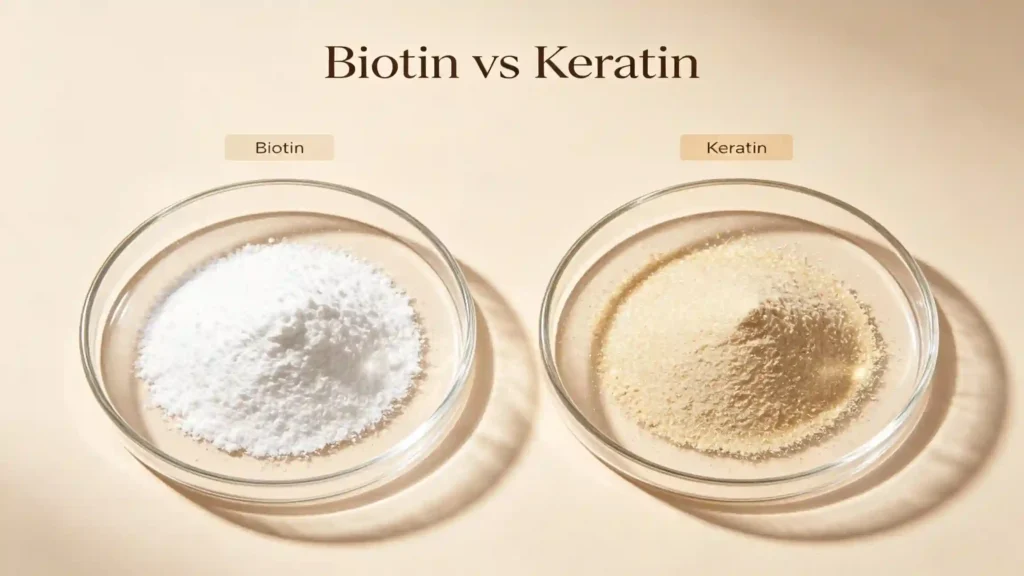
1. Abstract
Keywords: Biotin vs Keratin; Biotin; Keratin; Functional Comparison; Industry Trends
Biotin and keratin are two core functional ingredients for hair health and livestock nutrition, yet their mechanisms of action and application boundaries are often confused.
Starting from chemical properties and physiological mechanisms, this paper systematically compares the fundamental differences in molecular structure and biological functions.
The study reveals that biotin acts as a “catalyst” in metabolic regulation as a carboxylase coenzyme, while keratin serves as the “physical building block” of tissues as a structural protein.
The two ingredients feature complementary functions, and rational compounding is a core approach to achieving synergistic effects.
2. Review
2.1 Research on Biotin
As a member of the B vitamins, biotin features a chemical structure consisting of a urea ring linked to a tetrahydrothienoimidazole ring via a valeric acid side chain. This unique structure endows it with high stability and biological functionality in organisms.
As a cofactor for carboxylases, biotin plays an irreplaceable role in the metabolism of carbohydrates, lipids, and proteins, particularly in the fixation and transfer of carbon dioxide during carboxylation reactions.
Studies show that biotin is widely found in animals and plants and can also be biosynthesized by microorganisms. Its abundant sources lay a foundation for its application in food, feed, and pharmaceutical industries.
With in-depth research on biotin in recent years, its applications in human health have continued to expand.
For instance, biotin has been proven to significantly boost the health of skin, hair, and nails, with remarkable clinical effects in alleviating hair loss and brittle nail syndrome.
In addition, biotin is increasingly adopted as a feed additive in livestock breeding. Research confirms it can greatly improve the laying performance of laying hens and the growth rate of pigs.
These research findings provide solid theoretical support for the multi-scenario application of biotin.
2.2 Research on Keratin
Keratin refers to a class of highly cross-linked scleroproteins whose molecular structures are primarily composed of α-helices or β-sheets, providing outstanding stability and mechanical strength.
By source, keratin is divided into α-keratin (predominantly found in hair and nails) and β-keratin (mainly present in feathers, scales, and similar tissues).
Keratin is broadly sourced from animal hair, feathers, hooves, and other keratinized tissues, with diverse extraction methods including chemical treatments (acid-base treatment), biological enzymatic hydrolysis, and physical processing (high-temperature and high-pressure treatment).
Remarkable progress has been made in research on keratin applications across multiple industries in recent years.
In the health supplement sector, keratin is used as a hair-care supplement to improve hair quality and stimulate hair growth.
In materials science, keratin is widely used to develop biomedical materials, such as tissue-engineering scaffolds and wound dressings, due to its favorable biocompatibility and biodegradability.
Furthermore, keratin has attracted considerable attention in environmental applications; it can serve as a biosorbent for removing heavy metal ions.
Such studies demonstrate that keratin holds great value in traditional sectors and tremendous untapped potential in emerging fields alike.
2.3 Comparative Research on Biotin and Keratin
On one hand, biotin is a water-soluble vitamin coenzyme that primarily regulates metabolism in organisms, whereas keratin is a structural protein responsible for mechanical support and protection.
On the other hand, their application sectors differ noticeably: biotin is widely used in health supplements and feed industries, while keratin boasts unique advantages in cosmetics, biomaterials, and environmental protection fields.
Existing literature mostly explores biotin and keratin separately, and systematic comparative studies on their compound synergistic mechanisms and differentiated applications across scenarios remain scarce. This paper fills this research gap.
3. Fundamental Differences: Vitamin Coenzyme vs Structural Protein – In-depth Mechanism Analysis
3.1 Essence and Mechanism of Biotin
3.1.1 Chemical Structure of Biotin
Biotin is a sulfur-containing, water-soluble B vitamin, also known as 5-(3aS,4S,6aR)-2-oxohexahydro-1H-thieno[3,4-d]imidazole-4-pentanoic acid and commonly known as Vitamin B7.
Its molecular structure features a fused bicyclo[2.2.2]octane skeleton composed of a ureido ring (imidazolidinone) and a tetrahydrothiophene ring, extended and connected by a valeric acid side chain. A free carboxyl group at the terminal of the side chain can form an amide bond with the lysine residue of carboxylases in vivo (generating biocytin), thereby covalently anchoring biotin to enzyme proteins.
This unique fused bicyclic structure confers high reaction specificity on biotin, enabling it to serve as a cofactor for multiple carboxylases (e.g., pyruvate carboxylase, acetyl-CoA carboxylase) and to play a key role in gluconeogenesis and fatty acid synthesis.
Moreover, sulfur atoms in the tetrahydrothiophene ring and carbonyl/nitrogen atoms in the ureido ring jointly form a rigid fused ring framework.
The skeleton structure and length of the valeric acid side chain directly determine the degree of spatial matching and binding affinity between biotin and the active sites of target enzymes, thereby affecting catalytic efficiency.
It should be noted that free biotin is unstable under strong acid, strong alkali, or high temperatures; its functional stability in vivo relies on microenvironmental protection after binding to enzyme proteins.
3.1.2 Biological Functions of Biotin
As a vital vitamin coenzyme, biotin participates in numerous metabolic pathways in humans and animals and is critical for the synthesis and catabolism of carbohydrates, lipids, and proteins.
In carboxylation reactions, biotin covalently binds to enzymes via carboxyl groups on its ureido ring, thereby activating and facilitating carbon dioxide fixation and transfer, and further regulating fatty acid synthesis, gluconeogenesis, and amino acid metabolism.
For example, in laying hens, biotin acts as a cofactor for pyruvate carboxylase, significantly increasing glucose utilization and promoting fat synthesis and deposition, thereby improving laying performance.
In pig farming, biotin deficiency disrupts lipid metabolism, leading to slow growth and skin lesions, underscoring biotin’s indispensable role in maintaining animal health and high productivity.
Additionally, biotin modulates gene expression to regulate the synthesis and release of cytokines, expanding its role in immune regulation.
Recent studies also identify biotin’s vital role in human health: it improves the metabolic state of keratinocytes, supporting the healthy growth of skin, hair and nails.
3.2 Essence and Mechanism of Keratin
3.2.1 Structural Characteristics of Keratin
Keratin is a class of highly cross-linked fibrous structural proteins abundant in animal hair, feathers, scales, claws, and hooves. Its molecules consist of multiple α-helical or β-sheet peptide chains that form stable supramolecular complexes via disulfide bonds, hydrogen bonds, and hydrophobic interactions.
Based on secondary structures, keratin falls into two major categories: α-keratin with right-handed helical conformation, mainly found in mammalian hair and skin; and β-keratin with parallel sheet structures, mostly present in feathers and scales of birds and reptiles.
The structural stability of keratin primarily stems from abundant cysteine residues in its molecules, which form extensive disulfide bonds upon oxidation, enhancing tensile strength and chemical resistance.
Furthermore, the intermolecular forces of keratin are closely associated with the high proportion of glycine, alanine, and serine in its amino acid sequences.
The periodic arrangement of these amino acids helps maintain the regular alignment and mechanical properties of keratin.
3.2.2 Biological Functions of Keratin
Keratin primarily provides structural support and protective functions in various biological tissues.
Its unique molecular structure and chemical properties form a vital barrier that defends organisms against environmental stress.
In hair and skin, keratin forms a highly cross-linked network that provides excellent mechanical strength and elasticity, effectively preventing physical damage and moisture loss.
For instance, the α-helical structure of human hair provides favorable flexibility and stretchability, while disulfide bonds significantly enhance its fracture resistance.
In animal hooves and claws, dense accumulation and high cross-linking of keratin provide outstanding wear and compression resistance, enabling adaptation to complex movement and environmental conditions.
In addition, the hydrophobic surface of keratin provides waterproof protection for organisms. For example, the sheet structure of β-keratin in bird feathers effectively blocks water penetration while retaining light weight and flexibility, which are prerequisites for flight performance.
3.3 Summary of Fundamental Differences
Biotin and keratin differ drastically in chemical nature, molecular structure and biological functions, reflecting their distinct roles in living systems.
From a chemical perspective, biotin is a small-molecule organic compound classified as a vitamin, whose functions depend on its ability to act as a coenzyme in enzymatic reactions; keratin is a macromolecular structural protein whose functions are reflected in its physical properties and tissue-supporting effects.
In terms of molecular structure, biotin has a relatively simple chemical structure, yet its ring structure and side chain arrangement decisively determine its functionality; in contrast, keratin features a complex, highly cross-linked molecular structure whose stability relies on the synergy of disulfide bonds and hydrogen bonds.
From a biological perspective, biotin, as a coenzyme, broadly regulates metabolism and is central to energy metabolism and the synthesis of substances; keratin primarily provides mechanical strength and tissue protection through its structural properties.
In summary, fundamental differences in the structure and mechanisms of biotin and keratin dictate their distinct functions and applications in organisms.
4. Comparative Efficacy Testing by Industry Track: Human Health Supplements & Livestock Feed
4.1 Human Health Supplement Industry
4.1.1 Efficacy of Biotin
As a B vitamin, biotin’s significance to human health has been extensively researched. By participating in carboxylation reactions, biotin plays a core role in carbohydrate, lipid, and protein metabolism, especially in maintaining healthy skin, hair, and nails.
Clinical studies indicate that biotin deficiency may trigger dry, flaky skin and thinning hair, while adequate biotin supplementation can markedly alleviate these symptoms.
Despite the low daily human demand for biotin, its status as an essential nutrient is irreplaceable. Moderately increasing biotin intake during high-intensity exercise or in special physiological conditions (e.g., pregnancy and lactation) helps maintain overall health.
4.1.2 Efficacy of Keratin
Keratin is a structural protein naturally present in human hair, skin, and nails. Its unique molecular structure endows tissues with superior mechanical strength and stability.
In the health supplement sector, hydrolyzed keratin is commonly used as a hair nutritional supplement to strengthen hair toughness and luster via exogenous supplementation.
Studies show that oral keratin supplements can effectively increase cystine content in hair, thereby facilitating disulfide bond formation and improving hair tensile strength and elasticity.
A double-blind trial in patients with hair loss demonstrated that subjects taking keratin-containing supplements for 12 weeks experienced a notable reduction in hair shedding, along with marked increases in the diameter and length of new hair growth.
Moreover, keratin is widely used in skincare products due to its favorable biocompatibility and moisturizing properties, helping relieve dry and aging skin.
It should be noted that the efficacy of keratin correlates strongly with its source and extraction process. Keratin products from different preparation methods vary greatly in purity and activity, which further impacts practical application results.
4.2 Livestock Feed Industry
4.2.1 Efficacy of Biotin
Biotin plays a pivotal role in livestock breeding. As a coenzyme for multiple metabolic enzymes, it directly participates in energy metabolism and cellular signal transduction, exerting far-reaching impacts on animal growth performance and production efficiency.
For laying hens, biotin not only regulates fat and protein synthesis but also significantly affects economic indicators such as eggshell quality and yolk color.
In pig production, biotin deficiency causes stunted growth, rough coats, and hoof lesions. Optimizing biotin supply can significantly alleviate these symptoms and improve overall production performance.
Additionally, biotin delivers certain anti-stress effects, helping livestock maintain normal immune function and metabolic balance under high-temperature or high-density breeding conditions.
Demand for biotin has grown steadily with the rise of intensive farming, further underscoring its central role in modern animal husbandry.
4.2.2 Efficacy of Keratin
As a high-molecular-weight protein, keratin has attracted growing attention for its use in livestock feed in recent years.
Rich in essential amino acids (e.g., cystine, lysine, and arginine), keratin is recognized as a high-quality protein source suitable for feed formulas for monogastric and ruminant animals alike.
Research reveals that adding keratin hydrolysate to pig feed improves protein digestibility and significantly boosts daily weight gain and feed efficiency of pigs.
Supplementary keratin also has positive effects in poultry feed, such as enhancing feather luster and reducing the incidence of feather pecking.
Furthermore, keratin boasts favorable adhesion and stability, serving as a functional additive to improve pellet formation and water resistance of feed.
Notably, the cost-effectiveness of keratin hinges on its extraction process. Adoption of advanced biological, enzymatic, or chemical processing can drastically cut production costs while raising product purity and utilization rate.
Therefore, keratin features broad application prospects in livestock feed, yet further optimization of production processes is required to meet large-scale commercial demands.
4.3 Summary of Efficacy Comparison
Overall, biotin and keratin offer distinct advantages in human health supplements and livestock feed, with functional differences arising from their chemical properties and biological mechanisms.
In human health applications, biotin acts as a key nutrient that maintains skin, hair, and nail health through metabolic regulation, while keratin demonstrates outstanding potential in hair nutritional supplements and skincare products due to its structural characteristics.
In livestock feed, biotin, an essential micronutrient, promotes animal growth performance, production efficiency, and anti-stress capacity; keratin, by contrast, functions primarily as a high-quality protein source and functional additive, excelling at upgrading feed quality and improving animal appearance.
Though the two ingredients may generate synergistic effects in specific scenarios (e.g., when used together, they simultaneously improve hair quality and accelerate animal growth), their core functions remain fundamentally distinct and cannot fully replace one another.
Thus, rational selection of biotin or keratin based on specific demands is required to achieve optimal practical effects.
The content of this chapter is based on public literature and experimental research; actual application shall comply with the relevant regulatory requirements of the country/region concerned.
5. Core Procurement Considerations for Manufacturers: Cost, Technology, Stability, Compatibility
5.1 Cost Considerations
5.1.1 Cost Analysis of Biotin
As a vitamin coenzyme, the industrial production cost of biotin is determined by multiple factors, including raw material procurement, production process complexity, and fluctuations in market demand.
Its production cost is constrained by fermentation efficiency, energy consumption & technical requirements for purification, leading to sharp price swings across different periods.
In addition, rising demand from laying hen and pig farming industries further intensifies price volatility driven by supply-demand relations.
For example, the recommended addition rate of biotin in high-yield layer compound feed is 150–250 mg per ton, a standard directly fueling market demand for feed-grade biotin.
Nevertheless, biotin production relies heavily on microbial fermentation technology; product yield and purity are often limited by strain performance, fermentation conditions, and post-processing techniques, thereby driving production costs to relatively high levels.
In the long run, biotin’s market price is also affected by the stability of raw material supply, energy price fluctuations and environmental protection policies, which collectively shape the overall trend of procurement costs.
5.1.2 Cost Analysis of Keratin
Keratin’s cost structure is closely tied to its source and extraction process. Raw materials mainly consist of animal hair, feathers, and keratinized tissues, making the abundance and sustainability of raw material supply a major cost driver.
Chemical extraction remains the mainstream keratin production method, yet it requires strong acid or alkali treatment, which increases energy consumption and the risk of environmental pollution, raising overall costs.
By comparison, biological enzymatic extraction offers greater selectivity and environmental friendliness, yet the exorbitant costs of enzyme preparations limit its large-scale adoption.
Moreover, prices in the keratin market are influenced by raw material quality, extraction efficiency, and downstream application demand.
For instance, high-purity keratin for cosmetics and health supplements demands stricter purity standards, further lifting extraction costs and processing difficulty.
Overall, keratin cost trends feature heavy reliance on raw materials, broad room for process optimization, and demand-driven pricing.
5.2 Process Considerations
5.2.1 Biotin Production Technology
Industrial production of biotin mainly adopts microbial fermentation, chemical synthesis, and semi-synthesis methods. Microbial fermentation stands out as the mainstream commercial technology due to high efficiency and economic viability.
This process screens high-yield strains to achieve efficient biotin accumulation under optimized fermentation conditions, followed by extraction, crystallization, and other steps for product purification.
However, biotin production technology still faces multiple technical hurdles: byproduct generation during fermentation may reduce product purity, while solvent consumption and post-processing energy costs require urgent solutions.
Furthermore, biotin product quality is affected by the composition of the fermentation medium, temperature, pH, and other parameters, which directly determine the purity and yield of the final products.
In recent years, advances in genetic engineering have enabled strain metabolic pathway modification to boost biotin yield and purity, offering new directions for process optimization.
5.2.2 Keratin Extraction Technology
Keratin extraction falls into two primary categories: chemical extraction and biological enzymatic extraction, each with unique merits, drawbacks, and applicable scenarios.
Chemical extraction breaks disulfide bonds in keratin using strong acids or alkalis to dissolve and extract proteins. Despite simple operation and low cost, strong corrosive reagents may damage the molecular structure of keratin and impair product functionality. Waste liquid treatment also limits its application in sectors with strict environmental standards.
In contrast, biological enzymatic extraction utilizes specific enzymes to degrade non-protein components surrounding keratin, enabling efficient extraction under mild conditions while preserving intact keratin functionality. However, high enzyme costs and stringent reaction conditions remain major barriers to its widespread adoption.
Future optimization directions for keratin extraction technology focus on developing novel, high-efficiency, eco-friendly enzyme preparations and refining extraction conditions to increase yield and product performance.
5.3 Stability Considerations
5.3.1 Stability of Biotin
Biotin stability is affected by numerous environmental factors, among which temperature, humidity, and pH are key variables.
Research shows that biotin maintains decent stability at room temperature, yet readily degrades at high temperatures or high humidity; decomposition rates accelerate drastically under acidic or alkaline conditions.
For example, high-temperature pelleting during feed processing may partially inactivate biotin and reduce its nutritional value.
In addition, long-term exposure to light or air triggers oxidation reactions, further reducing biotin activity. Microcapsule embedding technology is widely adopted in industrial production to protect biotin and slow its degradation in complex environments.
Therefore, environmental adaptability must be fully considered throughout biotin procurement and storage, with scientific management protocols in place to ensure product quality.
5.3.2 Stability of Keratin
Variations in keratin stability during processing and storage have critical impacts on the performance of end products.
Although keratin exhibits high structural stability due to abundant internal disulfide and hydrogen bonds, denaturation or degradation may still occur under extreme conditions.
For example, high temperatures or strong acids/alkalis can destroy keratin’s secondary structure, reducing its mechanical strength and solubility.
Furthermore, keratin may suffer microbial contamination or oxidation during storage, further diminishing its functionality.
Industrial producers often adopt cross-linking modification or composite treatment technologies to enhance keratin stability by introducing additional functional groups or materials to form stable network structures and improve its resistance to degradation.
Such technologies not only boost keratin’s adaptability to complex application scenarios but also lay a foundation for its use in high-end fields.
5.4 Compatibility Considerations
5.4.1 Compatibility of Biotin
Biotin’s compatibility in different product systems is closely linked to its chemical structure and physiological functions.
In health supplement formulas, biotin often works synergistically with other B vitamins to enhance metabolic regulation.
For example, in compound products targeting skin, hair, and nail health, biotin complements trace elements including zinc and selenium to elevate overall efficacy.
Nevertheless, biotin may interact unfavorably with certain formulations: its stability declines in acidic environments, thereby lowering bioavailability.
Compatibility of biotin in feed formulas requires consideration of its miscibility with basic feed ingredients.
For instance, biotin may form insoluble complexes with phytic acid in feeds high in plant protein, thereby hindering absorption efficiency.
Thus, the dosage and formulation form of biotin shall be adjusted according to specific formula systems in practical applications to deliver optimal effects.
5.4.2 Compatibility of Keratin
Keratin’s compatibility across diverse application scenarios is primarily determined by its molecular structure and surface chemical properties.
In the cosmetics industry, keratin is widely used as a core ingredient in hair care products, with outstanding film-forming and moisturizing properties to enhance hair luster and smoothness.
However, keratin may aggregate in high-concentration electrolyte solutions, impairing its dispersibility and stability. In feed additives, keratin coordinates with other nutrients (e.g., amino acids, minerals) to meet livestock growth demands.
For example, moderate supplementation of keratin in pig feed provides additional sulfur-containing amino acids, thereby improving hair and skin health.
In addition, keratin demonstrates favorable compatibility with environmental materials; blending it with other biopolymers can produce high-performance bio-based materials.
Overall, research on keratin compatibility supports its application across multiple sectors by providing theoretical and technical support.
5.5 Summary of Comprehensive Considerations
Manufacturers shall comprehensively evaluate cost, technology, stability, and compatibility during the procurement of biotin and keratin to balance economic benefits and product quality.
In terms of cost, price volatility of biotin and diversified raw material sources of keratin both influence procurement decisions, requiring reasonable forecasting based on market trends.
In terms of technology, biotin fermentation and keratin extraction each have distinct pros and cons, with the appropriate technical route selected based on production scale and product quality requirements.
In terms of stability, biotin’s sensitivity to environmental conditions and keratin’s structural stability are key priorities during processing and storage, both of which are addressable via technical improvements.
In terms of compatibility, the differentiated performance of biotin and keratin across application scenarios shall be verified through experiments and formula optimization to ensure functionality in complex systems.
In conclusion, comprehensive assessment of the above factors and formulation of scientific procurement strategies help enterprises gain an edge in fierce market competition.
6. Dispelling Three Major Industry Misconceptions
6.1 Misconception 1: Biotin Can Fully Replace Keratin’s Functions
Fundamental disparities in chemical nature and biological functions between biotin and keratin determine their irreplaceability in application sectors.
As a vitamin coenzyme, biotin mainly regulates metabolic processes in humans and animals, playing a key role in carbohydrate, fat, and protein metabolism. Keratin, as a structural protein, provides mechanical support and protection, with outstanding stability in tissues such as hair, skin, and nails.
Taking layer feed as an example: biotin supplementation significantly boosts laying performance and the metabolic efficiency of hens, yet cannot substitute for keratin’s amino acid nutritional value in feed.
Likewise, in human health supplements, biotin improves hair, skin, and nail health through metabolic regulation rather than direct structural repair. Keratin, by contrast, supplements amino acids required by the stratum corneum to more effectively strengthen the mechanical strength of hair and nails.
Therefore, functional differences prove biotin cannot fully replace keratin’s unique functions.
Further analysis reveals essential disparities in their mechanisms of action: biotin covalently binds to enzymes as a cofactor of carboxylases, participating in carbon dioxide fixation reactions that regulate multiple metabolic pathways. Keratin forms highly stable fiber networks through unique molecular and secondary structures (α-helices and β-sheets) that provide mechanical tissue support.
Such structural traits render keratin irreplaceable in hair care products.
For instance, research on hair loss shows that topical keratin solution markedly improves hair diameter and tensile strength, while biotin alone only accelerates hair growth rate without resolving structural brittleness.
Evidently, biotin and keratin feature complementary rather than substitutable functions, further highlighting their unique value in respective application fields.
6.2 Misconception 2: Poor Keratin Stability Restricts Its Application
The claim that keratin suffers from poor stability and limits its application overlooks dramatic improvements in keratin stability brought by modern extraction technologies and process upgrades.
Keratin stability is influenced by multiple factors, including temperature, humidity, pH, and extraction methods. Traditional chemical extraction (reduction or oxidation methods) effectively decomposes keratin but often destroys its molecular structure, thereby impairing the final product’s performance.
However, biological enzymatic keratin extraction technology has matured in recent years. This method decomposes matrix components surrounding keratin via specific enzymatic hydrolysis, preserving the intact natural structure while raising extraction efficiency.
For example, research shows that wool keratin extracted by enzymatic methods exhibits greater anti-degradation capacity under simulated gastrointestinal conditions, supporting its use as a feed additive.
Moreover, successful keratin application cases across multiple sectors refute the misconception of poor stability.
In cosmetics, keratin is widely used in hair care products, and its stability can be further enhanced through formula optimization. For instance, compounding keratin with appropriate moisturizers (e.g., glycerin) and antioxidants (e.g., Vitamin E) extends shelf life and strengthens its adhesion and moisturizing effects on skin.
Similarly, in biomaterials, keratin is used to develop tissue-engineering scaffolds and wound dressings due to its favorable biocompatibility and processability. Cross-linking modification technology enables precise control of the mechanical properties and degradation rates of keratin-based materials to meet the demands of diverse applications.
These cases fully demonstrate that the limitations of keratin’s stability are surmountable through process upgrades and formula optimization.
6.3 Misconception 3: Combined Use of Biotin and Keratin Generates No Synergistic Effects
The combined application of biotin and keratin in specific scenarios not only leverages their respective advantages but also yields pronounced synergistic effects.
Taking livestock feed as an example: biotin supplementation improves animal growth performance and production efficiency, while keratin serves as a high-quality amino acid source, supplementing sulfur-containing essential amino acids (cystine, methionine) and optimizing feed nutritional balance.
Studies show simultaneous addition of biotin and keratin to layer feed raises laying rate and feed conversion ratio while improving eggshell quality and yolk color.
This synergy stems from biotin’s promotion of keratin metabolism, enabling more efficient absorption and utilization of amino acids in keratin.
The combined use of biotin and keratin also delivers remarkable synergies in human health supplements.
For hair nutrition supplements, biotin regulates the metabolic activity of hair follicle cells to extend hair growth cycles, while keratin replenishes the amino acids required by the stratum corneum to strengthen hair’s mechanical strength and luster.
A clinical trial confirmed that subjects taking both biotin and keratin exhibited significantly faster hair growth and thicker hair diameter compared to control groups receiving only one ingredient.
Furthermore, pairing biotin’s metabolic regulation capacity with keratin’s physical protective effects in skincare products effectively repairs skin barrier function and reduces moisture loss, achieving superior moisturizing and repairing results.
Such experimental data confirm that the combined use of biotin and keratin provides complementary functions and pronounced synergistic effects in specific scenarios, offering new ideas for relevant product development.
7. Conclusion
7.1 Research Summary
A systematic comparison of chemical essence, physiological mechanisms, and application scenarios clearly illustrates that biotin and keratin are two substances with fundamentally distinct chemical natures and biological functions, each holding irreplaceable importance in its respective industry.
From an essential perspective, biotin, a vitamin coenzyme, participates in the metabolism of proteins, carbohydrates, and fats through its unique chemical structure. Keratin, with stable molecular structures, is the primary structural protein of hair, skin, and other tissues, providing mechanical support and protection for organisms.
In application terms, biotin delivers notable efficacy in health supplements and livestock feed, such as improving human skin and hair health, and boosting the laying performance of hens and the growth speed of pigs. Keratin is widely used in hair nutritional supplements and feed additives to provide specific nutrients or enhance product quality.
During manufacturer procurement, cost, technology, stability, and compatibility are core decision-making factors. Biotin’s production cost is subject to volatile market prices, while keratin’s extraction cost is heavily dependent on raw material sources.
In addition, compliance thresholds for the two ingredients vary widely across countries and regions, imposing higher requirements on enterprises engaged in international production and export.
Overall, the unique strengths of biotin and keratin render them indispensable in related sectors. Further optimization of their application effects and advancement of industrial development can be realized through in-depth research and analysis.
7.2 Further Support
For more services, please feel free to contact us:
- Obtain detailed raw material specifications and COA templates
- Apply for samples
- Consult regulatory compliance and formula technical support
- Request abstracts of the latest market research reports
Contact Us
Jayoo Biotech
Phone: +86 15817492830
WeChat: 15817492830
E-mail: info@jayoobio.com, sales@jayoobio.com
References
[1] Dang Xiaopeng, Liu Mei. Regulation of Biotin on Metabolic Gene Expression in Laying Hens and Recommended Dietary Dosage[J]. Jiangxi Feed, 2023(6):6-10.
[2] Meng Jing, Wu Yujian, Zhong Lixia, Cheng Xiang, Wang Rui. Uncertainty Evaluation for Microbiological Determination of Biotin in Special Medical Use Formula Foods[J]. Acta Metrologica Sinica, 2021, 42 (10): 1404-1408.
[3] Li Qianqian, Cao Xinnong, Liu Guohua. Yeast Single-Cell Protein and Its Application in Animal Production[J]. China Feed, 2023(22):188-195.
[4] Wu Zhenyu, Luo Jianfeng. Clinical Analysis of One Child with Biotinidase Deficiency[J]. Chinese Journal of Maternal and Child Health Research, 2021, 32 (1): 146-151.
[5] Cai Jinxing, Xue Jun, Zeng Hai, Zou Qi, Chen Youwei, Wang Lisu, Zhu Gengzhen. Overview of Biotin Characteristics and Its Application in Biomedicine[J]. Strait Pharmaceutical Journal, 2020, 32 (7):155-157.
[6] Song Liying, Li Yulong, Fan Xuesong, Yuan Hui. Research Progress on Biotin Interference in Clinical Test Results[J]. Journal of Medical Research, 2019, 48 (4): 144-147.
[7] Han Haoyue (Trans.), Zhang Peipei (Rev.). Biotin in Poultry Nutrition: An Essential Yet Costly Vitamin[J]. Foreign Animal Husbandry: Swine and Poultry, 2019, 39 (10):3.