
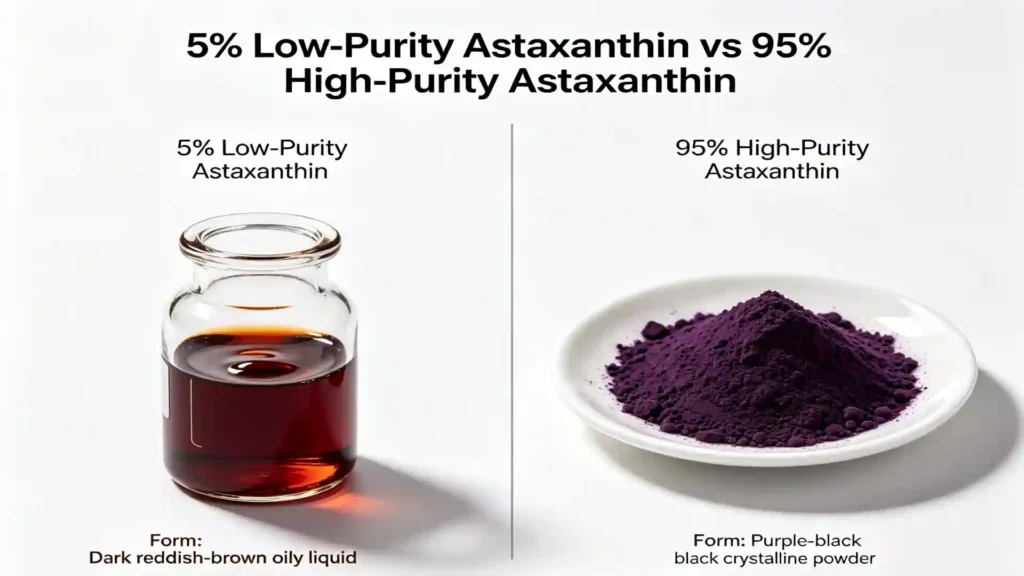
In the astaxanthin market, businesses often face a confusing dilemma: 5% natural astaxanthin oils are labeled by purity, alongside 95% high-purity chemically synthesized crystals.
If higher purity astaxanthin equates to better quality, then the 95% variant would seem to be the clear winner.
However, the reality is far more complex. The debate over astaxanthin purity essentially boils down to three core trade-offs: natural complex compounds versus synthetic monomers, actual bioavailability versus nominal purity values, and active shelf life versus storage & processing costs.
To determine which option is superior, we break down the comparison across six key dimensions below.
I. Defining Purity: What Do 5% Purity Astaxanthin and 95% Purity Astaxanthin Actually Mean?
Before diving into the comparison, we must clarify the true definition of these two figures.
| Item | 5% Natural Astaxanthin Oil | 95% High-Purity Astaxanthin Crystal |
| Definition | 5 grams of astaxanthin monomers per 100 grams of oleoresin | 95 grams of astaxanthin monomers per 100 grams of crystal |
| Form | Dark reddish-brown oily liquid | Purple-black crystalline powder |
| Source | Extracted from natural Haematococcus pluvialis | Chemically synthesized (Naturally sourced 95% high-purity astaxanthin exists only as lab standards, with no mass-produced commercial supplies) |
| Auxiliary Ingredients | Contains vegetable oil, vitamin E, and other carotenoids | Almost pure monomers with no auxiliary ingredients |
(Note: 5% purity astaxanthin is also available as dark red powder, produced via different extraction processes. While purity remains 5%, its applications vary, including aquafeed, livestock feed, and solid tablet formulations.)
Key Takeaway: The 5% oleoresin form disperses astaxanthin molecules naturally within oils and cofactors. The 95% crystalline form tightly clusters astaxanthin monomers, resulting in extremely high chemical reactivity.
II. Source Dictates Fundamental Quality Differences
The source of astaxanthin creates the most critical divide between the 5% and 95% variants.
Natural Haematococcus pluvialis Source (5% Oleoresin)
- Under environmental stress, Haematococcus pluvialis accumulates astaxanthin as a self-protective mechanism. Extraction yields a natural complex that, in addition to astaxanthin monomers, inherently carries cofactors such as β-carotene, lutein, canthaxanthin, polyunsaturated fatty acids, and plant sterols.
- These cofactors form a synergistic antioxidant network with astaxanthin. Multiple in vitro cellular and animal studies confirm that natural complexes deliver stronger antioxidant capacity than pure monomers at equivalent astaxanthin dosages.
- The 5% purity is not a limitation of production technology; it is a deliberate formulation choice to preserve the natural composite structure and stable oil matrix. Furthermore, astaxanthin from Haematococcus pluvialis primarily exists as mono- and diesters (esterified astaxanthin). Compared to the free-form astaxanthin in synthetic products, esterified astaxanthin boasts superior stability in oil media and milder, sustained intestinal absorption—another major driver of its high bioavailability.
Chemically Synthesized Source (95% Crystal)
- Chemical synthesis routes produce high-purity crystals ranging from 95% to 99%. Synthetic astaxanthin forms a mixture of cis-trans isomers (near 1:1 ratio of all-trans to cis forms) and contains zero natural cofactors.
- These high-purity crystals are primarily used for pigmentation in farmed salmon, shrimp, and crab aquafeed, rather than mainstream human dietary supplements.
Conclusion: The 5% natural variant and 95% synthetic variant are fundamentally distinct substances, not merely different concentrations of the same compound.
III. Isomers: 95% High Purity ≠ 95% High Bioactivity
Astaxanthin molecules feature chiral centers, creating three optical isomers: 3S,3’S (levorotatory), 3R,3’R (dextrorotatory), and meso form.
| Isomer Indicator | 5% Natural Algae-Derived Astaxanthin Oil | 95% Chemically Synthesized Astaxanthin Crystal |
| Optical Configuration | Almost entirely 3S,3’S levorotatory | Racemic mixture (levorotatory: meso: dextrorotatory ≈ 1:2:1) |
| All-trans Ratio | ≥70% | ~50% |
| Cellular Uptake Efficiency | Very high | Relatively low |
| Bioavailability | Excellent | Poor |
Core Fact: The 3S,3’S levorotatory configuration is the product of natural biological evolution. Carotenoid-binding proteins on human cell membranes recognize and transport this configuration with maximum efficiency. Many isomers in the synthetic racemic mixture can barely be utilized by the human body, which explains the gap in cellular uptake efficiency shown in the table.
Therefore, in standard oral formulations without specialized embedding treatment, the actual usable active ingredients from 95% synthetic high-purity monomers are typically far lower than the biological efficacy delivered by the equivalent labeled astaxanthin dosage in 5% natural oleoresin.
IV. Stability: Higher Purity Equals Harder Storage Conditions
This counterintuitive technical truth is critical: astaxanthin stability is inversely proportional to its purity.
| Stability Indicator | 5% Natural Astaxanthin Oil | 95% High-Purity Astaxanthin Crystal |
| Molecular State | Evenly dispersed in oil with large molecular spacing | Densely clustered with minimal molecular spacing |
| Oxidation Risk | Low (dual protection from oil and vitamin E) | Extremely high (rapid degradation upon exposure to light, oxygen, or heat) |
| Ambient Shelf Life | ≥24 months | Hours to days (without protective treatment) |
| Storage Requirements | Sealed, shaded room-temperature storage | Low-temperature, nitrogen-flushed, light-proof, airtight storage |
(Note: The “hours to days” shelf life cited for 95% crystals refers to extreme conditions: open exposure, light, and no protective measures. Industrial nitrogen-sealed packaging extends lifespan, yet cold-chain transport remains mandatory at all times. The ≥24-month shelf life for 5% oleoresin applies to standard sealed, shaded ambient storage.)
Why Higher Purity Reduces Stability
- Astaxanthin contains multiple conjugated double bonds, making it highly susceptible to chain oxidation reactions with oxygen.
- In unembedded, unisolated 95% high-concentration crystals, astaxanthin molecules sit tightly adjacent to one another. Once oxidation initiates in a single molecule, free radicals rapidly spread to neighboring molecules, triggering exponential degradation.
- In 5% oleoresin, astaxanthin molecules are separated by vegetable oil and vitamin E. Vitamin E acts as a free radical scavenger to terminate oxidation chain reactions, delivering long-term protection for astaxanthin.
A revealing industry reality: If a so-called “95% high-purity astaxanthin” product remains stable for months in standard room-temperature packaging (non-nitrogen-flushed, non-light-proof sealed packaging), it likely no longer contains genuine 95% astaxanthin. Pure 95% astaxanthin crystals visibly discolor and degrade within hours when exposed to open air, light, oxygen, and no protective agents at room temperature.
V. Comprehensive Scientific Comparison: 5% vs 95%
| Evaluation Dimension | 5% Natural Algae-Derived Astaxanthin Oil | 95% Chemically Synthesized Astaxanthin Crystal |
| Source | Natural Haematococcus pluvialis | Chemical synthesis |
| Form | Oily liquid with natural cofactors | Purple-black crystalline powder |
| Optical Configuration | 3S,3’S levorotatory (high human affinity) | Racemic mixture (low bioavailability) |
| All-trans Ratio | ≥70% | ~50% |
| Antioxidant Activity (Cell Assays) | High (synergistic cofactor effect) | Low (no natural cofactors) |
| Ambient Stability | Excellent (≥24-month shelf life) | Very poor (specialized storage required) |
| Bioavailability (Standard Oral Formulations) | High | Low |
| Recommended Applications | Human dietary supplements | Aquafeed, laboratory calibration standards |
| Safety Profile | GRAS-certified algae source, safe for long-term consumption | Restricted for human consumption in multiple regions |
VI. Clearing Up Common Industry Misconceptions
Misconception 1: “95% astaxanthin is superior simply because it has higher purity.”
Fact: Higher purity only means astaxanthin monomers account for a larger mass share of the total product—it does not equate to higher bioactivity for humans. The 5% natural oleoresin contains astaxanthin in the human-friendly levorotatory configuration, paired with natural synergistic cofactors and a stable delivery matrix, delivering far greater biological efficacy than 95% synthetic alternatives.
Misconception 2: “High-purity astaxanthin is the premium choice for nutritional supplements.”
Fact: Over 95% of global production of 95%+ high-purity astaxanthin crystals supplies the aquafeed industry (for salmon pigmentation), not human nutritional supplements. The mainstream raw material for human consumer products (dietary supplements, functional foods) consistently remains 5%–10% natural algae-derived oleoresin.
Misconception 3: “Higher purity equals higher price—more expensive products are better.”
Fact: The production cost of 95% synthetic crystals is far lower than that of extracted 5% natural oleoresin. Low-priced products labeled “high-purity astaxanthin” almost always use synthetic sources. By contrast, genuine 5% natural astaxanthin oleoresin requires strict algae cultivation, green extraction, and stabilization processing, resulting in a higher market price.
VII. Decision Guidance for B2B Industry Practitioners
As raw material suppliers, we recognize B2B clients make purchasing decisions based on far more than nominal purity—formula compatibility, production stability, cost efficiency, and regulatory risk all carry weight. Below are practical recommendations built on the six-dimensional analysis above.
For Formulators: Prioritize Effective Bioactivity Over Nominal Purity
- 5% Natural Oleoresin: Liquid form offers native compatibility with oil-based formulations (softgels, functional oil beverages, emulsions). No extra surfactants or chemical modification are required; it can be directly incorporated as the oil phase during emulsification and homogenization, drastically lowering production barriers. Its esterified astaxanthin releases gradually within oil matrices to minimize antioxidant loss, and synergistic cofactors boost the finished product’s overall ORAC (oxygen radical absorbance capacity).
- 95% Synthetic Crystal: Powder form insoluble in water and barely soluble in standard oils, requiring complex preprocessing such as microencapsulation or nano-embedding before use in finished formulations. Unembedded high-purity crystals degrade severely during preprocessing, leading to far lower actual yield than theoretical purity values. Much of the premium cost paid for “95% purity” is lost to oxidation during early-stage manufacturing.
Recommendation: For standard dietary supplements and functional food development, 5% oleoresin enables direct feeding, simple processing, and preserved active ingredients. Reserve synthetic crystals only if you possess specialized embedding technology and your sole goal is pigmentation—otherwise, the tradeoff is not worthwhile.
For Procurement Specialists: Calculate Full Shelf-Life Loss Costs, Not Just Unit Price
- 5% Natural Oleoresin: ≥24-month ambient shaded shelf life simplifies inventory management with minimal product loss. Though its per-kilogram purchase price appears higher than synthetic crystals, nearly 100% of the labeled astaxanthin content remains intact in finished end products.
- 95% Synthetic Crystal: Mandates low-temperature, nitrogen-flushed, light-proof, airtight storage and transport, inflating full supply chain costs. More critically, brief ambient exposure of semi-finished or finished products triggers rapid astaxanthin degradation. If transport temperatures exceed 25°C for over 48 hours in summer, finished goods may test at only 60%–70% of the labeled astaxanthin content upon shipment—this hidden cost is frequently overlooked.
Recommendation: Request accelerated stability test data and astaxanthin retention rates in finished formulations from suppliers, rather than relying solely on COA (Certificate of Analysis) initial purity figures. 5% oleoresin delivers lower full-lifecycle loss, resulting in superior total cost of ownership (TCO).
For Enterprise Decision-Makers: Mitigate Regulatory and Brand Reputational Risks
- 5% Natural Algae Source: Approved under major global regulatory frameworks (US GRAS, EU Novel Food, China New Food Raw Material). It provides solid compliance support for “natural source” clean label marketing to end consumers.
- 95% Synthetic Source: Regulations in China and other regions strictly limit synthetic astaxanthin to aquafeed applications. Using it in human oral supplements creates clear regulatory compliance risks. Additionally, public discourse around low bioavailability of synthetic racemic isomers could trigger consumer trust crises if highlighted by media.
Recommendation: For brands targeting premium human nutrition markets, 5% natural oleoresin delivers long-term safety, regulatory compliance, and scientific credibility. Synthetic 95% crystals are cost-effective only for aquafeed pigmentation lines; the two product categories serve entirely separate use cases and do not compete directly.
Concluding Summary
5% natural oleoresin delivers a stable, synergistic active complex; 95% synthetic crystal delivers a high-risk chemical monomer.