
Core Conclusion First
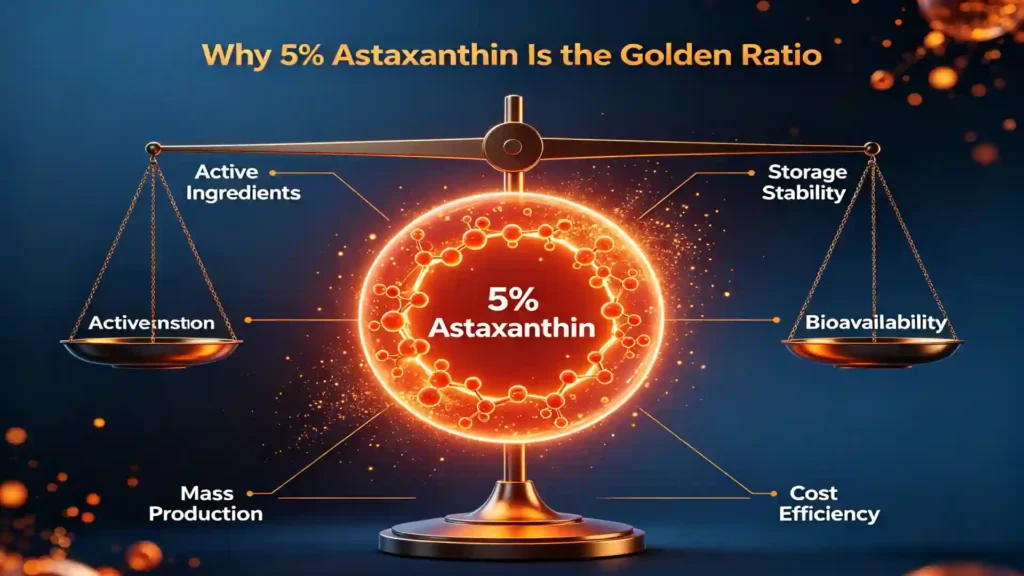
Among commercially available natural astaxanthin raw materials on the market today, 5% astaxanthin (oil-based, sourced from Haematococcus pluvialis) is a long-term, market-verified balance point across five dimensions: retained active ingredients, storage stability, bioavailability, mass-production process compatibility, and overall cost. It is also one of the most widely adopted specifications for oral dietary supplements.
I. Core Definition: What Does the Industry Mean by 5% Astaxanthin?
The 5% astaxanthin discussed in this article exclusively refers to raw materials tailored for oral dietary supplements that meet all the following criteria:
- Derived from Haematococcus pluvialis
- Produced via supercritical CO₂ low-temperature extraction
- Oil-soluble form
- Formulated for oral dietary supplements
This specification is the mainstream compliant standard in the global dietary supplement market, and it is entirely distinct from chemically purified crystalline powder and synthetic high-purity astaxanthin.
Under stress cultivation conditions, regular strains of dried Haematococcus pluvialis naturally contain 1%–3% astaxanthin, while high-yield strains can reach 3%–5%. Industrial production uses mild extraction and precise deglazing processes to achieve a 5% concentration, striking the optimal balance between preserving natural active ingredients and enabling stable mass manufacturing.
At this concentration, naturally esterified astaxanthin, lutein, β-carotene, unsaturated fatty acids, and other algae-derived synergistic components are well retained.
Critical Distinction by Application Scenarios
The final concentration of astaxanthin for topical skincare products only ranges from 0.1% to 1%, functioning as surface-layer antioxidants for the skin. The 5% concentration is a base specification for oral raw materials, optimized for intestinal absorption and metabolism in humans. Concentrations for oral and topical use are not interchangeable.
II. Full Spectrum of Concentration Specifications: Distinguish Authentic Commercial Grades from Marketing Gimmicks
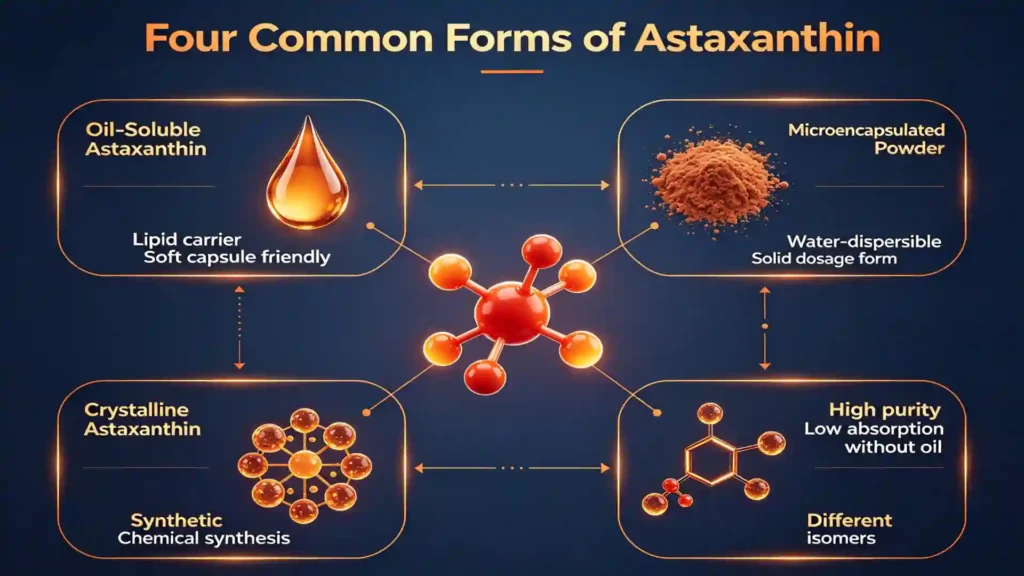
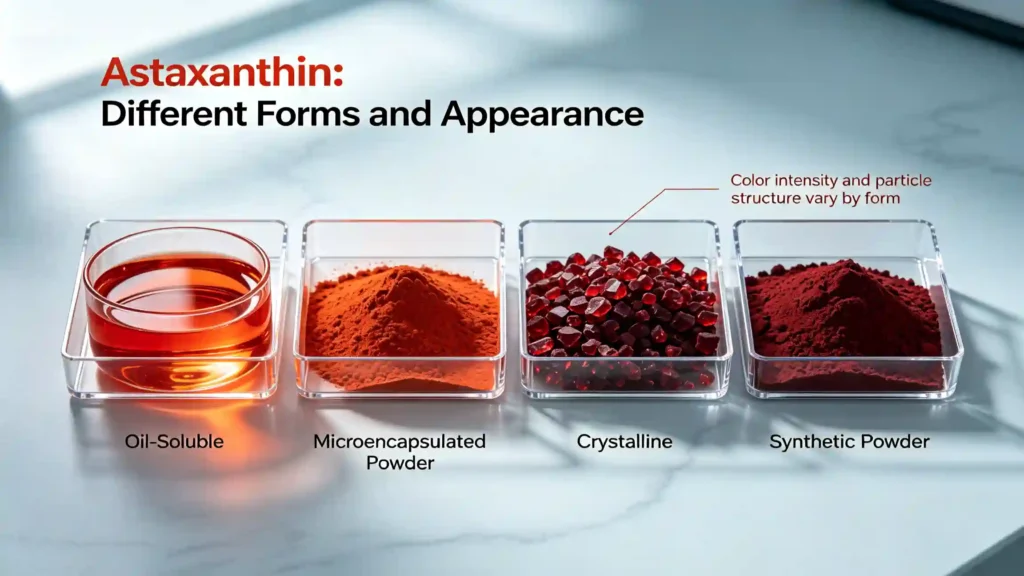
All astaxanthin concentrations available on the market fall into four categories: authentic commercial oil-soluble grades, niche ultra-high-concentration oil-soluble grades, industrial high-purity crystalline grades, and false conceptual grades. Many concentrations circulated online lack standardized mass-produced raw materials and exist purely as marketing hype.
1. Standard Commercial Oil-Soluble Grades
- 1% Astaxanthin: Highly diluted oil-based raw materials with extremely low active ingredient content and excessive carrier oil. It is only suitable for surface antioxidant use in skincare products. It fails to deliver effective oral dosages and offers poor cost performance, so it is rarely used in oral formulations.
- 2%–3% Astaxanthin: Oversaturated with carrier oil that heavily dilutes active ingredients, resulting in large raw material volumes per unit of active compound. Excess oil raises the risk of rancidity, complicating shelf-life control for finished goods. Surplus oil may also cause gastrointestinal discomfort such as a greasy aftertaste or mild intolerance in some consumers. Primarily used in aquafeed and low-cost OEM products.
- 5% Astaxanthin: Features an accurately balanced ratio of active molecules and carrier oil, with intact natural ester structures and retained synergistic components. It boasts excellent room-temperature stability and optimal human absorption, compatible with mass production of all dosage forms. It is the top choice for high-end oral anti-aging and eye-health products.
- 10% Astaxanthin: Insufficient carrier oil leads to high molecular density of astaxanthin, drastically accelerating oxidative degradation and discoloration. Low-temperature storage and transportation are mandatory to preserve activity. Inadequate emulsifying carriers reduce human absorption efficiency compared to the 5% grade, and it has low fault tolerance for mass manufacturing. Suitable only for lab-scale trials and niche custom formulations; large-scale production requires case-by-case evaluation.
2. Ultra-Niche Oil-Soluble Grades
- 15% Astaxanthin: Near the solubility ceiling of oil-based systems. This supersaturated custom grade readily crystallizes under low temperatures and suffers poor stability, making it unsuitable for regular mass production.
3. Industrial High-Purity Crystalline Grades (Not Recommended as Core Oral Raw Materials)
- 90%–95% Astaxanthin: Refined via solvent extraction, column chromatography, and recrystallization, stripping all oil and algae-derived synergistic components to retain only free-form astaxanthin. Without oil carriers, it cannot be fully emulsified by human bile, leading to extremely low oral absorption rates. The powder is highly sensitive to light and heat, oxidizing rapidly upon exposure to the environment, making long-shelf-life oral formulations unfeasible. Limited to laboratory calibration standards, pharmaceutical intermediates, feed colorants, and skincare compounding.
- 100% Astaxanthin: Not a viable commercial mass-production raw material, merely laboratory-grade reference standard substances. Output is minimal, and costs are exorbitant; it oxidizes rapidly at room temperature, cannot be conventionally stored or mass-processed, and has poor human bioavailability. All “100% ultra-high-purity astaxanthin” products on the market are marketing fallacies.
4. Controversial Concentrations Circulated Online: 20%–80% Differentiated by Form
- Oil-soluble astaxanthin ≥20%: Restricted by the solubility limit of vegetable oils; no stable standardized mass-produced raw materials exist. Any oil-soluble astaxanthin exceeding 15% will inevitably crystallize, stratify, or precipitate, precluding stable commercial oil raw materials.
- 20% microencapsulated astaxanthin powder: A water-dispersible system distinct from oil-soluble grades, which does exist but remains non-mainstream. Some 20% specifications are water-soluble astaxanthin microcapsule powders embedded with cyclodextrin or colloids (solid dispersions), intended for solid beverages and tablets. However, high-concentration microcapsule powder suffers low embedding efficiency and poor stability, with inferior bioavailability relative to oil-soluble alternatives. The mainstream mass-production grades remain 5% and 10% microcapsule powders.
- 30%–80% full concentration range: No standardized industrial mass-produced raw materials exist in either oil-soluble or water-soluble forms. These are purely false marketing concepts lacking industrial production logic and compliant quality inspection standards.
III. Five Core Dimensions: Why 5% Is the Golden Ratio for Astaxanthin
Across all authentic astaxanthin concentration specifications, 5% stands out as the industry’s recognized superior solution, delivering a well-rounded balance unachievable by other concentrations across five metrics: activity, stability, absorption rate, process compatibility, and cost performance.
1. Optimal Activity: Preserve the Natural Compound Antioxidant System
The core advantage of natural astaxanthin lies not in its single molecular form, but the natural synergistic antioxidant system inherent to Haematococcus pluvialis. Naturally occurring β-carotene, lutein, unsaturated fatty acids, and trace algal active substances form a complementary, synergistic antioxidant network with astaxanthin, drastically boosting overall biological activity and reducing oxidative loss of ingredients.
Producing concentrations of 10% and above requires multi-stage deep purification and deglazing, which completely strips algae-derived auxiliary active components and leaves only isolated astaxanthin molecules. Despite higher labeled concentration, the core value of natural algae sources is lost, and the natural ester configuration of astaxanthin is damaged, sharply diminishing in vivo activity.
By contrast, 2%–3% low-concentration raw materials are over-diluted with excessive carrier oil and insufficient active ingredients, failing to meet daily human dosages for effective antioxidant action. Only the 5% grade avoids over-purification or extra dilution, perfectly retaining the original natural active ratio of algae.
2. Superior Stability: Eliminate Mass Production Quality Control Challenges
Astaxanthin is a highly active antioxidant inherently sensitive to light and heat, prone to oxidation, discoloration, and loss of efficacy — the primary challenge in formulation R&D and mass storage. The 5% concentration delivers the optimal stable ratio inherently suited to industrial storage.
High-concentration grades (≥10%) feature densely packed astaxanthin molecules that trigger auto-oxidation, accelerating efficacy loss and discoloration at room temperature. Cold-chain light-shielded storage and transportation are mandatory, leading to high production losses, strict packaging and warehousing thresholds, and low manufacturing fault tolerance.
Low-concentration grades (2%–3%) contain excessive carrier oil susceptible to rancidity, which in turn degrades astaxanthin activity. Finished goods stored long-term may develop turbidity, off-odors, and dull discoloration.
The 5% astaxanthin grade strikes a precise balance between active ingredients and carrier oil: the oil uniformly wraps active molecules to form a natural protective barrier against light and oxygen, eliminating the need for complex stabilized compound formulations. Sealed nitrogen-filled raw materials remain stable for 18–24 months under room-temperature light-shielded conditions; finished soft capsules maintain a 24-month shelf life under conventional light-shielded storage, with minimal production losses and top-tier stability.
3. Maximum Absorption: Perfectly Aligned with Human Intestinal Metabolism Mechanisms
As a lipophilic ingredient, astaxanthin’s absorption efficiency depends not on purity, but on the ratio of carrier oil and molecular configuration. Human absorption relies entirely on oil emulsification and bile dissolution, making the raw material’s oil ratio the decisive factor for absorption, rather than numerical concentration alone.
10% high-concentration raw materials lack sufficient inherent carrier oil, which may reduce emulsification efficiency if used directly. While absorption can be improved by adding extra oil excipients during formulation, this raises process complexity and lowers fault tolerance. Therefore, 10% is usable only with stricter formulation controls and is not a universal optimal choice.
2%–3% low-concentration grades carry excess oil that burdens gastrointestinal metabolism, potentially triggering bloating, greasy sensations, and mild intolerance, while diluting unit active ingredient concentration and weakening overall antioxidant efficacy.
90%–100% oil-free high-purity crystalline powder cannot be fully emulsified by bile and is mostly excreted unabsorbed.
5% astaxanthin is formulated with premium compatible carrier oils such as safflower seed oil and sunflower oil, whose oil ratio perfectly matches intestinal emulsification efficiency in humans. It enables efficient penetration and absorption of lipophilic active components without excessive oil burden. Industry research and application data confirm the 5% grade delivers peak intestinal absorption and bioavailability of astaxanthin.
4. Optimal Process Compatibility: Zero Shortcomings for All Oral Dosage Forms
For formulators and manufacturers, premium raw materials are judged not only by theoretical efficacy but also by practical manufacturability at scale. 5% astaxanthin is the only universal specification compatible with all mainstream oral dosage forms.
In terms of processing performance, 5% raw material oil has moderate fluidity, seamlessly adapting to soft capsules, hard capsules, chewable tablets, gel candies, solid beverages, and other mainstream formats. It avoids static agglomeration and uneven feeding common in high-concentration raw materials, as well as sticky machinery and deformed finished goods seen with low-concentration grades, drastically cutting production rejection rates and quality control costs.
In terms of compound compatibility, stable and mild 5% astaxanthin blends seamlessly with mainstream antioxidant and eye-health ingredients including lutein, vitamin E, CoQ10, grape seed extract and resveratrol, with no stratification, precipitation or ingredient antagonism. Both high- and low-concentration grades present compounding limitations incompatible with diversified formulation systems.
Additionally, 5% astaxanthin is a globally standardized, compliant specification with unified domestic and overseas filing standards and mature quality inspection systems, delivering consistent COA test data and making it the top choice for balancing compliance and universal applicability.
5. Best Cost Performance: Accurate Dosage & Controllable Expense
The effective daily oral dosage for anti-aging, eye care, and anti-inflammatory benefits is 4–12 mg of pure astaxanthin. The 5% concentration precisely matches human effective dosage requirements, balancing efficacy and cost.
200 mg of 5% raw material delivers 10 mg pure astaxanthin, enabling flexible dosage adjustment. Finished capsules feature a moderate size for easy swallowing, suitable for all age groups. 10% high-concentration raw materials carry severe brand premiums and vastly higher procurement costs, delivering poor mass-production cost performance. Low-concentration 2%–3% grades require double the raw material input, resulting in bulky finished products and redundant material consumption that drives up long-term manufacturing costs.
When factoring raw material procurement, production losses, warehousing & transportation, and finished product pass rates, 5% astaxanthin offers the lowest cost per unit of active ingredient and the highest overall cost performance.
IV. Three Core Misconceptions All Formulators Must Avoid
Misconception 1: Higher Purity Equals Better Product Efficacy
The final efficacy of oral products depends on the actual absorbed dose of active ingredients and natural molecular configuration in the human body, not the labeled raw material purity. Ultra-high-purity and ultra-high-concentration grades generally feature inflated numerical values paired with low absorption and poor active retention; marketing hype outweighs real functional benefits.
Misconception 2: Chemically Purified High-Purity Powder Outperforms Natural 5% Oil-Based Raw Materials
Chemically synthesized 90%+ high-purity astaxanthin consists primarily of cis-isomers as isolated free-form molecules, lacking natural synergistic systems. It exhibits far inferior biological activity, safety, and long-term efficacy compared to natural all-trans esterified astaxanthin sourced from Haematococcus pluvialis. It is not recommended as the core raw material for oral functional products marketed for high activity and natural origins.
Misconception 3: Concentrations for Oral and Topical Use Are Interchangeable
Topical skincare only requires surface-layer antioxidant action, with a final concentration of 0.1%–1% sufficient to meet demand. Oral absorption relies on intestinal emulsification and requires precise oil carriers and natural active systems. Oral and topical mechanisms of action are entirely distinct, so their concentrations cannot be swapped.
V. Astaxanthin Concentration Selection Reference Table for Formulators
| Raw Material Concentration & Form | Stability | Absorption & Activity | Processing Compatibility | Overall Positioning | Applicable Scenarios |
| 1% (Oil-soluble) | Stable, low activity | No oral application value | Simple processing | Diluted topical raw material | Skincare, not for oral use |
| 2%–3% (Oil-soluble) | Average, high rancidity risk | Average, excess oil burden | Prone to machine sticking | Low-end raw material | Aquafeed, low-cost OEM |
| 5% (Oil-soluble) | Excellent, stable for 18–24 months at room temperature | Excellent, optimal human compatibility | Compatible with all dosage forms | Top oral raw material grade | Mid-to-high-end oral health supplements |
| 10% (Oil-soluble) | Requires low-temperature storage & transportation | Potentially reduced absorption; absorption improvable via supplementary oil in formulations | Low manufacturing fault tolerance | Niche custom grade | Special formulations with strict process controls |
| 15% (Oil-soluble) | Poor, prone to crystallization & oxidation | Reduced absorption | Unstable processing | Ultra-niche custom grade | Only for special customized demands |
| 90%–95% (Crystalline powder) | Poor, light & heat sensitive | Low absorption without oil solubilization | Unsuitable for direct oral processing | Industrial / laboratory grade | Laboratory calibration, feed coloring, skincare compounding |
| 100% (Theoretical only) | Extremely poor | No practical oral application value | Unprocessable | Laboratory reference standard | No commercial application |
| 20%–80% (Online marketed grades) | No stable oil-soluble raw materials; microcapsule powder stability unproven | Unclear performance | No standardized mass production criteria | Mostly marketing gimmicks | No mainstream commercial applications |
VI. Final Takeaway for Formulators
5% astaxanthin earns its reputation as the industry’s golden ratio after evaluating all authentic commercial grades from 1%, 2%, 3%, 5%, 10%, 15% to 95%/100%, and clarifying form differences and marketing gimmicks surrounding 20%–80% concentrations. It is the scientifically optimal solution that best aligns with human oral metabolism, enables stable large-scale industrial production, supports long-term shelf-life preservation, and fully retains natural biological activity.
Professional formulators prioritize stable activity, high bioavailability, manufacturability, regulatory compliance, and cost efficiency over inflated concentration figures. Setting aside marketing tactics, natural 5% Haematococcus pluvialis-derived astaxanthin stands as the premier raw material choice for oral antioxidant products.
Further Support
Jayoo Biotech
Phone: +86 15817492830
WeChat: 15817492830
E-mail: info@jayoobio.com, sales@jayoobio.com