
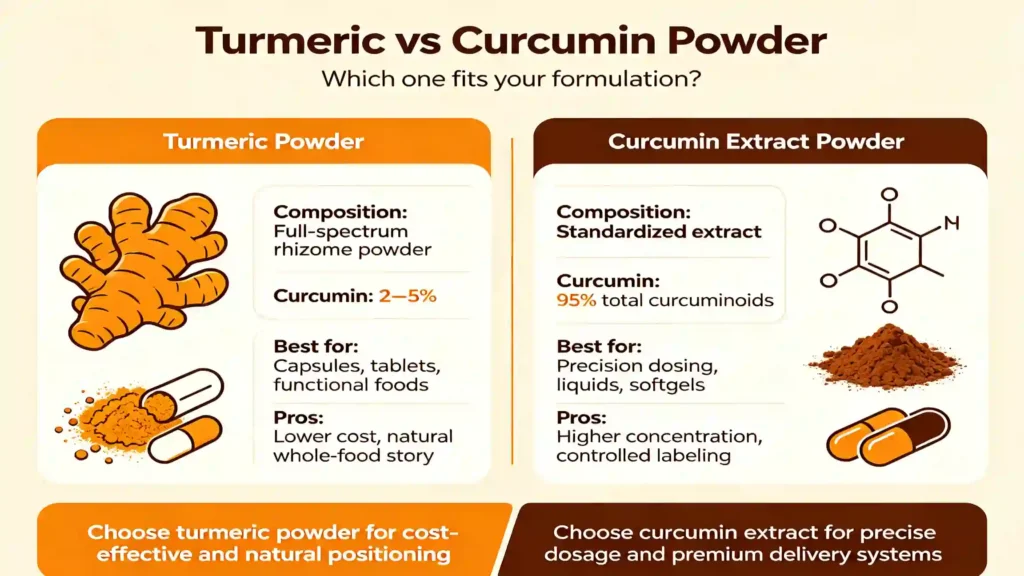
When evaluating turmeric vs curcumin powder for your next product line, the decision does not hinge on which format is “superior,” but on which format best addresses the specific formulation, cost, and stability challenges of your project.
Targeted at formulation engineers, raw material purchasers, and quality control specialists, this article distinguishes marketing rhetoric from genuine technical standards for turmeric-derived ingredients across five core dimensions: raw material composition, formulation hurdles, delivery technologies, compliance evidence, and supply chain costs. It delivers a ready-to-use material selection decision framework.
Part 1: Quick Decision Overview
The choice between turmeric powder and standardized curcumin extract depends on your target dosage form, budget, efficacy positioning, and whether you can substantiate any enhanced absorption claims with empirical data.
Below is a practical framework to guide preliminary screening before you invest in formulation trials for anti-inflammatory or joint health products.
1 When to Select Turmeric Powder
Turmeric powder remains the default raw material for most turmeric capsules, tablets, and functional foods on the market. It delivers straightforward processing, synergistic potential from full-spectrum phytochemicals, and substantially lower per-gram costs for anti-inflammatory support.
If your product concept calls for standard two-piece hard capsules with 500 mg to 2 g of turmeric powder per serving, unextracted turmeric powder enables simpler blending, predictable compaction behavior, fewer stability variables, and a “natural whole-food” marketing narrative.
Turmeric powder is also a viable option when your target consumers already understand the guidance to “take with food or fat.” It partially mitigates solubility limitations at minimal formulation expense. For new brands entering the turmeric category, launching with turmeric powder reduces project timelines, regulatory documentation risks, and supply chain complexity.
Additionally, turmeric powder retains essential oils (containing ar-turmerone and other compounds), polysaccharides, and naturally balanced curcumin ratios. These co-occurring constituents may synergistically boost curcumin stability and bioactivity, an unrivaled “full-spectrum advantage” that purified extracts cannot replicate.
2 When to Select Curcumin Extract
Standardized curcumin extracts emerge as the stronger candidate when your product brief demands precise dosage control, liquid supplements, ready-to-drink beverages, or any dosage form that must overcome curcumin’s inherently low native concentration and poor water solubility.
They are also suitable for premium functional positioning, where verifiable bioavailability advantages justify a higher price point, such as joint health, sports recovery, or clinical-grade anti-inflammatory regimens.
Standardized curcumin capsules and tablets stand out on retail shelves, provided the delivery system is genuinely effective and well-characterized. Evaluate standardized extracts if your product targets the following use cases:
- Strictly regulated markets requiring quantifiable active ingredient labeling (e.g., the EU, Australia TGA)
- Low-dose, high-absorption formulations (e.g., formulations paired with black pepper alkaloids or phospholipid complexes)
- Joint health or sports nutrition products where consumers expect measurable anti-inflammatory effects
- Softgels, liquid-filled capsules, or ready-to-drink beverages
- Formulations that need to counter curcumin’s photosensitivity and pH-dependent instability
3 Three Critical Verifications Before Making Efficacy Claims
Before advertising purported advantages of standardized curcumin extract formulations, validate three key points.
First, confirm the curcumin content and the ratio of the three curcuminoid homologs (curcumin, DMC, BDMC); do not rely solely on supplier marketing datasheets. Authentic “95% curcumin” should contain approximately 60–70% curcumin, 20–27% demethoxycurcumin (DMC), and 10–15% bisdemethoxycurcumin (BDMC).
Second, request dose-normalized pharmacokinetic or in vitro release data comparing standardized extracts and full-spectrum turmeric powder under identical test conditions. Many comparative studies reference total material weight rather than standardized curcumin content, which drastically skews perceived performance benefits.
Third, verify finished product stability: curcumin is extremely susceptible to degradation by light, heat, and alkaline pH. Your turmeric formulation must retain its labeled potency and bioactivity throughout the entire shelf life. Without these validations, a “95% curcumin” label only represents a concentration statement, not a guarantee of efficacy.
Part 2: Defining Turmeric vs Curcumin Powder Compositions
The terms “turmeric powder” and “curcumin extract” are loosely used across supplier catalogs and consumer marketing, often obscuring profound differences in chemical composition and functional performance. Before comparing costs, efficacy, or manufacturability, it is critical to clarify what each term describes at the raw material level.
1 Composition of Authentic Standardized Turmeric Powder
When procurement teams request bulk turmeric powder, they generally refer to ground, dried rhizomes of Curcuma longa L. standardized to a fixed curcumin content, typically quantified via HPLC at 2–5%.
Formal turmeric powder specifications must define curcumin concentration, particle size distribution, moisture content, ash content, volatile oil levels, heavy metal limits, microbial counts, and pesticide residues. The material is an orange-yellow powder with a rich turmeric aroma and mild pungency, supplied as an unprocessed full-spectrum plant matrix with no extraction, purification, or encapsulation steps.
Key Takeaway: The actual curcumin concentration in turmeric powder fluctuates widely based on origin, harvest season, storage conditions, and milling processes. Indian turmeric typically contains 3–5% curcumin, while some Southeast Asian variants can drop as low as 1–2%. This natural variability presents a persistent challenge for formulators.
2 Composition of Authentic Standardized Curcumin Extract
A genuine standardized curcumin extract means curcuminoids are enriched from turmeric rhizomes via solvent extraction (typically ethanol or acetone) and purification processes, yielding a final product standardized to 95% total curcuminoids.
Legitimate standardized extracts require a defined compositional fingerprint (ratios of the three curcuminoid homologs), quantifiable residual solvent limits, and stability data demonstrating consistent potency during storage. 95% curcumin extract is distinct from simple “turmeric concentrate” or turmeric oleoresin.
Key Takeaway: Extraction removes turmeric’s essential oils, polysaccharides, fiber, and other co-occurring constituents, natural components that create a protective matrix to stabilize and boost absorption of curcumin in the native plant. Purification elevates concentration while stripping away this natural protective network.
3 Why Product Terminology Conceals Major Structural Differences
This layer of ambiguity complicates supplier evaluation. Many products labeled “curcumin” fall into one of the following categories:
- Turmeric oleoresin: A blend of curcumin, essential oils, and resins, containing 15–45% curcumin
- Turmeric concentrate: Partially purified extract with 40–70% curcumin
- Curcumin-phospholipid phytosomes: Curcumin bound to phospholipids without forming true vesicles
- Curcumin nanoemulsions or self-emulsifying delivery systems
- Curcumin solid dispersions
- Simple physical blends of curcumin powder and excipients
While each of these formats can moderately improve curcumin solubility or dispersibility, none deliver the same compositional certainty and precise dosing as authentic 95% standardized curcumin extract. Request HPLC fingerprints and quantitative data for the three curcuminoid homologs from all suppliers. Vendors unable to provide these documents are unlikely to supply genuine standardized curcumin extract.
Part 3 Formulation Challenges Inherent to Curcumin
Curcumin is highly valued for its anti-inflammatory and antioxidant mechanisms, which support joint health, digestive function, and systemic inflammation management. Despite its appeal as a bioactive compound, its unique physical, chemical, and metabolic properties create tangible obstacles at the formulation bench.
Low curcumin bioavailability is not a marketing issue resolvable through label claims; it is a quantifiable limitation rooted in molecular chemistry that impacts every downstream decision, from dosage form design to cost per effective dose.
1 Poor Solubility and Aqueous Dispersibility
Curcumin is a hydrophobic polyphenol with aqueous solubility below 0.1 mg/mL at physiological pH. Without solubilization technologies, curcumin exhibits virtually no dispersibility in water.
For powder blends used in capsules or tablets, poor solubility does not create manufacturing issues. Still, it restricts curcumin dissolution in gastrointestinal fluids post-ingestion, limiting the quantity available for intestinal absorption.
Formulator Insight: All water-based turmeric products (beverages, oral liquids, effervescent tablets) require nanoemulsification, microencapsulation, cyclodextrin complexation, or liposomal delivery technology. Without these systems, most curcumin in the product passes through the digestive tract as undissolved particles with near-zero bioavailability.
Chemical Stability: Triple Threats from Light, Heat, and pH
Curcumin faces more severe stability risks than most flavonoids:
- Light sensitivity: Photodegradation occurs upon light exposure, fading the bright yellow pigment to colorless or brown
- Heat sensitivity: High-temperature processing (wet granulation drying, baking, sterilization) accelerates degradation
- pH sensitivity: Relatively stable under acidic conditions (pH < 5, retaining 85–95% potency), yet 90% degrades within 30 minutes under neutral/alkaline intestinal pH (7.2–7.4)
- Iron ion sensitivity: Forms complexes with iron, skewing potency testing and reducing bioactivity
Formulator Guidance:
- Formulate in acidic or slightly acidic systems (pH < 5)
- Use light-blocking packaging (amber bottles, aluminum foil pouches, opaque capsule shells)
- Restrict processing to low-temperature workflows (e.g., direct compression instead of wet granulation)
- Avoid contact with iron manufacturing equipment
- Incorporate antioxidants (vitamin E, ascorbic acid) as stabilizers
2 Dissolution Limitations and Gastrointestinal Behavior
Even with particle size reduction via micronization, curcumin dissolution remains slow in simulated gastric fluid (SGF, pH 1.2) and simulated intestinal fluid (SIF, pH 6.8). The practical outcome is that most oral curcumin doses transit the gastrointestinal tract without dissolving.
Gastrointestinal stability adds another layer of complexity. While curcumin remains relatively intact in acidic gastric fluid, the alkaline small intestine, where absorption primarily occurs, triggers rapid breakdown into metabolites such as ferulic acid. Formulators developing dissolution-enhanced curcumin must conduct testing under both pH conditions, not just one.
3 Metabolic Exposure and Variability in Oral Performance
The biggest barrier is not dissolving curcumin, but preserving its intact molecular structure post-absorption. Curcumin undergoes extensive metabolism: rapid glucuronidation and sulfation occur in the intestinal wall and liver during first-pass metabolism. This means even absorbed curcumin circulates primarily as conjugated metabolites (curcumin glucuronide, curcumin sulfate), not free curcumin.
Published pharmacokinetic data from animal models consistently show undetectably low plasma concentrations of unmodified curcumin after oral administration. Human pharmacokinetic trials mirror this trend: even with oral doses as high as 8 g of pure curcumin, circulating free curcumin levels remain barely measurable.
This metabolic reality applies equally to turmeric powder and standardized curcumin extract. Any supplier claiming drastically elevated systemic exposure must provide dose-normalized AUC (area under the curve) data representing total absorbed compound, not isolated relative fold-change figures stripped of baseline context.
Part 4 How Delivery Technologies Reshape Curcumin Performance Expectations
Curcumin delivery technologies can measurably alter curcumin performance profiles, yet the magnitude of improvement depends entirely on delivery system quality and its survivability through manufacturing, storage, and digestion.
Poorly engineered systems raise costs and excipient load without delivering meaningful functional anti-inflammatory benefits, while well-manufactured delivery vehicles modify dispersal behavior, release kinetics, and potentially intestinal uptake.
1 Generations of Delivery Technology: From Physical Blending to Nano-Targeted Systems
Current market enhancement technologies fall into three generations:
| Generation | Technical Principle | Vendor Self-Reported Absorption Multiplier* | Median Independent Third-Party Value** | Representative Technologies |
| 1st Generation | Piperine-mediated metabolic inhibition | 20x | 6–12x | Bioperine® |
| 2nd Generation | Phospholipid complexation; essential oil synergy | 29–50x | 10–25x | Meriva®, BCM-95® |
| 3rd Generation | Nanoparticles / Solid Lipid Particles (SLP) | 65–285x | 20–85x | Longvida®, Theracurmin® |
Footnotes:
* In-house animal trial data referenced in corporate patents and whitepapers
**Conservative estimates from independent third-party human pharmacokinetic studies, equivalent to 30–60% of vendor-reported values (see Note 2)
Notes:
- Vendor self-reported animal trial data sourced from corporate patents and whitepapers.
- Independent human clinical research indicates that for oral human use, the actual absorption boost of all delivery platforms generally equals only 30–60% of advertised vendor multipliers.
- To date, no large-scale, multicenter, industry-unfunded head-to-head human trials universally confirm one technology as definitively superior.
Formulator Decision Framework:
- Budget-sensitive + standard dosage forms → Turmeric powder + black pepper extract (1st Generation)
- Mid-tier premium positioning + full-spectrum marketing → Essential oil-containing extracts such as BCM-95® (2nd Generation)
- Clinical-grade efficacy claims + liquid/beverage dosage forms → Nanoemulsions or solid lipid nanoparticles (3rd Generation)
2 Full-Spectrum Turmeric vs Purified Curcumin: Higher Purity Does Not Equal Superiority
A frequently overlooked formulation principle:
Purified 95% curcumin extract removes turmeric’s essential oils, polysaccharides, and other co-occurring constituents, components that naturally stabilize curcumin and facilitate absorption. Turmeric essential oils (ar-turmerone, turmerone) act as natural dispersants and inhibit curcumin metabolism; polysaccharides form a protective matrix to slow degradation.
Full-spectrum turmeric formulations (e.g., BCM-95®, Cureit®) retain turmeric’s native chemical balance. Bisdemethoxycurcumin (BDMC) exhibits 7x greater stability than curcumin and acts as a “carrier” to shuttle curcumin to target tissues. Additionally, essential oil compounds stimulate bile secretion to promote micelle formation, indirectly boosting absorption.
Formulator Insight: Full-spectrum turmeric is preferable for brands emphasizing “natural whole-food” positioning or cost-sensitive lines. Standardized extracts are optimal for formulations requiring precise dose control (clinical research, highly regulated markets).
3 Dispersibility vs Genuine Solubility Improvements
Nanoscale delivery technologies do not render curcumin “water-soluble.” They create colloidal dispersions where curcumin resides within nanoparticles, micelles, or vesicles suspended in aqueous media. This distinction is vital for formulators developing turmeric beverage powders or oral liquids.
True curcumin solubilization requires alternative approaches such as cyclodextrin complexation, co-solvent systems, or pH adjustment. The core advantage of nanodispersion systems is protecting active curcumin from degradation and partially bypassing hepatic first-pass metabolism via lymphatic transport, not increasing water solubility.
Part 5 Evidence Standards for Evaluating Absorption Claims
Claims that standardized curcumin extracts deliver “20x” or “50x” greater absorption than conventional turmeric powder are ubiquitous, yet the evidentiary quality supporting these figures varies drastically. Formulators and procurement buyers require a clear evidence-based framework to assess these marketing assertions.
1 What Animal and Human Pharmacokinetic Data Can Demonstrate
Curcumin animal pharmacokinetic studies, typically conducted in rats or mice, generate the most commonly cited absorption fold-increase values. These trials measure Cmax (peak plasma concentration), Tmax (time to peak concentration), and AUC (area under the curve) for enhanced delivery systems versus baseline formulations.
Published data consistently show meaningful AUC elevations for enhanced curcumin in rodent models, with reported fold-improvements varying widely across technology generations.
These observations are empirically valid yet carry critical caveats:
- Rodent gastrointestinal physiology differs substantially from humans
- Test doses far exceed typical commercial supplement dosages
- Metabolite profiles do not translate directly to human biology
- Many trials are funded by patent holders, creating conflicts of interest
Human pharmacokinetic data for curcumin remains limited. As of mid-2026, several randomized crossover studies have been published, yet large-scale, multicenter, independently funded trials remain scarce. Clinical research from institutions including the Mayo Clinic continues to accumulate supporting evidence, though no industry-wide consensus confirms one delivery technology outperforms all raw material formats.
2 Why Dose Normalization Is Mandatory for Fair Comparative Testing
This is the primary reason many supplier claims collapse under scrutiny. Meaningful curcumin absorption studies must compare formulations at identical active curcumin doses, not identical finished material weights.
Key Calculation Example:
- 500 mg turmeric powder (3% curcumin content) = 15 mg pure curcumin
- 500 mg standardized extract (95% curcumin content) = 475 mg pure curcumin
- The observed AUC difference (approximately 32x) stems almost entirely from dosage disparity, not inherent advantages of the extract format
A study comparing 500 mg standardized extract against 500 mg turmeric powder and reporting AUC disparities primarily reflects differences in curcumin concentration, not delivery efficiency. Valid comparative testing must evaluate either:
- Equimolar curcumin doses (e.g., 15 mg curcumin sourced from turmeric powder vs 15 mg purified curcumin extract)
- Equal finished material weight with explicit labeling of total curcumin content
Always request dose-normalized AUC and Cmax data. Confirm whether comparative testing used identical curcumin quantification methods and analytical standards (HPLC vs spectrophotometry). Without this rigor, absorption claims constitute marketing language, not scientific evidence.
Part 6 Manufacturing Quality and Commercial Viability
Selecting between standardized curcumin extract and turmeric powder is both a formulation decision and a manufacturing/supply chain decision. Your chosen raw material dictates specification requirements, viable dosage forms, and long-term anti-inflammatory efficacy profiles.
1 Raw Material Specifications and Required Documentation
Bulk turmeric powder incoming specifications must cover:
- Total curcuminoid content (three homologs quantified via HPLC)
- Volatile oil concentration
- Particle size distribution, bulk density
- Moisture content, ash content
- Heavy metal limits (lead, arsenic, cadmium, mercury)
- Microbial limits
- Pesticide residue screening
- Irradiation disclosure
A full Certificate of Analysis (COA), Material Safety Data Sheet (MSDS/SDS), and third-party testing reports from accredited laboratories represent baseline requirements.
Standardized curcumin extracts require expanded documentation:
- HPLC-quantified total curcuminoids and ratios of the three homologs
- Residual solvent limits (ethanol, acetone, ethyl acetate, etc.)
- Particle size distribution, bulk density
- Moisture content, heavy metal limits, microbial limits, pesticide residues
- Extraction process disclosure (solvent type, extraction temperature)
Enhanced delivery systems (phospholipid complexes, nanoparticles) demand additional documentation:
- Encapsulation efficiency or drug loading capacity
- Particle size distribution and PDI (polydispersity index, measuring particle uniformity)
- Zeta potential
- Phospholipid source and quality (soy/sunflower/egg phospholipids, non-GMO status)
- Dissolution profiles in simulated gastric/intestinal fluid
- Rehydration performance (dry powder formulations)
- Accelerated and real-time stability data
Credible suppliers provide comprehensive technical data sheets and stability reports covering all these parameters. Re-evaluate procurement partnerships with vendors unable to furnish this documentation.
2 Dosage Form Suitability for Capsules, Tablets, Softgels, Liquids, and Sachet Powders
| Dosage Form | Advantages | Critical Considerations |
| Hard Gelatin/HPMC Capsules | Simple blending, natural whole-food marketing narrative | Requires large capsule sizes (Size 00 or 000) to deliver efficacious doses |
| Tablets | Direct compression or wet granulation viable | Strict temperature control for wet granulation; volatile oils may compromise tablet hardness |
| Functional Foods | Natural colorant and flavor source | Poor thermal stability; avoid high-heat baking processes |
| Teas / Instant Powders | Aligns with Ayurvedic traditional positioning | Extremely low curcumin solubility; most active ingredient precipitates out |
Standardized Curcumin Extract Compatibility
| Dosage Form | Advantages | Critical Considerations |
| Hard/Soft Capsules | Precise dosing, compact volume | Pair with black pepper alkaloids or phospholipid complexes to boost absorption |
| Tablets | High active loading, cost-controllable | Light-blocking coating required; direct compression recommended to minimize heat exposure |
| Softgels | Oil-based dispersion leverages lipophilic advantages | Select MCT oil as carrier over vegetable oils |
| Oral Liquids | Compatible with nanoemulsification technology | Solubility and pH-dependent degradation must be resolved |
| Beverage/Sachet Powders | Compatible with nano/microencapsulation | Maintain acidic formulation pH; use light-proof packaging |
| Topical Skincare | Anti-inflammatory and antioxidant topical benefits | Formulate to skin-compatible pH (4.5–6.5); mitigate photosensitivity risks |
Key Limitations:
- Turmeric powder cannot be used for clear liquid formulations (sedimentation occurs)
- Unmodified standardized curcumin extract delivers negligible performance in water-based products (insolubility + rapid degradation)
- Nanocurcumin formulations are generally incompatible with traditional tableting workflows (high phospholipid content causes sticking during compression)
3 Stability, Packaging, Supply Chain, and Supplier Qualifications
Turmeric powder remains relatively stable when stored in cool, dry, light-free conditions. Volatile oils oxidize over time, altering flavor and active ingredient potency. With adequate oxygen-barrier packaging and desiccants, a 24–36 month shelf life is achievable, though batch-by-batch curcumin potency testing is recommended.
Standardized Curcumin Extract Stability
Standardized extracts demand stricter storage controls. Primary risk factors include:
- Photodegradation: Mandatory light-blocking packaging (amber bottles, aluminum foil pouches, opaque capsule shells)
- Thermal sensitivity: Accelerated stability testing must be conducted at 25°C/60%RH and 40°C/75%RH
- pH-driven degradation: Finished formulations must maintain acidic pH (<5)
- Oxidation: Extracts oxidize more readily than full-spectrum powder; antioxidant excipients are recommended
- Turmeric Powder: India supplies over 80% of global volume, with secondary sources in China, Myanmar, and Indonesia. Supplier pools are extensive, yet quality varies drastically; monitor curcumin content fluctuations and pesticide residues closely.
- Standardized Extracts: India (Sabinsa, Arjuna, etc.) and China represent primary manufacturers. Organic solvent extraction workflows require rigorous supplier GMP audits and residual solvent oversight.
- Enhanced Delivery Systems: Limited supplier base (e.g., Indena’s Meriva®, Verdure Sciences’ Longvida®), higher minimum order quantities, and extended lead times paired with elevated technical barriers to entry.
Part 7 Frequently Asked Questions
1 How Do Curcumin Delivery Technologies Alter Absorption Relative to Conventional Turmeric Powder?
Delivery technologies (phospholipid complexes, nanoparticles, solid lipid nanoparticles) improve curcumin performance via four core mechanisms:
- Enhanced dispersibility in gastrointestinal fluids, increasing contact surface area with intestinal epithelium
- Molecular protection against gastric degradation and photo-oxidation
- Partial bypass of hepatic first-pass metabolism via lymphatic transport pathways
- Delayed glucuronidation to extend systemic circulation duration
Animal pharmacokinetic studies report AUC elevations ranging from approximately 10x to nearly 300x for third-generation nanotechnologies versus unenhanced curcumin. Critical caveat: these fold-values are often derived from equal-weight material comparisons rather than equal-active-dose testing. After dose normalization, the actual performance gap narrows significantly.
2 Do Standardized Curcumin Extracts Deliver Noticeably Stronger Effects at Equal Doses vs Turmeric Powder?
The definition of “equal dose” is the decisive factor.
- When comparing equal weights of finished material (e.g., 500 mg turmeric powder vs 500 mg 95% extract), extract performance will appear vastly superior. This discrepancy stems primarily from a 15–30x difference in curcumin concentration, not inherent extract superiority.
- When comparing equal active curcumin doses (e.g., 15 mg curcumin from turmeric powder vs 15 mg purified curcumin), performance gaps are driven almost entirely by delivery technology. Unmodified pure curcumin powder and curcumin within turmeric powder face identical barriers of poor solubility and extensive first-pass metabolism.
Conclusion: When curcumin dosages are matched, purified extracts do not automatically outperform full-spectrum turmeric powder. Meaningful performance differences originate from delivery enhancements (black pepper alkaloids, phospholipid complexes, nanoparticles), not the extraction process itself.
3 What Equivalent Dosage of Standardized Curcumin Extract Matches a Typical Turmeric Powder Serving?
No universal conversion ratio exists for three key reasons:
- Turmeric powder curcumin concentrations fluctuate by origin and batch (1–5%)
- Co-occurring full-spectrum constituents (essential oils, polysaccharides) deliver unique synergistic benefits
- Delivery technology drastically modulates final bioavailability
Simplified Equal-Curcumin Conversion Framework:
- 1 g turmeric powder (3% curcumin) ≈ 32 mg 95% curcumin extract
Many formulators apply a 1:10 to 1:20 conversion ratio accounting for full-spectrum synergies (i.e., 1 g turmeric powder ≈ 50–100 mg standardized extract).
Formulator Guidance: Avoid rigid equivalence conversions. Select raw materials aligned with your product positioning:
a. Full-spectrum marketing: Use turmeric powder
b. Precise dose labeling: Use standardized extracts
c. Premium clinical efficacy claims: Use enhanced delivery platforms
4 What Time of Day Delivers Optimal Curcumin Efficacy?
Standard turmeric powder and unmodified curcumin extract perform best when consumed alongside fat-containing meals for three reasons:
- Dietary fat stimulates bile secretion, promoting micelle formation to solubilize lipophilic curcumin
- Food delays gastric emptying, extending curcumin’s exposure to intestinal absorption sites
- Co-administered piperine (black pepper extract) delivers maximum metabolic inhibition when paired with food
Liposomal or nanocurcumin formulations contain inherent phospholipid lipid carriers, reducing reliance on dietary fat timing, though co-consumption with meals remains recommended to leverage additional bile-mediated absorption support.
Targeted dosing schedules based on intended use:
- Daily systemic anti-inflammatory support: With breakfast or lunch
- Post-exercise recovery: 30–60 minutes after physical activity, paired with a fat-containing meal
- Chronic joint health maintenance: Split twice-daily dosing (morning and evening) to sustain steady plasma curcumin levels
5 Key Criteria for Selecting High-Quality Curcumin Supplements
- Confirm curcuminoid quantification via HPLC (reject spectrophotometry-only testing)
- Verify geographic origin and organic certification (if applicable)
- Obtain non-irradiation documentation (if required by regulations)
- Sensory evaluation: Fresh powder exhibits a rich, characteristic turmeric aroma with no mold or rancid off-notes
- Request HPLC fingerprinting to validate ratios of the three curcuminoid homologs.
- Confirm residual solvent compliance with ICH Q3C international standards
- Review heavy metal and pesticide residue testing reports
- Secure non-GMO certification (if required by brand positioning)
- Request third-party validated particle size distribution, PDI, and zeta potential data (nanoscale formulations)
- Verify encapsulation efficiency and drug loading metrics
- Demand dissolution testing data in simulated gastric and intestinal fluids
- Confirm rehydration performance for dry powder formats
- Disclose phospholipid source (soy vs sunflower)
- Request accelerated and real-time stability study reports
6 Does Consuming Curcumin with Fatty Meals Match the Absorption Improvements of Enhanced Delivery Systems?
Consuming standard curcumin or turmeric powder with fat-containing meals moderately improves dissolution and absorption. Yet, this simple intervention cannot replicate the molecular protection and targeted transport mechanisms built into specialized delivery platforms.
Dietary fat co-administration delivers a modest absorption boost (roughly 2–5x), while well-characterized phospholipid complexes or nanoparticle formulations deliver fold-improvements ranging from tens to hundreds of times greater.
That said, pairing standard curcumin with dietary fat remains the most cost-effective strategy for basic daily anti-inflammatory supplements. Investment in enhanced delivery systems is only justified for products marketed with measurable, substantiated absorption superiority claims.
Part 8 Summary: Formulator Decision Matrix
| Evaluation Dimension | Turmeric Powder (Full-Spectrum) | Standardized 95% Curcumin Extract | Enhanced Delivery Systems (Nano / Phospholipid) |
| Cost per Gram | Lowest | Moderate (5–15x turmeric powder cost) | Highest (20–100x turmeric powder cost) |
| Active Ingredient Concentration | Low (2–5%) | High (95%) | Moderate (10–50%, technology-dependent) |
| Dosing Precision | Poor (natural batch variability) | Excellent | Good |
| Water-Based Formulation Compatibility | Poor | Very Poor (requires specialized processing) | Good |
| Stability Risk Profile | Low (full-spectrum natural protection) | High (light/pH sensitive) | Moderate (technological protective matrix) |
| Baseline Bioavailability | Extremely Low | Extremely Low (without enhancement) | Moderate to High |
| Full-Spectrum Synergistic Constituents | Present (essential oils, polysaccharides) | Absent | Typically Absent |
| Regulatory Compliance Complexity | Low | Moderate | High (expanded documentation requirements) |
| Supply Chain Complexity | Low | Moderate | High |
| Optimal Product Applications | Functional foods, traditional wellness, cost-sensitive lines | Precision-dose capsules/tablets, highly regulated markets | Premium functional supplements, liquid dosage forms, clinical-grade positioning |
Part 9 Final Recommendation
Avoid “purity bias” driving formulation decisions. Turmeric powder and standardized curcumin extract are not competing alternatives; they are specialized tools designed for distinct product positioning.
To develop formulations that serve both consumers and brand objectives, fully understand each raw material’s inherent limitations, cost structures, and suitable use cases. Within the dietary supplement industry, the priciest raw material is not inherently superior; the optimal choice aligns with your product brief and budget constraints.