
Abstract: Calcium Alpha‑Ketoglutarate (Ca‑AKG, also written as Ca‑KG) is the calcium salt of α‑ketoglutarate, a key intermediate in the tricarboxylic acid (TCA) cycle. It has garnered substantial attention in anti‑aging medicine following the Rejuvant study, which suggested it may reverse human biological age by an average of approximately 8 years. This review systematically summarizes Ca‑AKG across six dimensions: molecular structure, metabolic pathways, epigenetic regulation, clinical evidence, dosing regimens, and safety, providing references for individuals over 30 concerned with healthspan.
I. What is Calcium Alpha‑Ketoglutarate (Ca‑AKG)?
1.1 Chemical Nature and Molecular Structure
α‑Ketoglutarate (α‑KG, AKG) is a five‑carbon dicarboxylic keto‑acid with the molecular formula C₅H₆O₅. It is a core molecule in cellular energy metabolism. Free AKG exhibits poor stability under gastric acid conditions and low absorption efficiency. For this reason, it is industrially formulated into salt forms. Among these salts, calcium alpha‑ketoglutarate (Ca‑AKG) has become the dominant formulation owing to its mineral‑supplying benefits and improved stability.
Ca‑AKG generally has the molecular formula C₅H₄CaO₅ with a molecular weight of approximately 172.17 g/mol. It appears as a white to off‑white crystalline powder, freely soluble in water and slightly soluble in ethanol.
1.2 Why Choose the Calcium Salt Rather than Free Acid?
| Characteristic | Free AKG | Ca‑AKG (Calcium Salt) |
| Stability | Poor; prone to moisture‑induced degradation | High; suitable for long‑term storage |
| Bioavailability | Moderate‑to‑low | Relatively high |
| Gastrointestinal tolerance | Gastro‑irritating | Mild |
| Additional benefits | None | Provides elemental calcium (18–22 % by mass) |
| Production cost | Low | Moderate |
1.3 Endogenous Metabolic Role in the Human Body
AKG is synthesized endogenously in humans, primarily derived from:
- TCA cycle: Isocitrate dehydrogenase (IDH) catalyzes the oxidative decarboxylation of isocitrate to yield AKG.
- Amino‑acid transamination: Glutamate is reversibly converted to AKG via glutamate dehydrogenase (GDH).
- Glutamine metabolism: Glutaminase converts glutamine into glutamate, which is further metabolized to AKG.
Key fact: Plasma AKG concentrations decline markedly with age. Studies indicate that after age 40, circulating AKG levels may drop to 50 %‑60 % of youthful concentrations. This forms one theoretical rationale for exogenous supplementation.
II. Mechanisms of Action: Why Ca‑AKG Has Become a Focus of Anti‑Aging Research
2.1 Substrate for Mitochondrial Energy Metabolism
As a substrate at the fourth stage of the TCA cycle, AKG is catalyzed by the α‑ketoglutarate dehydrogenase complex (OGDH) to produce succinyl‑CoA, with concomitant release of NADH and CO₂, directly driving mitochondrial ATP synthesis. Supplemental Ca‑AKG sustains TCA‑cycle flux under high‑metabolic‑demand conditions such as exercise, post‑surgical recovery, and advanced age.
2.2 Epigenetic Regulation: TET Enzymes and DNA Demethylation
This represents the most intensively studied anti‑aging mechanism of Ca‑AKG:
- AKG acts as an essential co‑substrate for the Ten‑Eleven Translocation (TET) family of dioxygenases.
- TET enzymes oxidize 5‑methylcytosine (5mC) to 5‑hydroxymethylcytosine (5hmC), initiating active DNA demethylation.
- By reversing excessive methylation at CpG sites, AKG may reset the epigenetic clock.
In addition, AKG serves as a co‑factor for JmjC‑domain‑containing histone demethylases (KDMs), participating in the erasure of histone marks H3K9me3 and H3K27me3 and modulating gene‑expression profiles.
2.3 Modulation of the mTOR Signaling Pathway
Animal studies show that AKG inhibits ATP synthase and the mTORC1 pathway, mimicking the effects of caloric restriction and activating autophagy to clear damaged proteins and mitochondria. This pathway partially overlaps with rapamycin’s anti‑aging route.
2.4 Hub for Amino‑Acid and Nitrogen Metabolism
AKG functions as a biosynthetic precursor for non‑essential amino acids including glutamate, glutamine, proline, and arginine. Via transamination reactions, it also scavenges excess ammonia (NH₃), conferring clinical relevance for hepatic encephalopathy prophylaxis, exercise‑fatigue mitigation, and post‑surgical nitrogen balance maintenance.
2.5 Antioxidant Activity and Hydroxyl‑Radical Scavenging
AKG reacts directly with hydrogen peroxide (H₂O₂) to form 2‑hydroxyglutarate, acting as a non‑enzymatic antioxidant that protects mitochondrial membranes from oxidative damage.
III. Pre‑Clinical and Clinical Evidence: How Potent Is Ca‑AKG?
3.1 The Landmark Rejuvant Human Study (2020)
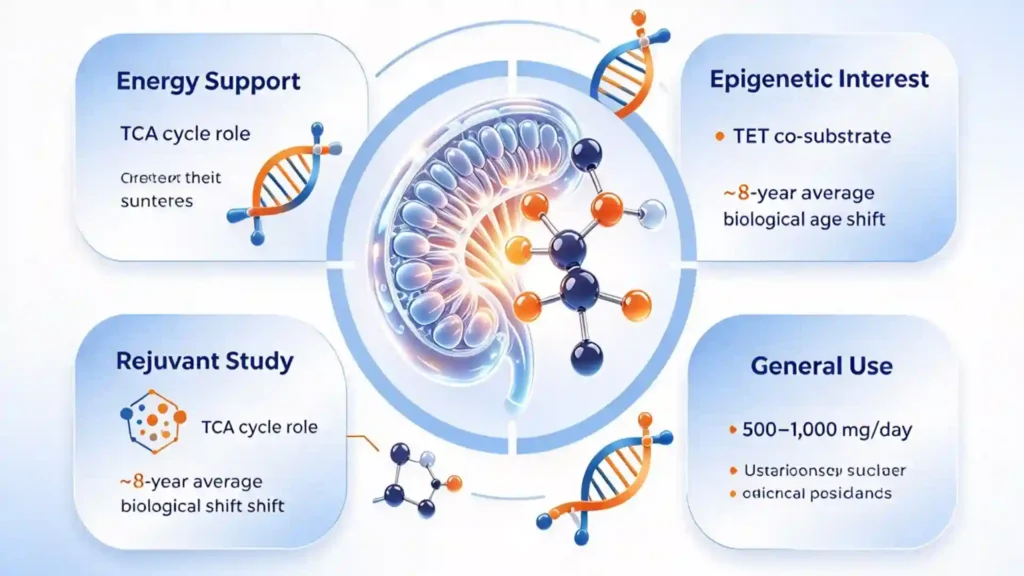
Published in Aging, this open‑label human trial (Edgar, 2020; PMID: 33376687) enrolled 42 healthy adults (mean age 47 years) who received a Ca‑AKG‑containing compound formulation (Rejuvant) daily for 12 months. Biological age was assessed with the TruAge® methylation clock.
- Mean biological‑age reduction of approximately 8 years (p < 0.001).
- Good 12‑month adherence; no serious adverse events reported.
- Largest effect magnitude observed in participants aged 40‑55 years.
⚠️ Limitations: Small sample size, non‑double‑blind design, and multi‑ingredient intervention restrict causal attribution solely to Ca‑AKG.
3.2 Animal Studies: Comprehensive Improvement of Aging‑Related Phenotypes
Work by Ryu et al. (Cell Metabolism, 2020) showed that middle‑aged mice supplemented with AKG exhibited:
- Median lifespan extended by 8‑12 %; significantly reduced frailty index in female animals.
- Improvements in bone mineral density, muscle strength, and hair condition.
- Reduced levels of pro‑inflammatory cytokines IL‑6 and TNF‑α.
3.3 Bone Health
The calcium moiety of Ca‑AKG provides building blocks for bone‑matrix mineralization. Meanwhile, AKG serves as a co‑factor for prolyl hydroxylases involved in collagen synthesis. The two components act synergistically, supporting theoretical value for osteoporosis prevention. Multiple studies support its adjuvant use in post‑menopausal women.
3.4 Exercise Performance and Muscle Recovery
As a central node of nitrogen metabolism, AKG can:
- Attenuate post‑exercise blood‑ammonia accumulation to delay central fatigue.
- Promote the utilization of branched‑chain amino acids (BCAAs).
- Support myoprotein synthesis via mTOR‑pathway modulation.
AKG salts (especially arginine‑AKG and AAKG) are widely used in sports‑nutrition supplements in clinical nutrition practice.
3.5 Clinical Nutrition and Post‑Surgical Recovery
Within Europe, AKG is available as a prescription parenteral‑nutrition component for:
- Nitrogen‑balance preservation following major surgery.
- Adjuvant support for chronic kidney disease (CKD) patients on low‑protein diets (as a keto‑acid analog).
- Repair following severe burns and trauma.
IV. Dosage, Formulations and Bioavailability
4.1 Effective Dosage Ranges
| Purpose | Recommended Dosage | Notes |
| General anti‑aging / healthspan support | 500‑1000 mg/day | Administered in 1‑2 divided doses |
| Dose used in the Rejuvant study | Approx. 1000 mg/day Ca‑AKG | Compound formulation with additional ingredients |
| Exercise performance | 1500‑3000 mg/day | 30‑60 minutes prior to training |
| Clinical nutritional support | Up to 5‑10 g/day per medical instruction | Requires medical supervision |
4.2 Timing of Administration and Absorption
- Co‑administration with meals minimizes gastrointestinal discomfort and enhances calcium absorption.
- Split morning‑and‑evening dosing better aligns with endogenous AKG circadian rhythms.
- Avoid concurrent high‑dose iron, zinc, or magnesium intake (calcium competes for absorption).
- Co‑supplementation with vitamin D₃ and K₂ amplifies bone‑health benefits.
4.3 Formulation Comparison
- Immediate‑release tablets/powder: Rapid absorption, ideal for pre‑exercise use.
- Sustained-release capsules: Stabilized plasma concentrations, suited for long-term anti-aging use.
- Enteric‑coated capsules: Preferred for subjects with low gastric tolerance.
V. Safety and Adverse Effects
Ca‑AKG is well‑tolerated within recommended dosage ranges; most clinical studies report no serious adverse events. Important considerations include:
- Gastrointestinal reactions: Doses exceeding 3 g/day may induce bloating and diarrhea.
- Hypercalcemia risk: Use with caution in patients with renal insufficiency or hyperparathyroidism.
- Drug interactions:
- Thiazide diuretics: May raise serum calcium concentrations when combined.
- Tetracycline and quinolone antibiotics: Ca‑AKG reduces antibiotic absorption; separate administration by ≥2 hours.
- Patients taking anticoagulants (warfarin): Monitor INR levels.
- Contraindicated populations: Pregnant or lactating women, children, and dialysis‑dependent patients should seek medical advice prior to use.
The no‑observed‑adverse‑effect level (NOAEL) from animal studies exceeds 2 g/kg/day, indicating a wide human safety margin.
VI. Selecting High‑Quality Ca‑AKG Products
When purchasing products, verify the following six criteria:
- Raw‑material source: Prefer microbial fermentation over chemical synthesis for lower impurity profiles.
- Purity certification: HPLC analytical reports confirming ≥98 % purity.
- Heavy‑metal testing: Lead, arsenic, mercury, and cadmium must comply with USP <232> or EU standards.
- Calcium labeling: Explicitly report elemental calcium content rather than total Ca‑AKG mass.
- Third‑party certifications: NSF, GMP, and Informed‑Sport (for athletes).
- Formulation and excipients: Avoid excessive magnesium stearate and artificial colorants.
VII. Frequently Asked Questions (FAQ)
Q1: What is the difference between Ca‑AKG and NMN / NAD⁺ precursors?
NMN primarily elevates cellular NAD⁺ levels and acts through sirtuin pathways. Ca‑AKG functions as both a TCA‑cycle substrate and an epigenetic modulator. Their mechanisms are complementary. Co‑supplementation is feasible, yet high‑dose stacking is discouraged.
Q2: How long does it take to observe effects?
The Rejuvant study identified a 6‑12‑month window for measurable shifts in biological age. Subjective improvements in energy and recovery may manifest within 4‑8 weeks.
Q3: Can Ca‑AKG replace calcium supplements?
Ca‑AKG contains 18‑22 % elemental calcium by weight. One gram of Ca‑AKG delivers only approximately 200 mg elemental calcium, insufficient to meet full adult calcium requirements (RDA 1000‑1200 mg/day).
Q4: Is Ca‑AKG suitable for vegans and vegetarians?
Yes. The dominant microbial‑fermentation production process yields non‑animal‑derived Ca‑AKG and is vegan‑friendly.
Q5: Is concurrent use with metformin or rapamycin safe?
No direct pharmacological interactions are known in theory. Nevertheless, while AKG plus rapamycin produces synergistic anti‑aging outcomes in mouse models, human evidence remains limited. Always consult a physician if taking prescription medications.
Q6: At what age should one start taking Ca‑AKG?
Given the age‑related decline in plasma AKG concentrations, 35‑40 years of age represents a reasonable starting point. Individuals with a family history of aging‑associated diseases may consider earlier initiation.
VIII. Conclusion
Calcium alpha‑ketoglutarate (Ca‑AKG) is not merely a marketing construct; it is a metabolic supplement supported by defined molecular mechanisms, pre‑clinical animal data, and preliminary human‑trial evidence. Its core merits include:
- Replenishment of a TCA‑cycle intermediate depleted with advancing age.
- Modulation of DNA and histone methylation via TET / JmjC enzymes, with potential to reset the epigenetic clock.
- Multi‑faceted benefits covering energy metabolism, nitrogen homeostasis, bone health and antioxidant defense.
- A broad safety margin and favorable long‑term tolerability.
Nevertheless, Ca‑AKG is not a “youth‑restoring pill”. Its effects accumulate gradually over long‑term intake. It should be integrated alongside regular physical activity, quality sleep, and a balanced diet to achieve a complete strategy for extending healthspan.
Additional Support Services
You can contact us for the following resources and services:

Obtain detailed raw material specifications and COA templates

Apply for samples

Consult regulatory compliance and formula technical support

Request an abstract of the latest market research reports
Contact Us:
Phone:+86 15817492830
Wechat:15817492830
E-mail:info@jayoobio.com 、 sales@jayoobio.com
References
- Edgar D. (2020). Retrospective Clinical Study on the Effects of Calcium Alpha‑Ketoglutarate on Human Biological Age. Aging, 12(24). PMID: 33376687
- Ryu D, et al. (2020). A NAD⁺ World in Aging. Cell Metabolism.
- Asadi Shahmirzadi A, et al. (2020). Alpha‑Ketoglutarate, an Endogenous Metabolite, Extends Lifespan and Compresses Frailty in Aging Mice. Cell Metabolism, 32(3).
- Chin RM, et al. (2014). The metabolite dimethylglycine extends lifespan. Nature.