
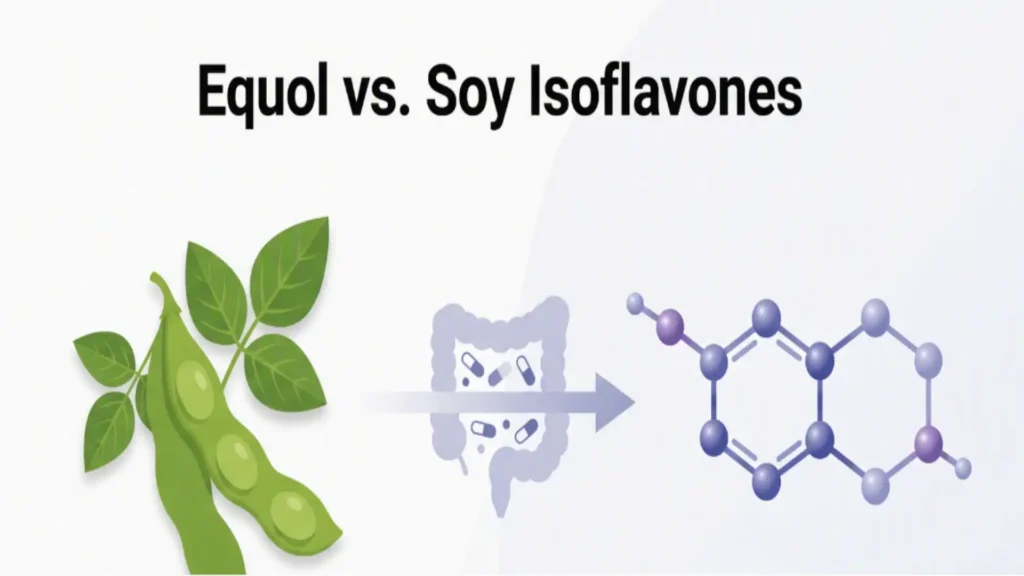
I. The Relationship First: Precursor and Final Metabolite
Soy isoflavones are a family of compounds naturally present in soybeans. The three main aglycones are genistein (CAS 446-72-0), daidzein (CAS 486-66-8), and glycitein. In soybeans and ordinary extracts, they occur mostly as glycosides, which intestinal enzymes must first hydrolyze after oral intake to release the aglycones.
Equol (CAS 531-95-3, molecular formula C15H14O3, molecular weight 242.27) is not simply another soy isoflavone. It is the end-product metabolite formed when specific gut bacteria, such as Adlercreutzia equolifaciens and Slackia equolifaciens, reduce daidzein in several enzymatic steps. Along the way, the core ring system changes from an isoflavone to an isoflavan and gains a chiral center. Human gut flora produce only the S-configuration, so in the context of human metabolism, “equol” normally refers to S-equol.
In one sentence: daidzein is the feedstock, equol is the finished product the human body makes from it, and the two no longer belong to the same chemical class.
II. Why This Difference Between Equol and Soy IsoflavonesMatters for B2B Buyers
2.1 Response variability: soy isoflavone outcomes depend on the consumer
Studies report that only about 50-60% of Asian adults and about 20-30% of Western adults carry the gut microbiota needed to convert daidzein into equol effectively (figures vary with population, diet, and assay methods). The real-world effect of a soy isoflavone product therefore depends heavily on the individual consumer’s microbiome, and the same formula can perform very differently across user groups. Supplementing S-equol directly bypasses this uncontrollable variable: the dose-to-exposure relationship is clear, and the product story is much easier to communicate.
2.2 Receptor potency and selectivity: the metabolite is stronger than its precursor
The published literature reports that S-equol binds estrogen receptor beta (ERbeta) with roughly 13-fold higher affinity than ERalpha, making it the strongest estrogen receptor ligand among soy isoflavone-related metabolites. Its precursor daidzein, by contrast, binds estrogen receptors only weakly. High ERbeta selectivity also gives related products clearer mechanistic positioning.
2.3 Pharmacokinetics: a terminal metabolite is more stable
Equol sits at the end of the metabolic pathway: it is essentially not metabolized any further, and a high proportion circulates in the free form. The reported elimination half-life is about 7-8 hours, and apparent clearance (about 8.7 L/h) is markedly lower than that of daidzein (about 30 L/h), providing steadier, longer-lasting systemic exposure.
2.4 Clearer dosing
Clinical studies of S-equol commonly use 10-30 mg per day. Soy isoflavone products typically require tens of milligrams of aglycone equivalents, and their effect depends on the consumer’s producer status. For formulation and label design, this makes dose communication much simpler.
2.5 A different regulatory and claims landscape
In 2012, EFSA rejected the health claim applications for soy isoflavones on “reduction of vasomotor symptoms associated with menopause” and “maintenance of bone mineral density”, finding the evidence insufficient to establish cause and effect. Whichever ingredient you choose, health claims in the EU market remain tightly restricted; the US market operates under the structure/function claim rules for dietary supplements, where disease claims are not allowed. For S-equol, some raw materials have obtained US GRAS status, but claims for newer ingredients likewise deserve careful review.
2.6 A different supply and cost structure
Soy isoflavones are a mature commodity ingredient: many suppliers, low prices, and heavy commoditization. S-equol suppliers are fewer, and prices are higher, but the payoff is differentiation and a technical barrier to entry, which suits premium product lines.
III. Side-by-Side Comparison
| Dimension | Soy Isoflavones | S-Equol |
| Chemical class | Isoflavones (aglycones and glycosides) | Isoflavan (chiral; S-configuration in humans) |
| Representative CAS | Daidzein 486-66-8; genistein 446-72-0 | 531-95-3 (racemate: 94105-90-5) |
| Molecular weight | Daidzein 254.24 | 242.27 |
| Source | Extracts of soy germ or soybean meal | Fermentation, or chemical synthesis plus chiral resolution |
| Prerequisite for activity | Depends on individual gut microbiota conversion | No conversion needed, direct supplementation |
| Receptor profile | Weak ER binding, no pronounced selectivity | About 13-fold higher affinity for ERbeta than ERalpha (as reported) |
| Pharmacokinetics | Further metabolized, faster clearance | Terminal metabolite, half-life approx. 7-8 h, slow clearance |
| Typical dose | Tens of mg (aglycone equivalent), effect depends on producer status | 10-30 mg/day, clear dose-exposure relationship |
| Supply and cost | Mature commodity, low price, highly commoditized | Fewer suppliers, higher price, differentiated positioning |
| Regulatory note | EFSA rejected hot flash and bone density claims | Some materials hold GRAS status; health claims still need caution |
Table 1. Key parameters of equol vs. soy isoflavones
IV. Sourcing Specification Essentials
1. Stereochemical identity is the first specification. Chemical synthesis by default yields racemic equol (CAS 94105-90-5), and only the S-enantiomer matches the metabolite found in the human body. A standard “99% by HPLC” assay cannot distinguish a racemate from S-equol. Always request the chiral HPLC chromatogram and the ee (enantiomeric excess) value.
2. Verify the CAS number. S-equol is 531-95-3. If a specification sheet lists “equol” with CAS 94105-90-5, the material is the racemate. It usually costs less, but it is a different biological proposition and should not be purchased at S-equol pricing.
3. COA checklist: assay (HPLC), ee value with chiral chromatogram, residual solvents, heavy metals, and microbiology; add third-party retesting when warranted.
4. Know the production route. Fermentation (which naturally yields the S-configuration) and chemical synthesis with chiral resolution differ in cost, impurity profile, and regulatory communication. Choose according to your target markets and product positioning.
V. Frequently Asked Questions
Q1: Is equol a type of soy isoflavone?
No. Soy isoflavones have an isoflavone core (an unsaturated, carbonyl-bearing structure), while equol has an isoflavan core (reduced, with a chiral center). The two stand in a precursor-to-final-metabolite relationship and differ in receptor binding and metabolism.
Q2: What does the “S” in S-equol mean? Does it stand for “synthetic”?
The S refers to the chiral (stereochemical) configuration and has nothing to do with synthetic origin. Human gut bacteria produce only the S-configuration, while chemical synthesis without chiral resolution yields a racemate. Telling them apart requires chiral HPLC testing.
Q3: Can the two ingredients be used together?
Yes. A “soy isoflavones plus equol” combination is an established formulation concept: the former supplies the dietary precursor, and the latter covers non-producers. Specific formulas and claims must be evaluated against the regulations of each target market.
Q4: What can we claim in the EU market?
EFSA rejected the soy isoflavone health claims for “reduction of menopausal vasomotor symptoms” and “maintenance of bone mineral density” in 2012, and no related authorized claims exist for either ingredient in the EU. We recommend limiting statements to ingredient and process descriptions, or seeking case-by-case assessment under member-state rules.
VI. About Us
Jayoo Biotech supplies high-purity S-equol and SR-equol raw material with chiral HPLC identity verification and ee-value documentation. Full COAs and third-party test reports are available. For specifications, samples, or business inquiries, please contact sales@jayoobio.com
VII. Appendix: Fact-Check List
| # | Key statement in the article | Verification result | Main sources |
| 1 | S-equol CAS 531-95-3 | Confirmed; consistent across major reagent catalogs | Sigma-Aldrich (SML2147), ChemicalBook, CATO |
| 2 | Racemic equol CAS 94105-90-5 | Confirmed | Nutrabiotechchem and other supplier catalogs |
| 3 | R-enantiomer CAS 221054-79-1 (not used in the article, kept for reference) | Confirmed | Molaid chemistry database |
| 4 | Producer prevalence: approx. 50-60% in Asian, 20-30% in Western populations | Confirmed; figures vary across studies by population and method, wording uses “about” | Review (PMC11229234: approx. 60% Asian, 30% Western) and other literature |
| 5 | S-equol affinity for ERbeta is about 13-fold higher than for ERalpha | Confirmed | Muthyala et al. 2004 (J. Med. Chem., PubMed 15018930), cited in a 2024 review |
| 6 | Highest ER affinity among soy isoflavone-related metabolites | Confirmed | 2024 review (PMC11229234) |
| 7 | Half-life approx. 7-8 h; clearance approx. 8.7 vs 30 L/h | Literature values from a single source; wording uses “about”. For stronger support, cite Setchell 2005 additionally | S-equol pharmacokinetic studies (cited in an industry review) |
| 8 | Common clinical dose 10-30 mg/day | Confirmed | SE5-OH clinical studies (10/30 mg); Ausio synthetic S-equol phase I (10-160 mg twice daily) |
| 9 | EFSA rejected the soy isoflavone claims on hot flashes and bone density in 2012 | Confirmed (Article 13(1) further assessment opinion) | EFSA NDA Panel scientific opinion (2012) |
| 10 | Human gut flora produce only the S-configuration | Consensus in the literature | Setchell et al., series of studies |
| 11 | Daidzein CAS 486-66-8, genistein CAS 446-72-0; daidzein MW 254.24 | Confirmed | Established chemical data |
| 12 | Equol molecular formula C15H14O3, MW 242.27 | Confirmed | Established chemical data |
| 13 | Some S-equol raw materials hold US GRAS status | Conservative wording; verify the specific GRAS notice number before citing | Industry review (GRAS held by the SE5-OH stakeholder) |