
A Technical Review of Tetrasodium Glutamate Diacetate (GLDA) (CAS 51981-21-6)
I. Introduction: The Chelating-Agent Industry’s Green Turn
In nearly every industry that works with aqueous formulations (detergents, personal care, water treatment, pulp, paper and textiles) chelating agents are the invisible yet indispensable supporting players. They capture multivalent metal ions in water such as calcium, magnesium, iron, copper and manganese, preventing scale deposition, catalyst deactivation, futile decomposition of bleaching agents, and product discoloration.
Yet the long-dominant workhorses, EDTA (ethylenediaminetetraacetic acid) and NTA (nitrilotriacetic acid), are facing tightening regulatory pressure. EDTA barely degrades in the natural environment (less than 20% biodegradation in 28 days), accumulates persistently in water bodies, and can remobilize heavy metals from riverbed sediments into the food chain; NTA is classified as a suspected carcinogen (Category 2). Driven by EU REACH, the EU Ecolabel and phosphate restrictions worldwide, the whole industry is searching for alternatives [4][5].
Tetrasodium glutamate diacetate (GLDA, CAS 51981-21-6) is the star molecule that has risen to prominence in this context. Synthesized from natural L-glutamic acid, the main component of monosodium glutamate (MSG), it combines rapid biodegradability, phosphorus-free chemistry and high-performance chelation, and is widely regarded as the “green successor” to EDTA and NTA.
II. Molecular Identity: A Chelator from the MSG Family
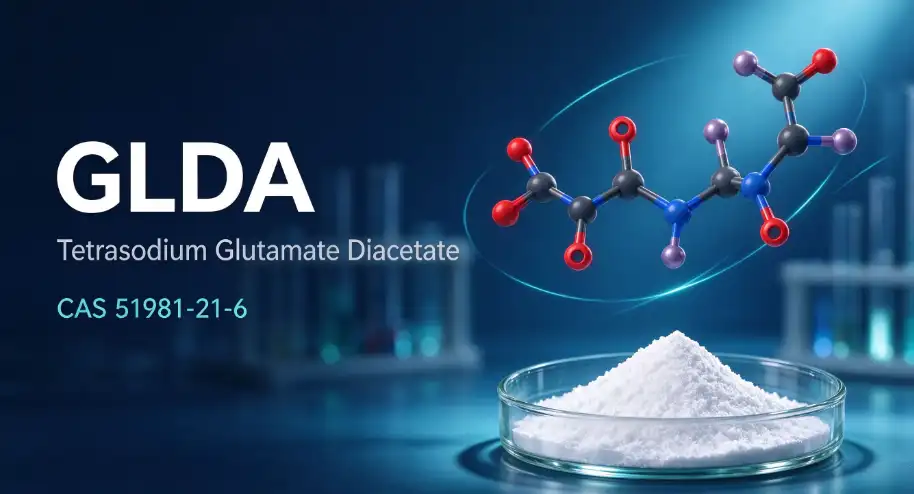
GLDA belongs to the aminopolycarboxylate family. It is made by carboxymethylating L-glutamic acid and then fully neutralizing with sodium hydroxide. Its chemical name is tetrasodium N,N-bis(carboxymethyl)-L-glutamate; molecular formula C₉H₉NO₈Na₄, molecular weight 351.13 g/mol, EC No. 257-573-7.
Its molecular backbone comes directly from L-glutamic acid, a natural amino acid. This means about 56% of GLDA‘s carbon originates from renewable bio-based feedstock, rather than the purely petrochemical route behind EDTA. That is not just a marketing story, it largely determines GLDA’s environmental fate (see below).
Common commercial synonyms: GLDA, GLDA-Na₄, GLDA-4Na.
III. Hard Performance Numbers: A Green Performer That Matches EDTA
When choosing a chelating agent, performance is the final judge. GLDA can replace EDTA not merely because it is “green”, but because beneath the green label it is a first-rate technical performer.
3.1 Chelation capacity: 18% higher than EDTA
Chelation capacity is expressed as milligrams of calcium ions bound per gram of active matter. GLDA delivers about 186 mg Ca²⁺/g, roughly 18% higher than EDTA’s 158 mg Ca²⁺/g, and also above MGDA (about 165) and NTA (about 160) [2]. At equal formulation performance, less GLDA is needed, partially offsetting its unit-price premium.
3.2 Broad pH adaptability: still working in strong acid
EDTA free acid has low solubility under low-pH conditions and precipitates readily, whereas tetrasodium GLDA is highly water-soluble and retains good solubility and chelation performance across a wide pH range. Its typical working window is roughly pH 2–12: under strongly acidic conditions its solubility is generally superior to EDTA free acid, although its chelating capacity does decline below about pH 3. GLDA can therefore be used for acidic cleaning, metal descaling, and metal-ion control in oilfield systems.
3.3 Thermal stability: rock-solid at 170°C
Thermogravimetric analysis shows GLDA keeps its structure and chelation capacity intact at 170°C [7], whereas EDTA begins thermal decomposition above 150°C and NTA tolerates even less (about 130°C). This makes GLDA suitable for high-temperature industrial boilers, geothermal systems and deep high-temperature oilfield operations.
3.4 Comparison with other mainstream chelating agents
| Parameter | GLDA (tetrasodium) | EDTA (tetrasodium) | NTA (trisodium) | MGDA (trisodium) | EDDS (trisodium) |
| CAS No. | 51981-21-6 | 64-02-8 | 5064-31-3 | 164462-16-2 | 178949-82-1 |
| Carbon source | Bio-based (glutamic acid) | Petrochemical | Petrochemical | Bio-based / synthetic | Bio-based (aspartic acid) |
| 28-day biodegradation (OECD 301D) | >60–80% (readily) | <20% (not readily) | >60% (ecotoxicity concerns) | >60–80% (readily) | >60% (readily) |
| Ca-chelation capacity (mg Ca²⁺/g) | 186 | 158 | 160 | 165 | 102 |
| Thermal stability | Stable at 170°C | Degrades >150°C | Degrades >130°C | Stable ~150°C | Stable ~150°C |
| Solubility in acid (pH 1–2) | >25 wt% | Very poor (<0.1 wt%) | Low | Moderate | Good (>10 wt%) |
| Regulatory status | EU Ecolabel / COSMOS accepted | Restricted / REACH watch list | Suspected carcinogen (Cat. 2) | EU Ecolabel compliant | EU Ecolabel allowed |
IV. Why It Earns the “Green” Label
4.1 The chemical essence of rapid biodegradation
In OECD 301D closed-bottle tests, GLDA achieves more than 60% biodegradation in 28 days (most literature reports above 80%), meeting the “Ready Biodegradability” criterion [1][7]. The key lies in its amino-acid backbone: environmental microbes have long evolved the complete enzymatic machinery to recognize and metabolize the L-glutamate skeleton, so for them GLDA is a familiar nutrient that ultimately breaks down into non-toxic amino-acid residues, carbon dioxide and water.
An easily overlooked detail:GLDA’s rapid degradation depends strictly on L-glutamic-acid-based raw material. With the D-configuration or a racemic mixture, microbes can barely recognize the molecule and biodegradation drops sharply. Checking the supplier’s optical-purity specification during procurement is therefore worthwhile.
4.2 Regulations and eco-certifications
• The EU Ecolabel (detergents) and COSMOS/Ecocert (cosmetics) both accept GLDA;
• Phosphorus-free, compliant with detergent phosphate bans worldwide;
• Non-irritating and non-sensitizing to skin and eyes; CIR assessment considers it safe in both leave-on and rinse-off cosmetics [6];
• By contrast, EDTA is explicitly excluded from the EU Ecolabel detergent criteria and NTA is a suspected carcinogen; neither can pass eco-certification.
4.3 A bonus skill: preservative boosting
GLDA has another distinctive selling point, preservative boosting. The outer membrane of Gram-negative bacteria relies on Ca²⁺/Mg²⁺ ions bridging lipopolysaccharides (LPS) to maintain an intact barrier; by chelating these divalent cations, GLDA increases outer-membrane permeability so preservatives penetrate the cell more easily. In practice, GLDA can cut required preservative dosages by up to about 50%, and is particularly effective against Escherichia coli and Pseudomonas aeruginosa at pH 4–6 [1]. For a personal-care industry captivated by “preservative-free” and “low-preservative” claims, this is highly attractive.
V. Application Map: Which Industries Use GLDA
5.1 Homecare and industrial cleaning
This is currently GLDA’s largest application market. In automatic dishwashing detergents (ADW), it sequesters the calcium and magnesium ions of hard water, preventing calcium-carbonate spotting and white filming on glassware; in laundry liquids and hard-surface cleaners, it boosts surfactant efficiency, prevents fabric encrustation, and stabilizes sodium-percarbonate bleach systems. In many scenarios GLDA can directly replace EDTA at a 1:1 ratio.
5.2 Personal care and cosmetics
As a replacement for disodium/tetrasodium EDTA, GLDA is used in shampoos, facial cleansers, sunscreens, lotions and cleansing wipes, where it sequesters the iron and copper ions that catalyze oil rancidity, extends shelf life, and doubles as a preservative booster.
5.3 Water treatment and boiler systems
In recirculating cooling water and boiler feed systems, GLDA serves as a high-temperature scale inhibitor and dispersant, chelating copper, iron and manganese ions and preventing the heat-transfer losses and metal-catalyzed corrosion caused by scale layers.
5.4 Oilfield chemistry
In fracturing and matrix acidizing jobs, GLDA is an ideal iron-control agent: it prevents iron-hydroxide precipitation at high temperatures across the wide acidic-to-neutral pH window, offering a high-performance replacement for conventional HEDTA/EDTA.
5.5 Agriculture and soil remediation
GLDA complexes with micronutrients such as iron, zinc, manganese and copper to make water-soluble foliar fertilizers and hydroponic nutrient solutions; once taken up by crops in the soil it degrades naturally, unlike EDTA, which persists on farmland. In environmental engineering, GLDA is also used for contaminated-soil washing, extracting heavy metals such as cadmium, lead and copper without damaging soil structure.
5.6 Emerging applications: dust suppression and beyond
Recent research combines GLDA with surfactants for coal-dust suppression: GLDA dissolves the inorganic mineral crusts on coal particle surfaces, raises surface polarity, and lowers the water contact angle to about 18°, enabling rapid wetting and efficient dust control [8]. Paper bleaching and textile auxiliaries are gradually adopting it as well.
VI. A Buyer’s Perspective: Forms, Specifications and Supply Chain
6.1 Commercial forms
| Form | Typical specification | Best suited for |
| Liquid (mainstream) | 38% or 47% active matter; clear pale-yellow to amber aqueous solution; density ≥1.20 g/cm³; 1% solution pH 10–12 | Liquid detergents, personal care, water treatment; pump-and-dose friendly with no dissolving step |
| Powder / solid (niche) | ≥88% active matter; off-white spray-dried powder | Dry-blend laundry powders, solid fertilizers, long-haul shipping where freight savings matter |
The market mainstream is the tetrasodium aqueous solution (e.g., Dissolvine GL-38 / GL-47-S); the free-acid form is essentially not traded commercially. The liquid is alkaline (pH 10–12) and should be handled as an alkaline chemical: splash goggles plus nitrile or PVC gloves. Typical packaging: 25 kg drums, 250 kg plastic drums, 1,200 kg IBC totes and ISO tanks. Store at 5–40°C away from strong acids and oxidizers; shelf life in the original sealed package is typically 24 months.
6.2 Purchasing checklist
• Compare on active matter/chelation value: a 38% liquid and an 88% powder differ more than twofold per unit weight, so raw unit-price comparisons are meaningless;
• Watch residual NTA: premium technical-grade GLDA holds NTA-3Na ≤0.1% and free chloride ≤3.0%, the NTA figure affects labeling and customer acceptance;
• Demand the COA (chelation value, NTA, pH, color) and SDS from the actual manufacturer; beware of rebranding traders;
• Optical purity (L-configuration) affects biodegradation performance.
6.3 Global supply landscape
China is the largest growth pole for new production capacity, with outstanding export cost-performance. By regional demand, Asia-Pacific accounts for roughly 38%–40% of global consumption, Europe about 28% and North America about 22%. The global biodegradable chelating agents market is currently sized in the hundreds of millions to one billion US dollars (estimates vary considerably with scope), while the GLDA segment is growing clearly faster than the overall market (CAGR around 7.5%–11%) [9].
VII. A Sober View: GLDA’s Limitations and Competition
No raw material is perfect, and GLDA has its own weak spots:
• Pricier than EDTA: the unit price is still 1.5–2× or more above EDTA, so in commodity applications without eco-label pressure, winning share takes time;
• High alkalinity: the tetrasodium salt sits at pH 10–12, unsuitable for the few formulations that must stay neutral;
• MGDA competition: MGDA (trisodium methylglycine diacetate) is likewise a bio-based, readily biodegradable chelant, with slightly lower thermal tolerance (~150°C) but excellent formulation compatibility; it competes head-to-head with GLDA in applications such as dishwasher tablets, and formulators typically pick one based on performance and price;
Overall, GLDA (together with MGDA and EDDS) is steadily eroding the market share of EDTA, NTA, and phosphates. Because this substitution trend is regulation-driven rather than cost-driven, its direction is essentially irreversible.
VIII. Conclusion
GLDA’s story comes down to this: a molecule that starts from MSG feedstock, armed with a chelation capacity 18% above EDTA’s, thermal stability at 170°C, a broad working pH window of roughly 2–13, and 60%–80% biodegradation within 28 days; it delivers a green replacement of legacy chelants without sacrificing performance. For formulators, it is a shortcut to eco-certification and simplified compliance review; for buyers, the essentials are comparing on active matter, controlling NTA impurity, and picking the right liquid or powder form; for the industry at large, it marks fine chemicals’ shift from “performance first” to the dual standard of “performance + sustainability”.
If you are evaluating alternatives to EDTA, GLDA deserves the top spot on the shortlist; validate formulation compatibility and stability with lab samples first, then discuss suppliers and prices. That is the safest path.
References
[1] NOURYON. Dissolvine® GL-38: Technical Data Sheet[Z]. Amsterdam: Nouryon, [s.a.]. (Low-pH solubility >25% w/w, chelation value and preservative-boosting data are taken from this product datasheet.)
[2] JINING YUANLIAN CHEMICAL TECHNOLOGY CO., LTD. Tetrasodium glutamate diacetate (GLDA-Na₄) technical guide[EB/OL]. (2026-07-31)[2026-10-22]. https://www.yuanlianchem.com/blog/514.html. (The original source of claims such as “pH 1.0–14.0” and “35 wt% at pH 1.0”; a distributor technical article rather than a manufacturer datasheet.)
[3] ChemSec. Dissolvine GL technical brochure[Z/OL]. [2023-03]. https://marketplace.chemsec.org/api/file/attachment/1040.
[4] EUROPEAN COMMISSION. Commission Decision (EU) 2017/1218 of 23 June 2017 establishing the ecological criteria for the award of the EU Ecolabel for laundry and dishwasher detergents[J]. Official Journal of the European Union, L 178, 2017. (This criteria set excludes EDTA and its salts, and NTA.)
[5] EUROPEAN COMMISSION. Proposal for a Commission Decision establishing the ecological criteria for the award of the EU Ecolabel for laundry detergents, automatic dishwasher detergents and hard-surface cleaning products[R/OL]. Brussels, 2026-09. (The revised draft maintains the exclusion of EDTA and NTA.)
[6] BERKSOY E, BRESDORF K, CHWALEK M, et al. Safety assessment of EDTA, calcium disodium EDTA, and calcium trisodium EDTA as used in cosmetics[J]. International Journal of Toxicology, 2019, 38(1_suppl): 5S-38S. (The CIR re-evaluation of EDTA salts; for GLDA’s cosmetic usability see also the CosIng database and COSMOS standards lists.)
[7] HARTMANS P, DE HAAN L, NOVOTAN L, et al. Biodegradability, ecotoxicity and eco-efficiency of new alternative chelants in detergents[J]. Tenside Surfactants Detergents, 2014, 51(1): 24-32.
[8] NOWACK B, KOZLOWSKI M J. Extraction of heavy metals from soils with the biodegradable chelating agents EDDS and GLDA[J]. Journal of Plant Nutrition and Soil Science, 2001, 164(1): 67-72.
[9] GRAND RESEARCH INSIGHTS. Chelating Agents Market Report 2025-2035[R/OL]. Pune: Grand Research Insights, 2025.
[10] MURUGAN S E. Glutamic acid diacetic acid chelates for coal dust suppression[J]. Journal of Cleaner Production, 2020, 256: 120378.