
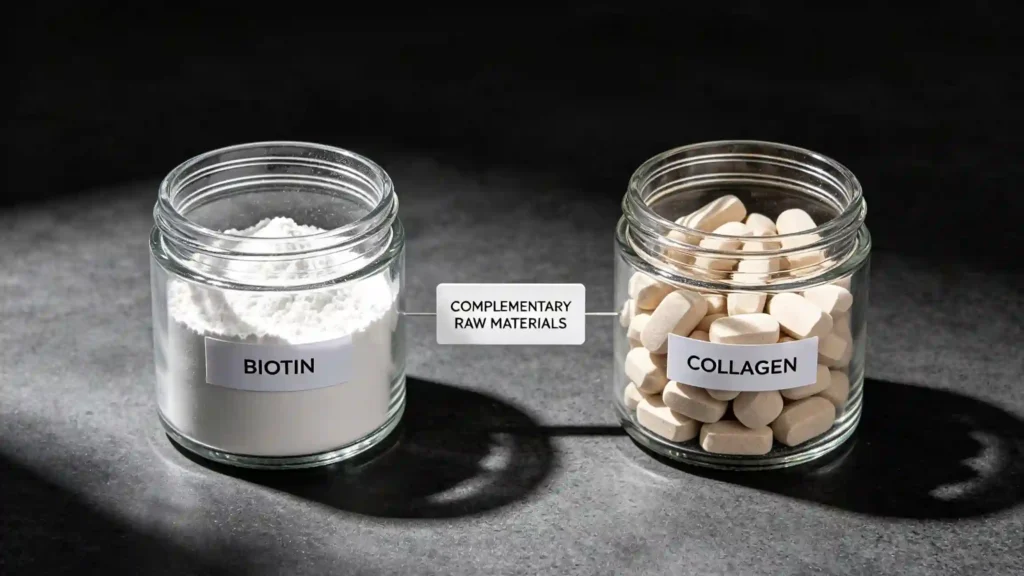
I. Core Conclusions in Advance
Biotin vs Collagen
- Biotin is a high-purity, chemically synthesized vitamin raw material with low cost, full standardization, and excellent compatibility with compounds.
- Collagen is an animal-derived active protein raw material with high added value, process sensitivity, and abundant differentiation potential.
The two are not substitutes for one another. Instead, they serve as core complementary raw materials for enterprises to deploy product lines covering both low-end and high-end markets.
II. Fundamental Properties of Raw Materials: Essential Manufacturing Differences (Underlying Logic)
The inherent characteristics of raw materials determine the entire production process, which is the fundamental driver of manufacturing disparities and the primary reference for enterprises when selecting raw materials for new projects.
1. Biotin (Vitamin B7): Small-molecule Functional Coenzyme Raw Material
It is a water-soluble vitamin produced solely by chemical synthesis, with no animal-derived ingredients, and has a stable molecular structure. Functionally, it acts as a coenzyme that facilitates keratin synthesis in the human body, thereby classifying it as a functional additive.
It cannot form human tissues independently and only participates in metabolic catalysis. With a single raw material form and highly targeted efficacy, it is an essential basic raw material for oral hair and nail care products.
2. Collagen (Collagen Peptides): Macromolecular Structural Active Protein Raw Material
It is a structural protein extracted from animal sources (mainly fish skin, bovine bone, and pig skin) and is rich in functional amino acids, including glycine and proline. It directly supports the structure of the skin, fascia, and hair follicle base tissues, serving as the core functional ingredient in finished products.
Collagen covers multiple subcategories (Type I, Type III, small-molecule peptides, etc.). Its activity and absorption rate vary widely depending on the production process, resulting in greater added value than that of biotin.
III. Comprehensive Comparison of Core Manufacturing Dimensions (Key Reference for Enterprises)
1. Production Processes & Manufacturing Barriers
Biotin: Mature processes, low technical barriers, and high standardization
Chemical synthesis dominates mainstream production, with a small number of premium variants adopting microbial fermentation. Global synthesis processes show little divergence.
The workflow is streamlined: synthesis & purification → crystallization & drying → crushing & sieving → packaging. No complex extraction or enzymolysis procedures are required. Production lines are universally compatible without the need for customized equipment.
Although large-scale manufacturers have cost advantages in raw material production, downstream OEM manufacturing has a low technical threshold and maintains a yield rate above 98%.
Collagen: Complex processes, high barriers, and strong differentiation potential
The full production workflow includes pretreatment of animal raw materials → degreasing & deodorization → high-temperature extraction → enzymatic hydrolysis & molecular shearing → filtration & purification → spray drying.
Stringent control of temperature, pH, enzymatic hydrolysis duration, and sterility is required throughout production. Extraction parameters differ greatly between fish-derived and bovine collagen.
High-end small-molecule peptides require precision enzymolysis equipment and a substantial upfront investment in production lines. The ability to control manufacturing processes directly determines the premium capacity of finished collagen products.
2. Cost Structure & Pricing System
Biotin: Low-cost, low-margin raw material for high-volume sales
Biotin boasts low raw material unit prices and a microgram-level addition per serving in finished goods. Its cost mainly covers synthesis, purification, and packaging, with no additional expenses for raw material losses or traceability management. Transparent market pricing makes it an ideal compound auxiliary ingredient.
Collagen: High-cost, high-margin raw material with premium potential
Major cost drivers include procurement of animal raw materials, losses from enzymolysis, sterile workshop operation, and deodorization & purification. The cost gap between ordinary collagen and small-molecule peptide variants is multiple times.
High-end fish collagen peptides carry far higher raw material costs than biotin, while finished collagen products offer substantial premium space. They act as core materials for enterprises to launch high-priced premium oral beauty supplements.
3. Quality Control Difficulty & Compliance Risks
Biotin: Simple quality control with minimal compliance risks
As a chemically synthesized single-component material, biotin features stable physical and chemical properties, resistance to deterioration, and odorlessness. Heavy metal residues are easy to control and have a long shelf life.
Its testing standards are straightforward, limited to purity and content detection. Mature compliance standards for health supplements are adopted worldwide. No animal traceability or microbial control procedures are needed, with nearly zero batch-to-batch variation.
Collagen: Rigorous quality control with complicated compliance requirements
Animal-derived collagen carries inherent risks, including excessive microbial contamination, heavy metal residues, residual fishy odor, and protein denaturation, which can lead to obvious batch differences.
Enterprises must implement full-process traceability for raw materials, standardized degreasing & deodorization, and sterile production, while complying with animal-product quarantine regulations.
Countries and regions enforce disparate compliance standards for collagen sources, raising export quality control thresholds and overall QC costs significantly compared to biotin.
4. Product Formulation & Form Compatibility
Biotin: Compatible with nearly all mainstream dosage forms, a universal compound additive
With stable properties and neutral taste & color, biotin can be incorporated into tablets, capsules, powders, gummies (requiring precise micro-blending processes), and oral liquids.
It is rarely sold as a standalone finished product and is mostly used as an efficacy booster combined with zinc, selenium, vitamins, or collagen. Targeting hair and nail care, it fits affordable mass-market staple products.
Collagen: Core main ingredient with dosage form limitations
Powders, oral liquids, and gummies are its primary product forms. Tablets, if developed, require low-temperature direct compression and strict temperature control during tableting to avoid high-temperature wet granulation, which damages collagen.
As the core functional ingredient, collagen is often formulated with elastin, hyaluronic acid, and vitamins for anti-aging, skin rejuvenation, and skin barrier repair, positioning it for mid- to high-end functional oral supplements.
5. Supply Chain & Inventory Pressure
Biotin: Stable supply chain with minimal inventory burden
Sufficient domestic large-scale production capacity eliminates long-term shortages or price hikes. Biotin raw materials are easy to store, mold-resistant, and long-lasting, allowing enterprises to purchase in bulk with low inventory turnover pressure.
Collagen: Volatile supply chain with strict inventory management rules
Raw material prices fluctuate with conditions in the aquatic and livestock markets. High-quality small-molecule collagen peptide capacity is concentrated among a few suppliers, leading to occasional supply shortages.
Finished collagen products require controlled-temperature, humidity-controlled storage; long-term storage degrades active ingredients, necessitating faster inventory turnover and more complex supply chain management for enterprises.
IV. Production Launch & Product Portfolio Strategies (Practical Core Content)
1. New Product Project Selection
- Mass-market affordable lines, entry-level health supplements, and staple hair & nail care products: Prioritize biotin as the core compound ingredient. Leverage its low cost, full compliance, and ease of production to launch cost-effective, traffic-driving SKUs that quickly capture mass consumer demand.
- Mid-to-high-end anti-aging oral beauty and refined wellness lines: Adopt small-molecule collagen peptides as the main ingredient. Create premium SKUs via differentiated production processes to elevate brand positioning and overall profit margins.
2. Premium Compound Formula: Mainstream Hit Product Logic
Manufacturing and efficacy logic confirm the two materials are highly complementary rather than competitive:
Collagen supplies structural raw materials to build the foundation of skin and hair follicles; biotin accelerates keratin synthesis to strengthen hair and nail toughness.
Enterprises can launch compound formulas of “biotin + collagen”. Low-cost biotin reinforces hair & nail care efficacy, while high-grade collagen elevates product value. Balancing cost performance and premium positioning, this combination dominates current oral beauty supplement bestsellers.
3. Production Line Resource Allocation
- Small factories and emerging brands: Prioritize biotin product lines for low upfront investment, low operational risks, and fast return on investment to quickly complete the oral beauty category layout.
- Large-scale manufacturers and proprietary brand enterprises: Focus on iterative optimization of collagen production processes to build proprietary technical barriers, while supporting biotin compound product lines to cover the full price range from entry-level to premium.
V. Industry Pain Points & Future Manufacturing Trends
1. Existing Industry Pain Points
- Biotin segment: Severe homogenization with no technical barriers, triggering cutthroat price wars and shrinking profit margins.
- Collagen segment: Widespread industry irregularities. Small manufacturers misrepresent ordinary macromolecular collagen as active small-molecule peptides. Substandard processes lead to weak efficacy and inconsistent brand reputation, alongside insufficient unified industry standards.
2. Future Manufacturing Trends
- Biotin: Shift from single-trace addition to precise multi-ingredient compound formulations. Enterprises will develop refined, customized formulas targeting segmented efficacy to escape low-price competition.
- Collagen: Process upgrading becomes the core competitive edge. Low-temperature directional enzymolysis, low-odor purification, and high-activity retention technologies will see continuous iteration. Full, transparent raw-material traceability and visual efficacy testing will become standard labels for premium collagen products.
- Compound formulations become mainstream: Standalone single-ingredient products will gradually lose market share. Dual-effect compound formulas that combine “tissue structure replenishment + metabolic enhancement” will drive new product iterations in the oral beauty sector.
VI. Conclusion: Core Decision-Making Guidelines for Enterprises
From a manufacturing perspective:
- Biotin is a low-cost, fast-to-launch, low-risk traffic-driving auxiliary raw material, ideal for enterprises launching entry-level lines, developing affordable traffic SKUs, and enriching overall product portfolios.
- Collagen is a high-value, high-barrier, high-premium core ingredient that generates main-ingredient profit, enabling brands to build differentiated technical advantages and boost overall profitability.
Biotin and collagen are not mutually exclusive alternatives. Instead, they form a dual portfolio of “mass-market traffic foundation + high-end profit engine” for enterprises operating in the oral beauty industry. Reasonable collocation of production lines, optimized formulas, and refined manufacturing processes are the core drivers for enterprises to capture market share.
Contact Us:
Phone:+86 15817492830
Wechat:15817492830
E-mail:info@jayoobio.com 、 sales@jayoobio.com