

Chelating agents are compounds that bind metal ions to form stable cyclic structures. They are widely used in industrial cleaning, water treatment, food, agriculture, cosmetics, pharmaceuticals, biochemistry and many other fields. When people first encounter the term “chelating agent”, many assume it refers to a single chemical additive. In fact, chelating agents represent a large family of functional compounds, including EDTA, citric acid, gluconic acid, EDDS, GLDA, organophosphonic acids and more.
This article systematically introduces the definition of chelating agents, how chelation occurs, categories of chelating agents, common examples, selection guidelines, and their safety and environmental impacts.
I. What Are Chelating Agents?
A chelating agent is a compound with two or more donor atoms that can form two or more coordinate bonds simultaneously with a single metal ion. When it binds metal ions, it forms coordination compounds with cyclic structures known as “chelates”.
The word “chelate” derives from the Greek word chele, meaning “crab claw”. This is a vivid metaphor: metal ions act like small spheres, while chelating agents resemble crab pincers that grip metal ions from multiple directions. This binding mechanism gives rise to the term chelation.
II. Core Characteristics of Chelating Agents
Chelating agents generally exhibit the following properties:
- Possess two or more donor atoms, such as nitrogen (N), oxygen (O), sulfur (S), phosphorus (P), etc.
- Capable of forming cyclic structures with a single metal ion.
- Resulting chelates are normally more stable than ordinary coordination complexes.
- Can modify the solubility, reactivity, color, redox behavior, or bioavailability of metal ions.
- Different chelators show distinct selectivity toward various metal ions.
Simply put, chelating agents are compounds that can “hold onto” metal ions and maintain them in stable forms within a system.
III. How Does Chelation Take Place?
Chelation is essentially a coordination reaction. Metal ions carry positive charges and have empty orbitals; donor atoms in chelating agents provide lone-pair electrons. Coordinate bonds form as donor atoms donate lone‑pair electrons to metal ions.
When a ligand binds to a metal ion via only one atom, it functions merely as a common complexing agent. A substance qualifies as a chelating agent when one ligand uses two or more donor atoms to bond simultaneously to the same metal ion and form a cyclic ring structure.
Five‑membered and six‑membered rings are the most prevalent chelate rings. More rings and better structural matching generally yield more stable chelates. This extra stability originating from cyclic architecture is called the chelate effect.
Chelation performance is affected by multiple factors:
- pH value
- Temperature
- Species and concentration of metal ions
- Competing ions
- Ionic strength
- Types of donor atoms in chelating agents
- Size and quantity of chelate rings
Accordingly, the binding capacity of a given chelating agent can vary significantly under different conditions and toward different metal targets.
IV. Types of Chelating Agents
No single standard classification exists for chelating agents. Common sorting approaches are based on chemical structure, application field or target metal ion. Classification by chemical structure is elaborated below.
1. Classification by Chemical Structure
Aminocarboxylic Acid Chelating Agents
Aminocarboxylic acids are the most widely used and classic chelator family. Representative substances include:
- EDTA: Ethylenediaminetetraacetic acid
- DTPA: Diethylenetriaminepentaacetic acid
- NTA: Nitrilotriacetic acid
- EGTA: Ethylene glycol‑bis(2‑aminoethylether)‑N,N,N′,N′‑tetraacetic acid
- EDDS: Ethylenediaminedisuccinic acid
- GLDA: Tetrasodium glutamate diacetate
- MGDA: Trisodium methylglycine diacetate
These chelators contain nitrogen atoms and carboxyl oxygen atoms, forming water‑soluble, stable chelates with diverse metal ions. EDTA is the best‑known example, widely used in industrial cleaning, cosmetics, food, agriculture, and water treatment. Because conventional EDTA is poorly biodegradable, eco‑friendly alternatives such as EDDS, GLDA, and MGDA are gaining adoption.
Hydroxycarboxylic Acid Chelating Agents
Typical hydroxycarboxylic acid chelators:
- Citric acid
- Gluconic acid
- Tartaric acid
- Malic acid
- Lactic acid
Their chelating strength is generally weaker than EDTA, yet they offer high safety and biodegradability, with applications in food, personal‑care formulations, cleaning products, and agriculture. Citric acid and gluconic acid are typical green chelators that bind calcium, magnesium, iron and other metal ions.
Organophosphonic Acid Chelating Agents
Common organophosphonic acid representatives:
- ATMP: Aminotrimethylene phosphonic acid
- HEDP: 1‑Hydroxyethylidene‑1,1‑diphosphonic acid
- EDTMP: Ethylenediamine tetra(methylene phosphonic acid)
- DTPMP: Diethylenetriamine penta(methylene phosphonic acid)
Organophosphonates deliver powerful chelating capacity with high temperature and alkali resistance. They are used in water treatment for scale inhibition, corrosion mitigation and industrial cleaning, effectively suppressing scale precipitation such as calcium carbonate and calcium sulfate.
Polycarboxylic Acid Chelating‑Dispersing Agents
Polycarboxylates encompass polyacrylic acid, polymaleic acid, acrylic‑maleic acid copolymers and others. They are generally high‑molecular‑weight chelate‑dispersants rather than small‑molecule chelators. Multiple carboxyl groups interact with metal ions while dispersing solid particles. Main deployment areas include water treatment, detergents and industrial circulating‑water systems.
Sulfur‑Containing Chelating Agents
Sulfur‑containing chelators:
- Dimercaprol
- Dimercaptosuccinic acid (DMSA)
- Sodium dimercaptopropanesulfonate (DMPS)
- Penicillamine
These agents exhibit strong affinity toward heavy metals including mercury, lead, arsenic and copper, primarily deployed for heavy‑metal detoxification in medical settings. Their selectivity largely follows the hard‑soft acid‑base theory, showing high affinity for soft metal ions.
Nitrogen‑Heterocyclic and Aromatic Chelating Agents
Typical examples:
- 8‑Hydroxyquinoline
- 1,10‑Phenanthroline
- Pyridine‑2,6‑dicarboxylic acid
- Dimethylglyoxime
They are vital within analytical chemistry for qualitative and quantitative metal‑ion determination, colorimetric assays and separation workflows.
Macrocyclic chelators cover crown ethers, cryptands, azacrown ethers, calixarenes and more. Their large cyclic frameworks provide the macrocyclic effect, selectively capturing specific metal ions or cations. Applications include ion recognition, separation science, sensors and supramolecular chemistry.
Natural and Green Chelating Agents
Natural and environment‑friendly chelators:
- EDDS
- GLDA
- MGDA
- Citric acid
- Gluconic acid
- Phytic acid
- Humic acid
- Amino‑acid‑based substances
This category emphasizes low toxicity and biodegradability as substitutes for poorly‑degradable traditional EDTA. Their utilization in detergents, agriculture, cosmetics and water treatment keeps expanding.
Medicinal‑Grade Chelating Agents
Medically important chelators for metal overload or heavy‑metal poisoning therapy:
- Deferoxamine
- Deferiprone
- Deferasirox
- Calcium disodium EDTA
- Dimercaptosuccinic acid
- Penicillamine
These pharmaceuticals must be administered under physician supervision, as chelation therapy may deplete essential mineral elements such as calcium, zinc and copper.
2. Classification by Application Field
- Food‑grade chelating agents: Calcium disodium EDTA, citric acid, gluconic acid, phosphates, etc.
- Water‑treatment chelating agents: HEDP, ATMP, EDDS, polycarboxylates, etc.
- Agricultural chelating agents: EDTA‑Fe, EDDHA‑Fe, EDDS, citric acid, etc.
- Pharmaceutical‑grade chelating agents: Deferoxamine, DMSA, penicillamine, etc.
- Cosmetic & personal‑care chelating agents: Disodium EDTA, citric acid, gluconic acid, etc.
- Industrial‑cleaning chelating agents: EDTA, EDDS, GLDA, MGDA, NTA, etc.
3. Classification by Target Metal Ion
- Iron chelators: EDDHA, EDDS, deferoxamine, deferasirox
- Calcium‑magnesium chelators: EDTA, citric acid, HEDP
- Copper chelators: Penicillamine, EDDS, EDTA
- Heavy‑metal chelators: DMSA, DMPS, dimercaprol (BAL)
- Radionuclide chelators: DTPA, etc.
V Representative Chelating Agents
| Chelating Agent | Main Category | Key Features | Typical Applications |
| EDTA | Aminocarboxylic acid | Strong chelating power, broad application scope, poor biodegradability | Cleaning, cosmetics, food, agriculture |
| EDDS | Green chelator | Biodegradable, structurally analogous to EDTA | Cleaning, agriculture, personal care |
| NTA | Aminocarboxylic acid | Cost‑effective, partial replacement for EDTA | Cleaning, water treatment |
| DTPA | Aminocarboxylic acid | Multidentate ligand, high chelating strength | Pharmacy, radionuclide handling, agriculture |
| GLDA | Green chelator | Good biodegradability, alkali‑resistant | Cleaning, personal‑care products, industry |
| MGDA | Green chelator | Biodegradable, strong chelating performance | Detergents, industrial cleaning |
| Citric acid | Hydroxycarboxylic acid | Food‑safe, mild, biodegradable | Food processing, cleaning, cosmetics |
| Gluconic acid | Hydroxycarboxylic acid | Mild, biodegradable | Food, cleaning, pharmacy |
| HEDP | Organophosphonic acid | High‑temperature‑resistant, scale & corrosion inhibition | Water treatment, industrial cleaning |
| ATMP | Organophosphonic acid | Scale‑inhibiting and dispersing properties | Water treatment |
| DMSA | Sulfur‑containing chelator | High affinity for heavy metals | Heavy‑metal detoxification |
| Penicillamine | Sulfur‑containing chelator | Targets copper and related metals | Medical treatment |
| EDDHA‑Fe | Iron chelator | Stable iron supply under alkaline soil conditions | Agriculture |
VI What Is the Difference Between Chelating Agents and Complexing Agents?
A complexing agent is a broader concept. Any substance that can form coordination compounds with metal ions qualifies as a complexing agent. A chelating agent specifically refers to a multidentate ligand that bonds to one metal ion via two or more donor atoms, forming a cyclic ring.
Key takeaways:
- All chelating agents are complexing agents.
- Not all complexing agents are chelating agents.
- Defining traits of chelators: multidentate coordination and cyclic ring formation.
- Chelates are normally more stable than ordinary coordination complexes.
For instance, ammonia forms complexes with copper ions but is not a chelator: it provides only one donor atom and cannot form chelate rings. By contrast, EDTA binds copper ions through multiple donor sites, forming stable chelate rings.
VII Major Applications of Chelating Agents
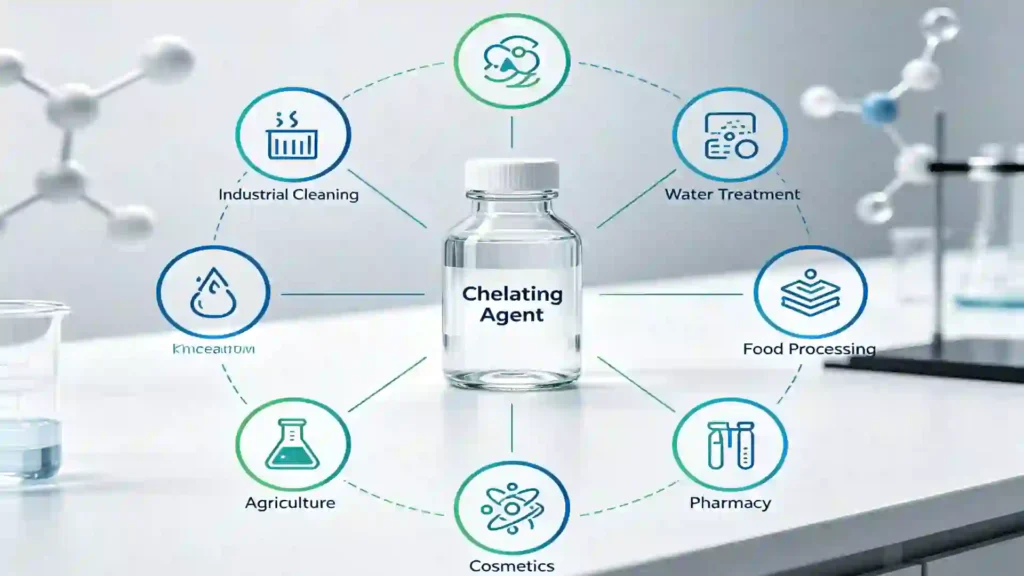
Chelating agents have extremely wide‑ranging end‑uses:
- Industrial cleaning: Removal of limescale, rust deposits and precipitated metal ions
- Water treatment: Scale inhibition, corrosion mitigation, dispersion of metal oxides
- Food industry: Suppress metal‑ion‑catalysed oxidation; stabilize color and flavor profiles
- Agriculture: Manufacture trace‑element fertilizers; improve bioavailability of iron, zinc, copper, manganese
- Cosmetics: Mitigate destabilizing effects triggered by metal ions in formulations
- Pharmacy: Treat iron overload and heavy‑metal poisoning
- Biochemistry: Sequester metal ions, suppress enzymatic activity; utilized in buffer solutions and laboratory reagents
- Electroplating & textile processing: Control metal‑ion concentration for improved process stability
- Paper‑making & photography: Regulate metal‑ion levels to prevent undesired side‑reactions
VIII How to Select a Suitable Chelating Agent?
Multiple dimensions must be weighed during selection:
- Target metal ion species
- pH of the working system
- Temperature and pressure conditions
- Required complex stability level
- Selectivity requirements
- Biodegradability requirements
- Compliance with food, pharmaceutical or cosmetic regulatory specifications
- Cost and supply reliability
- Compatibility with other formulation ingredients
- Human‑health and environmental impacts
Examples of practical choices: HEDP / ATMP organophosphonates for water‑treatment systems; citric acid, gluconic acid or calcium‑disodium‑EDTA for food applications; EDDHA‑Fe for agricultural iron supplementation; EDDS, GLDA or MGDA for eco‑friendly cleaning formulations.
IX Safety and Environmental Impacts of Chelating Agents
Chelators cannot be simply labeled as toxic or non‑toxic. Safety outcomes depend on compound identity, dosage, mode of utilization, exposure pathways and regulatory constraints.
Although widely used, conventional EDTA is poorly biodegradable and may accelerate heavy‑metal mobilization under certain conditions. Consequently, many industries are shifting toward green alternatives such as EDDS, GLDA, MGDA, citric acid, and gluconic acid.
Food and pharmaceutical applications impose strict usage limits and regulatory controls. Qualified clinicians must administer medical chelation therapy, since excessive chelation may leach essential minerals, including calcium, zinc, and copper.
X Frequently Asked Questions about Chelating Agents
Is a chelating agent equivalent to EDTA?
No. EDTA is merely one of the most classic and prevalent chelating substances. Additional examples include citric acid, gluconic acid, EDDS, GLDA, MGDA, HEDP, DTPA, DMSA and many others.
Are chelating agents poisonous?
There is no universal answer. Toxicity varies greatly between individual compounds. Food‑grade and pharmaceutical‑grade chelators can be safely applied within permitted dosages. Never incorporate industrial-grade chelating agents into food or pharmaceutical products. Chelation therapy requires medical oversight.
Why are chelating agents added to food?
Metal ions present in food can catalyze lipid oxidation and alter color and flavor. Chelating agents bind such metal ions and help maintain product stability. Common food‑use chelators are calcium disodium EDTA, citric acid and gluconic acid.
Which chelating agents are biodegradable?
EDDS, GLDA, MGDA, citric acid, gluconic acid and phytic acid generally exhibit favourable biodegradability. Traditional EDTA has relatively poor biodegradation performance.
Can the terms chelating agent and complexing agent be used interchangeably?
These two expressions are sometimes mixed in informal contexts. Strictly speaking, a chelating agent is a subset of complexing agents, specifically multidentate ligands that form cyclic chelate rings.
XI Summary
Chelating agents are compounds forming stable cyclic complexes with metal ions. Multiple donor‑atom “grips” capture metal ions to build chelates, modifying metal‑ion solubility, reactivity and bioavailability.
Chelators are highly diverse. From a chemical‑structure perspective, categories include aminocarboxylic acids, hydroxycarboxylic acids, organophosphonic acids, polycarboxylates, sulfur‑containing chelators, nitrogen‑heterocyclic/aromatic chelators, macrocyclic chelators, natural green chelators, and medicinal‑specialised chelators. By application, they are sorted into food‑grade, water‑treatment‑grade, agricultural‑grade, pharmaceutical‑grade, cosmetic‑grade and industrial‑grade variants.
Practical chelator selection demands trade‑offs among target metal species, pH conditions, complex stability, regulatory compliance, environmental footprint and cost. Driven by green‑chemistry trends, biodegradable chelators such as EDDS, GLDA, MGDA, citric acid and gluconic acid are becoming important alternatives to traditional EDTA.