
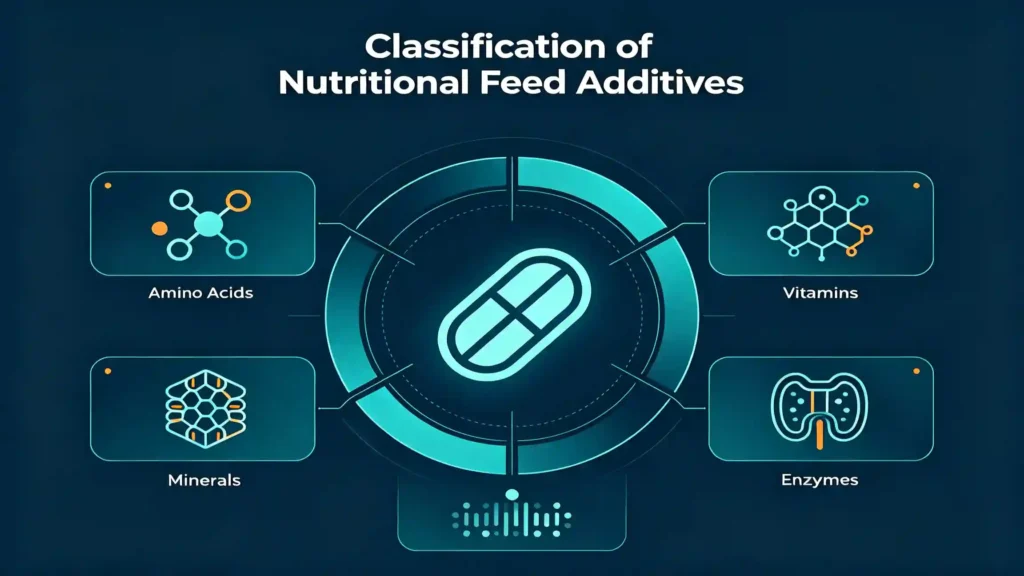
Introduction: Why Clarifying the Classification of Nutritional Feed Additives Is Critical
Feed formulation is far more than simple raw material mixing; it is a specialized discipline built on the precise classification of nutritional feed additives. For procurement specialists and feed formulators, a clear grasp of classification criteria for all nutritional feed additives lays the foundation for developing cost-effective, high-performance feed products.
This document establishes a systematic classification framework for nutritional feed additives tailored for procurement decision-makers, organized into three dimensions: nutritional composition, functional purpose, and raw materials and manufacturing processes.
Classification by Nutrient Composition – Five Core Categories of Nutritional Feed Additives
Amino Acids: Fundamental Building Blocks of Protein Nutrition
Amino acids supplement essential nutrients that animals cannot synthesize in sufficient quantities on their own. They balance dietary protein levels and serve as core raw materials in low-protein diet formulation.
As key nutritional additives, the following amino acid powders require focused attention during procurement:
- L-Lysine Hydrochloride
Typical purity ≥98.5%; Primary function: The first limiting amino acid for swine and poultry; Key procurement indicators: Assay content, moisture ≤1.0%, residue on ignition. - DL-Methionine
Typical purity ≥99%; Primary function: Sulfur-containing amino acid supporting feather and coat health; Key procurement indicators: Assay content, optical rotation (to evaluate bioavailability of DL-form). - L-Threonine
Typical purity ≥98.5%; Primary function: Protect intestinal mucosa and boost immune function; Key procurement indicators: Assay content, particle size (affects mixing uniformity). - L-Tryptophan
Typical purity ≥98%; Primary function: Improve feed intake and relieve animal stress; Key procurement indicators: Assay content, flowability, caking tendency. - L-Valine
Typical purity ≥98%; Primary function: Branched-chain amino acid for piglets and poultry; Key procurement indicator: Batch-to-batch consistency. - L-Histidine
Primary function: Functional amino acid participating in histamine synthesis and immune regulation, improving the intestinal barrier function of young animals. - Glycine
Primary function: Dual roles in flavor enhancement and physiological regulation; a precursor for glutathione synthesis to alleviate oxidative stress.
Key Procurement Notes for Amino Acid Additives
- Particle size distribution directly affects premix mixing uniformity: excessively fine powders cause dusting, while overly coarse particles lead to uneven mixing.
- Caking and material flowability affect the efficiency of automated weighing and batching; moisture control during storage is the core management parameter.
- Distinguish between effective nutritional content and crude protein content – only effective content reflects real nutritional contribution.
Vitamins: Micronutrients Indispensable for Metabolic Processes
Vitamins are organic micronutrients involved in all major metabolic pathways. Deficiency of any single vitamin triggers specific deficiency syndromes.
Vitamins are highly sensitive to light, heat, and oxygen, making them one of the additive categories with the strictest storage and transportation requirements.
- Fat-Soluble Vitamins: Mainly include Vitamin A, D3, E, K3; available as coated powders or carrier-adsorbed powders; Key procurement indicators: Potency (IU/mg), coating technology, carrier type.
- Water-Soluble Vitamins: Mainly include Vitamin B1, B2, B6, B12, Biotin, Vitamin C, Niacin, Folic Acid; available as crystalline powder or microencapsulated formulations; Key procurement indicators: Purity, light & heat resistance, flowability.
Key Procurement Notes for Vitamin Additives
- Potency conversion: Clarify the conversion relationship between IU/mg and purity percentage, and verify that suppliers use consistent testing standards.
- Coating technologies (microencapsulation, esterification, adsorption) determine nutrient retention rate during pelleting at 85°C and above.
- Carrier raw materials (corn starch, rice hull powder, silica) must be confirmed as non-GMO and allergen-free, as downstream customers increasingly demand clean-label products.
Minerals & Trace Elements: Structural Materials & Metabolic Catalysts
Minerals form animal skeletal structures, activate enzyme systems, and maintain electrolyte balance and hormone secretion.
Minerals usually account for the largest volume of procurement among nutritional additives. The selection between inorganic and organic forms is a core decision in procurement.
- Copper
Inorganic source: Copper sulfate pentahydrate; Organic source: Copper glycinate chelate; Core difference: Organic copper delivers 10%–40% higher bioavailability at a lower inclusion dose. - Zinc
Inorganic source: Zinc sulfate monohydrate; Organic source: Zinc methionine / Zinc glycinate; Core difference: Organic zinc reduces phytate antagonism and improves coat quality. - Iron
Inorganic source: Ferrous sulfate monohydrate; Organic source: Ferrous glycinate; Core difference: Organic iron alleviates intestinal irritation and stably elevates hemoglobin levels in piglets. - Manganese
Inorganic source: Manganese sulfate monohydrate; Organic source: Manganese glycinate; Core difference: Organic manganese generates superior bone development outcomes. - Selenium
Inorganic source: Sodium selenite; Organic source: Selenium yeast/Selenomethionine; Core difference: Organic selenium offers a wider safety margin and enhanced antioxidant and reproductive performance.
Key Procurement Notes for Mineral Additives
- The crystal water content of inorganic salts directly affects elemental content. For example, copper sulfate pentahydrate only contains approximately 25% elemental copper.
- Chelation rate of organic trace minerals carries greater weight than total metal content; the industry’s premium internal control standard is a chelation rate of ≥80%.
- Stringently limit heavy metals, including lead, arsenic, cadmium, and mercury. Export-oriented buyers must confirm compliance with destination-market regulations, including EU Regulation 1831/2003, which imposes extremely strict limits.
- Hygroscopicity and flowability affect product shelf life and operational performance in automated batching systems.
Enzymes: Biocatalysts to Boost Nutrient Utilization
Exogenous enzymes compensate for insufficient endogenous enzymes in animals and degrade anti-nutritional factors, rendering them indispensable nutritional additives in modern feed formulations.
- Superoxide Dismutase (SOD)
Core function: Endogenous antioxidant enzyme that directly eliminates free radicals, synergizing with glutathione to strengthen anti-stress capacity. - Phytase
Substrate & efficacy: Releases phytate-bound phosphorus to replace inorganic phosphorus raw materials; Typical activity range: 5,000–10,000 U/g. - Xylanase
Substrate & efficacy: Degrades non-starch polysaccharides (NSP) in wheat and corn to reduce digesta viscosity; Activity varies by strain and assay method. - Beta-Glucanase
Substrate & efficacy: Breaks down beta-glucans in barley and oats to improve energy utilization; Activity varies by strain and assay method. - Protease
Substrate & efficacy: Facilitates protein digestion, especially effective for young animals with limited endogenous enzyme secretion; Activity varies by strain and assay method. - Amylase
Substrate & efficacy: Aids carbohydrate digestion and improves starch utilization efficiency; Activity varies by strain and assay method.
Key Procurement Notes for Enzyme Additives
- Unified testing standards: Different manufacturers adopt FIP, International Units, and other assay systems. Procurement teams must confirm conversion factors to avoid misjudging claims of enzyme activity.
- Thermostability: Residual enzyme activity after 30 seconds of pelleting at 85°C is the core differentiator between standard and premium enzyme products.
- Storage stability: Half-life of enzyme activity at ambient 25°C, a critical factor for buyers in hot, humid regions.
Non-Protein Nitrogen (NPN): Special Nutritional Category Exclusive to Ruminants
NPN sources are nutritional additives uniquely applicable to ruminants such as cattle and sheep. Rumen microorganisms utilize NPN to synthesize microbial protein, indirectly supplying protein nutrition to host animals.
- Feed-Grade Urea
Nitrogen content ≥46%; Fast-release profile; Application: Standard beef and dairy rations requiring strict inclusion control. - Biuret
Nitrogen content approx. 38%; Slow-release profile with a higher safety margin; Application: Premium ruminant formulas to reduce ammonia toxicity risk. - Isobutylidene Diurea (IBDU)
Nitrogen content approx. 32%; Very slow-release profile; Application: Precision formulations for large-scale dairy farms.
Key Procurement Notes for NPN Additives
- Biuret impurity content must be controlled below 1.0%, as excessive biuret poses toxicity hazards.
- Coating integrity and release profile directly determine peak ammonia concentration in the rumen.
- Particle size governs ruminal release rate: Overly fine particles release nitrogen too rapidly and risk ammonia toxicity, while excessively coarse particles reduce utilization efficiency. Suppliers offering customized particle size specifications demonstrate stronger technical capabilities.
Classification by Functional Purpose
The five categories above are divided by nutrient composition, while the same nutritional feed additives can also be categorized from a functional perspective:
Nutritional Supplementation Category: Representative products – amino acids, vitamins, minerals; Core objective: Remedy specific nutritional deficiencies in basal diets.
Efficiency Enhancement Category: Representative products – enzymes; Core objective: Improve nutrient conversion rate of existing raw materials and eliminate metabolic toxins.
Cost Substitution Category: Representative products – NPN, phytase; Core objective: Cut formulation costs without compromising feeding performance.
Physiological Regulation Category: Representative products – organic trace minerals, Vitamin E, Vitamin C, Yucca extract, Rosemary extract, Astaxanthin; Core objective: Optimize animal reproductive performance, immunity and stress resistance.
When screening suppliers, prioritize those that can provide both nutritional composition and functional classification data for their products. For instance, to address antioxidant demands, suppliers should clearly distinguish among the applicable scenarios and the synergistic effects of synthetic Vitamin E, natural Vitamin E, rosemary extract, SOD, and glutathione.
Classification by Raw Material & Manufacturing Process
This classification dimension directly supports B2B buyers in evaluating supplier production capacity:
Fermentation-Derived Products
Production method: Microbial fermentation; Representative products: Lysine, Threonine, Phytase, Glutathione, SOD, Vitamin B2; Supplier evaluation metrics: Fermentation titer, strain stability, batch consistency.
Chemically Synthesized Products
Production method: Artificial chemical synthesis; Representative products: DL-Methionine, Vitamin A ester, MSM; Supplier evaluation metrics: Purity, by-product residues, solvent residuals.
Naturally Extracted Products
Production method: Purification from minerals, plants or animal sources; Representative products: Dicalcium phosphate, Rosemary extract, Yucca extract, Marigold extract, Natural Vitamin E; Supplier evaluation metrics: Raw material traceability, background heavy metal levels.
Chelated & Complexed Products
Production method: Metal ions bound with organic ligands; Representative products: Zinc glycinate, metal proteinates; Supplier evaluation metrics: Chelation rate, food-grade standard for ligand raw materials.
Fermentation-derived and chelated nutritional feed additives maintain premium pricing globally, driven by superior bioavailability and sustainable production profiles.
Practical Sourcing Guide – How to Select Suitable Nutritional Feed Additives
Follow these four steps to translate classification theories into actionable procurement plans:
Step 1: Confirm Target Animal Species & Growth Stage
Different species and production stages require fundamentally distinct nutritional feed additives:
- Weaned Piglets: Prioritize enzymes, including protease and amylase, along with organic zinc and glutathione to protect intestinal health and reduce the incidence of diarrhea.
- Growing-Finishing Pigs: Prioritize Lysine, Threonine and Phytase to optimize formulation costs.
- Peak-Laying Hens: Focus on calcium, phosphorus, Vitamin D3, and Methionine supplemented with marigold extract (lutein) to improve eggshell quality and yolk pigmentation.
- Broilers: Mainly Lysine, Methionine, and Xylanase; rosemary extract can be added in the late breeding stage for antioxidant effects to optimize feed conversion ratio.
- Lactating Dairy Cows: Combine NPN, Organic selenium, and Vitamin E to boost milk yield and reproductive performance.
- Aquaculture (Fish & Shrimp): Vitamin C, Taurine, and Organic trace minerals to enhance stress resistance and molting capacity.
Step 2: Identify Nutritional Gaps in Basal Diets
Analyze basal feed formulas to pinpoint actual nutrient shortages: add amino acids for protein deficiency, trace minerals for mineral insufficiency, and enzymes for low nutrient digestibility. Avoid blind over-supplementation.
Step 3: Match Category with Raw Material Form
After selecting the additive category, confirm specific grades (e.g., zinc glycinate vs. zinc methionine), particle-size standards, and packaging specifications.
Step 4: Establish Procurement Quality Specifications
Incorporate the following critical quality parameters into purchasing contracts:
- Amino Acid Powders
Key quality indicators: Assay content, moisture, residue on ignition, particle size; Acceptable standard: Assay ≥98.5%, moisture ≤1.0%. - Vitamin Powders
Key quality indicators: Potency, carrier moisture, heavy metals; Acceptable standard: Measured potency no less than labeled claim, lead ≤10 ppm. - Organic Trace Mineral Powders
Key quality indicators: Chelation rate, total metal content, heavy metals; Acceptable standard: Chelation rate ≥80%, lead ≤5 ppm. - Enzyme Powders
Key quality indicators: Actual enzyme activity and thermostability retention; Acceptable standard: Measured activity no less than the labeled claim, with≥70% activity retained after pelleting at 85°C. - NPN Powders
Key quality indicators: Total nitrogen content, biuret impurity, particle size; Acceptable standard: Biuret ≤1.0%.
Conclusion
The classification system of nutritional feed additives serves both as a scientific theoretical framework and a practical foundation for procurement decisions. A thorough understanding of these categorization logics enables precise feed formulation, controlled costs, and consistent finished feed quality.
Final Recommendation
When communicating with raw material suppliers of nutritional feed additives, go beyond price inquiries and Certificate of Analysis (COA) requests. Mandatorily require suppliers to provide Technical Data Sheets (TDS) and recommended inclusion rates for each product. Suppliers capable of furnishing complete supporting documents typically feature robust quality control systems and comprehensive technical support – this differentiates professional raw material partners from ordinary commodity distributors.
Further Support
For more services, please feel free to contact us:

Obtain detailed raw material specifications and COA templates

Apply for Fisetin samples

Consult regulatory compliance and formula technical support

Request an abstract of the latest market research reports
Contact Us:
Phone:+86 15817492830
Wechat:15817492830
E-mail:info@jayoobio.com 、 sales@jayoobio.com