
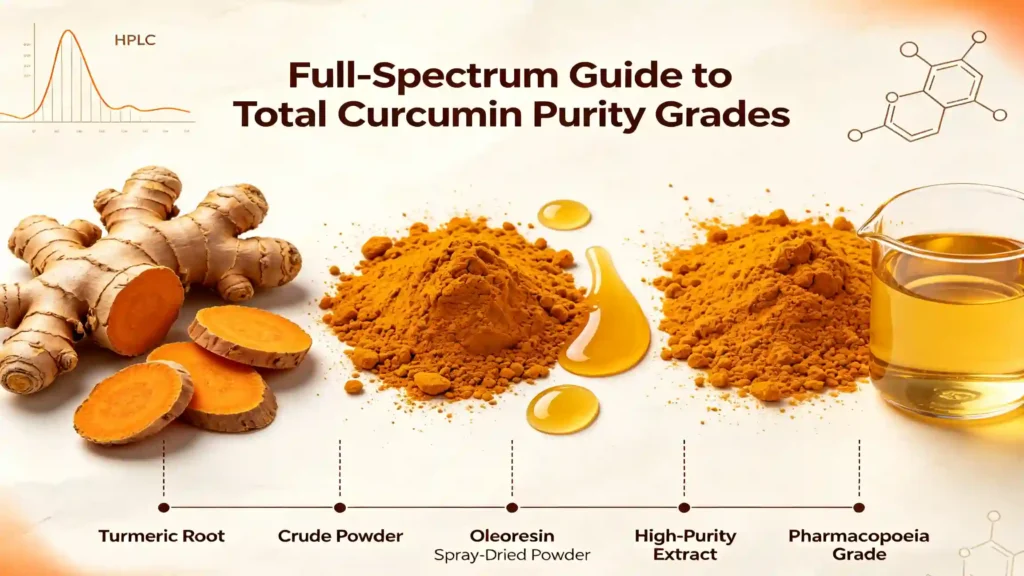
In industrial formulation development, curcumin purity directly affects processing performance, finished product quality, and cost.
This article provides a full-spectrum breakdown of various curcumin purity grades and their practical application scenarios.
Three Core Definitions of Curcumin Purity for Enterprise Procurement
When purchasing industrial raw materials, curcumin purity is far more than a single figure printed on product labels. As decision-makers for formulation R&D and manufacturing, you must break down the “purity” index into three independent, indispensable quantitative metrics when reviewing each raw material specification sheet. These metrics form the foundation for evaluating raw material value, calculating feeding costs, and controlling finished product quality.
| Metric Category | Definition |
| Total Curcuminoids | Sum of curcumin (C1), demethoxycurcumin (C2),bisdemethoxycurcumin (C3) |
| Ratio of Curcumin Monomer (Curcumin I / C1) | Percentage of C1 in total curcuminoids (natural ratio: approximately 75%–80%) |
| Impurity & Residue Profile | Curcuma oleoresin residues, organic solvent residues, heavy metals, pesticide residues, total ash content |
Do not rely solely on the figure “purity ≥95%”. Always request a complete Certificate of Analysis (COA) covering all three metrics. Missing any single metric creates uncontrollable risks within the supply chain.
Full Industrial Classification of Curcumin by Purity Grade
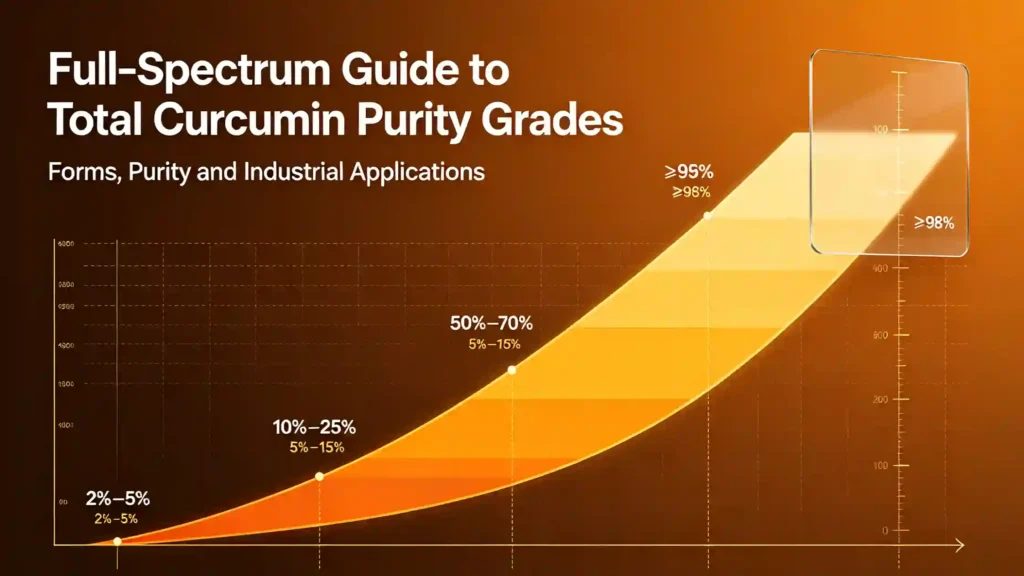
Raw materials are categorized into seven tiers based on form and processing depth, covering the full range from crude turmeric powder to pharmacopeia-grade refined products. Each tier specifies content range, core production processes, typical applications and processing limitations to help enterprises select optimal raw materials based on target dosage forms.
Level 0: Crude Turmeric Powder (2% – 5%)
- Processing: Simply cleaned, dried, milled and sieved, with no extraction procedures applied.
- Impurity profile: High starch content (~50%), dietary fiber, curcuma oil (3%–6%), and oxalates. Heavy metal levels fluctuate drastically based on soil conditions of origin, with high microbial loads.
- Industrial Applications:
- Food industry: Blending for curry powder, pickling seasonings, natural yellow colorant (note poor light stability and tendency to fade).
- Feed industry: Pigmentation for egg yolks and salmon muscle (must be fed with oils).
- Formulation Restrictions: Unsuitable for oral solid preparations due to insufficient active ingredient content; over 1 g of powder is required per capsule to reach target dosage. High risk of microbial exceeding limits; sterilization via irradiation or steam treatment is mandatory prior to factory intake.
- Cost Positioning: Bulk agricultural commodity, with prices fluctuating sharply by origin and season.
Level 1: Turmeric Oleoresin (10% – 25%)
- Processing: Solvent extraction (acetone/ethanol) → concentration and desolvation → viscous semi-fluid oleoresin.
- Composition characteristics: Curcuminoids account for 10%–25%, curcuma volatile oil 20%–40%, with the remainder consisting of plant resinous substances and waxes.
- Industrial Applications:
- Condiment industry: Base material for liquid flavors, color and flavor carrier for ready-to-eat sauces.
- Cosmetic industry: Natural colorant for lipsticks and soap (excellent oil solubility and dispersibility).
- Intermediate feedstock for further purification into higher-grade materials.
- Formulation Restrictions: Extremely poor flowability, not suitable for direct capsule filling; emulsification systems are required for water-based products.
- Cost Positioning: Priced by solids content, mid-tier industrial raw material cost.
Level 2: Low-Purity Spray-Dried Powder (5% – 15%)
- Processing: Turmeric oleoresin mixed with excipients (maltodextrin/starch/gum arabic) → emulsification and homogenization → spray drying.
- Core Clarification: This product is not produced via purification; it is a diluted and carrier-modified powder, converting oleoresin into a water-dispersible powder with large volumes of excipients.
- Industrial Applications: Water-soluble colorant and mild functional additive for beverage premixes, jelly powder, and instant soup; low-cost, low-activity tablet candy lines.
- Processing Warning: Excipients make up 85%–95% of the product, occupying significant formulation space for other active ingredients. The powder is highly hygroscopic; higher doses of flow aids such as magnesium stearate are required to prevent sticking during tableting.
- Cost Positioning: Low per-kilogram price when including carriers, yet uneconomical when calculated based on active curcuminoid content.
Level 3: Mid-Low Purity Extract Powder (20% – 40%)
- Processing: Solvent extraction → concentration → drying (no column chromatography or recrystallization purification, retaining abundant co-existing plant components).
- Composition profile: Total curcuminoids 20%–40%, with residual curcuma oleoresin, plant waxes, chlorophyll derivatives, and inorganic ash as the primary remaining components.
- Industrial Applications:
- Feed additives (pigmentation + mild antioxidant function, cost-effective for bulk use).
- Functional excipients for external plasters and heat patches (transdermal application only, not for oral use).
- Semi-finished raw material for secondary processing into 50%+ purity grades.
- Formulation Restrictions: Resinous impurities accelerate cross-linking and embrittlement of gelatin capsules; disintegration time is significantly prolonged in HPMC vegetarian capsules, requiring adjusted disintegrant systems.
- Cost Positioning: Low-to-mid tier industrial pricing, ideal for bulk non-oral applications.
Level 4: Medium-Purity Extract (50% – 70%)
- Processing: Multi-stage solvent extraction + preliminary recrystallization or membrane separation technology.
- Key Tier Significance: This grade marks the dividing line between industrial-grade raw materials and dietary supplement-grade raw materials. Purity above 50% renders the material viable for direct oral formulation production.
- Industrial Applications:
- Functional gummy candies (moderate activity content, bitterness effectively masked).
- Single-serve solid beverage sticks (blended with other plant extracts such as puerarin and vitamin C).
- External skincare serums (alcohol-soluble formulation systems).
- Formulation Considerations:
- 50% grade retains high ash content (~5%–8%), causing surface speckling and poor finish for coated tablets.
- 70% grade can be directly encapsulated, yet over 400 mg of powder must be filled per capsule to deliver target active dosage.
- Poor powder flow; additional 0.5%–1% silicon dioxide is required as a flow aid.
- Cost Positioning: Purity and unit price show nearly linear positive correlation within this range.
Level 5: High-Purity Standard Raw Material (≥95% Total Curcuminoids)
- Processing Route: Solvent extraction → concentration → column chromatography or recrystallization → vacuum drying → milling and sieving. This is a mature industrial process adopted globally.
- Industry Status: The dominant standard grade for dietary supplement manufacturing worldwide, compliant with draft requirements of major pharmacopeias including USP, EP and JP.
- Typical Quality Control Specifications:
- Total curcuminoids ≥95% (HPLC testing method)
- Natural C1 monomer ratio: 75%–82% (no artificial adjustment required)
- Curcuma oil residues ≤3%
- Total ash ≤3%
- Organic solvent residues comply with ICH Q3C guidelines (acetone ≤5000 ppm, ethanol ≤5000 ppm)
- Industrial Application Scenarios:
- Hard capsule filling: Directly usable without pre-granulation.
- Direct compression tableting: Additional binders and disintegrant systems required.
- Soft capsule suspensions: Must be dispersed in oil carriers and processed via colloid milling.
- Processing Challenges & Solutions:
- Severe static charge accumulation (high powder resistivity). Add antistatic agents during blending or control workshop relative humidity below 40%.
- Poor light stability. All production operations and packaging must avoid light exposure (aluminum foil bags + double-aluminum blister packs recommended).
- Cost Positioning: Wide price range determined by origin certifications, residue control standards, and batch volume.
Level 6: Ultra-Pure Curcumin Monomer (Curcumin I ≥98%)
- Processing: Produced from 95% grade feedstock via preparative HPLC or repeated recrystallization to selectively enrich C1 monomer and drastically remove C2 and C3.
- Restricted Industrial Applications (not universal):
- Reference standards for quantitative analysis (supplied with NMR and HPLC quantitative chromatograms).
- Research for specific drug delivery systems (e.g., liposomal injectables requiring ultra-high purity to mitigate immunogenic risks).
- Marker component in proprietary formulations to build intellectual property barriers.
- Critical Formulation Risks:
- Removal of C2 and C3 alters crystal morphology, resulting in slower dissolution rates compared to 95% natural curcuminoid blends.
- Unit price is 5–10 times higher than 95% grade, drastically squeezing end-product profit margins; unsuitable for standard dietary supplements.
- Cost Positioning: Premium specialty raw material with no standardized bulk market pricing.
Level 7: Pharmacopoeia-Grade Refined Material (≥97% – 99% with Full Impurity Profile Control)
- Core Definition: This tier is not merely an upgrade in content labeling, but a complete certified quality system. Beyond purity testing, it enforces strict limits on total polycyclic aromatic hydrocarbons (PAHs), aflatoxins (B1/B2/G1/G2), individual unknown impurities (single impurity ≤0.1%), and bacterial endotoxins (mandatory for injectable and implantable applications).
- Industrial Applications: Active pharmaceutical ingredients (API) for clinical trial filings, contract manufacturing (CMO) for European and American pharmaceutical companies, and the only compliant raw material for injectable and ophthalmic preparations.
- Cost Positioning: Custom-produced per batch with no public standard market prices; quotations require one-on-one negotiation with suppliers.
Enterprise Decision Matrix: Curcumin Purity vs. Dosage Form Compatibility
| Target Dosage Form | Recommended Raw Material Purity | Key Pre-Formulation Treatment | Unsuitable Purity Grades |
| Hard Capsules (Direct Powder Filling) | ≥95% | Pre-blend with 1% silicon dioxide to improve flowability | ≤70% (Excessive filling volume exceeds standard capsule capacity to deliver effective dosage) |
| Tablets (Wet/Dry Granulation) | ≥95% | Pre-granulation mandatory to avoid out-of-spec disintegration time during compression | ≤70% (Impurities interfere with binder and disintegrant functionality) |
| Soft Capsules | ≥95% | Disperse in MCT oil and homogenize via colloid mill | ≤50% (Oleoresin impurities cause content stratification and oxidation) |
| Functional Gummy Candies | 50%–70% | Cyclodextrin complexation or β-cyclodextrin addition for bitterness masking | ≥95% (Prohibitive cost and unmaskable intense bitterness) |
| Instant Solid Beverages | 5%–15% Spray-Dried Carrier Type | Add VC/sodium erythorbate for color stabilization | ≥95% (Poor water wettability, difficult to disperse in cold water) |
| Injectable & Ophthalmic Preparations | Pharmacopeia Grade ≥98% with Endotoxin Control | Nanonization + phospholipid encapsulation for delivery system construction | Non-pharmacopeia grades are strictly prohibited |
| Feed Premixes | 20%–40% | Pre-blend with soybean oil to reduce dust generation | ≥95% (Economically unviable, drastically elevates feed production costs) |
Three Mandatory Document Sets for Raw Material Purity Verification in Procurement
R&D and manufacturing managers cannot make purchasing decisions solely based on supplier label values. During inquiry and sample evaluation, the following three documents must be obtained from suppliers:
- Full Certificate of Analysis (COA)
Must include HPLC chromatograms, content assay values, five heavy metal indicators, arsenic speciation analysis, and pesticide residue screening complying with target market standards (Chinese Pharmacopeia or USP). Verify that the listed test methods reference official pharmacopeia protocols. - Organic Solvent Residue Test Report (GC-MS)
Focus on residual levels of acetone, n-hexane, and ethyl acetate. Although acetone is classified as a low-toxicity Class 3 solvent, premium export orders often enforce stricter internal limits than the general ICH standard; confirm client requirements in advance. - Particle Size Distribution Report (Laser Diffraction Method)
Used to assess powder blending uniformity and filling flow performance. Recommended specifications: D90 ≤ 80 μm, D50 ranging from 20–40 μm. Particles finer than 10 μm tend to agglomerate via static electricity; particles coarser than 150 μm lead to material segregation during blending.
Two Common Misconceptions in Enterprise Purity Grade Selection
Misconception 1: Higher purity delivers superior formulation performance
This belief is counterproductive for soft candies, instant beverages, and pet functional snacks. High-purity materials feature poor water wettability, intense bitter taste, and inflated raw material costs. Medium-purity extracts contain inherent natural oils that deliver superior processing performance in certain formulations. Matching raw material grade to target dosage form is the primary selection principle, rather than pursuing maximum purity.
Misconception 2: 95% grade and 98% monomer grade are interchangeable
Removal of C2 and C3 co-components in 98% monomer-grade curcumin creates measurable differences in melting point, crystallinity, and oxidation induction period compared to natural 95% curcuminoid blends. Unauthorized substitution in registered formulations may alter dissolution profiles and compromise bioequivalence. This risk carries critical regulatory implications for approved registered products.
Processing Supplement: Impact of Purity on Bioavailability Enhancement Formulations
When formulating with piperine or phytosome complexes to boost absorption efficiency, note the following processing details:
- Higher-purity materials (≥95%) achieve superior blending uniformity with piperine powder, making it easier to control content uniformity (RSD) within ideal ranges.
- For nano-dispersion production via co-milling, residual oily impurities in 50%–70% grade materials act as natural lubricants, enabling finer particle size reduction than 95% high-purity powder. This counterintuitive observation is frequently discovered by formulation engineers post-process scale-up. Parallel comparative testing during R&D is recommended to avoid forced raw material replacements after mass production launch.
Conclusion
As a supplier of curcumin powder raw materials, we recognize that selecting curcumin purity grade is far more than a simple numerical comparison. It requires balanced evaluation of dosage form processing requirements, cost models, and target market regulatory compliance.
This full-spectrum grading framework provides B2B partners with clear, actionable guidance for raw material screening.
Further Support
For more services, please feel free to contact us:
- Obtain detailed raw material specifications and COA templates
- Apply for samples
- Consult regulatory compliance and formula technical support
- Request abstracts of the latest market research reports
Phone: +86 15817492830
WeChat: 15817492830
E-mail: info@jayoobio.com, sales@jayoobio.com