
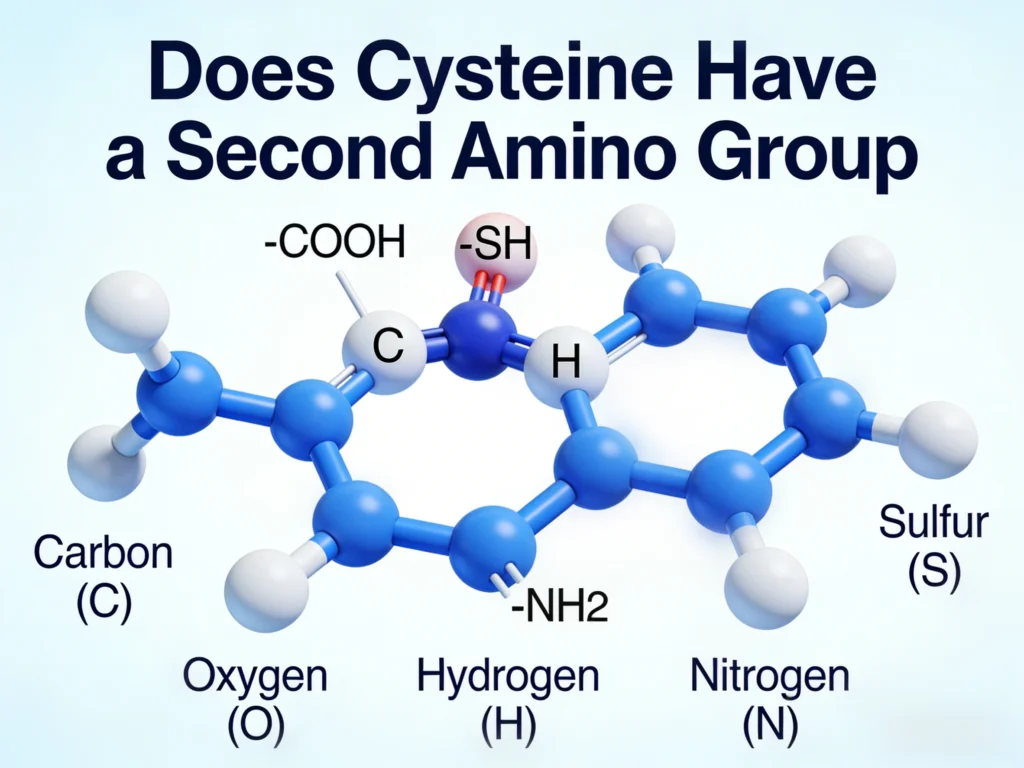
When exploring the structural characteristics of amino acids, a common question that arises is: Does cyseine have a second amino group? Cysteine, as one of the 20 natural amino acids that make up proteins, has unique chemical properties due to its special functional groups, and whether it contains a second amino group is not only a key point in understanding its structure but also an important basis for grasping its physiological functions. To answer this question thoroughly, we need to start with the basic structure of cysteine, combine its molecular composition and functional group characteristics, and conduct in-depth analysis, while repeatedly returning to the core question: does cysteine have a second amino group?
First, we need to clarify the basic structure of amino acids. Amino acids are organic compounds that contain both an amino group (-NH₂) and a carboxyl group (-COOH), and the amino group and carboxyl group of natural amino acids that make up proteins are usually directly connected to the α-carbon atom, which is called α-amino acids. The general structural formula of α-amino acids is H₂NCHRCOOH, where R represents a variable side chain, and the difference in the R group is the key to distinguishing different amino acids. For cysteine, its chemical name is 2-amino-3-mercaptopropionic acid, and its molecular formula is C₃H₇NO₂S, with a structural formula of HSCH₂CH(NH₂)COOH. From this structural formula, we can clearly see the functional groups contained in cysteine, and further judge whether it has a second amino group by analyzing these functional groups.
Looking closely at the structural formula of cysteine, we can find that there is only one amino group (-NH₂) in its molecule, which is directly connected to the α-carbon atom, that is, the amino group in the α-amino acid structure. The other functional groups of cysteine include a carboxyl group (-COOH) connected to the α-carbon atom and a sulfhydryl group (-SH) connected to the methylene group (-CH₂-) on the side chain. There is no other amino group in the entire molecular structure, whether on the main chain or the side chain. This directly answers the core question: Does cyseine have a second amino group? The answer is no. Cysteine only contains one amino group, which is the α-amino group necessary for the basic structure of amino acids.
To further confirm this conclusion, we can compare cysteine with other amino acids that contain multiple amino groups. For example, lysine, arginine, and histidine, which belong to basic amino acids, contain two or more amino groups in their molecules: lysine has one α-amino group and one ε-amino group on the side chain, arginine has a guanidine group containing multiple amino groups, and histidine has an imidazole ring with weak basicity and can be regarded as containing multiple amino groups in a broad sense. In contrast, cysteine is classified as a neutral amino acid, and its molecular structure only contains one amino group and one carboxyl group, which is consistent with the structural characteristics of neutral amino acids that “contain one amino group and one carboxyl group”. This comparison further verifies that cysteine does not have a second amino group.
Some people may have doubts: will the sulfhydryl group (-SH) in cysteine be mistakenly regarded as an amino group, leading to the misunderstanding that it has a second amino group? In fact, the two functional groups are completely different in chemical structure and properties. The amino group is a group composed of nitrogen and hydrogen (-NH₂), which is alkaline and can combine with hydrogen ions in the solution to show basicity; while the sulfhydryl group is a group composed of sulfur and hydrogen (-SH), which is weakly acidic and can lose hydrogen ions in the solution, and also has strong reducibility, which is the core functional group for cysteine to participate in redox reactions and form disulfide bonds. The obvious difference between the two eliminates the possibility of confusion, and also further confirms that the sulfhydryl group of cysteine will not be converted into an amino group, so cysteine will not have a second amino group.
In addition, from the perspective of the biosynthesis and metabolism of cysteine, we can also indirectly confirm that it does not have a second amino group. Cysteine is a conditionally essential amino acid in the human body, which can be converted from methionine (an essential amino acid in the human body) in the body, and can be converted into cystine with each other—the conversion between the two is realized through the oxidation and reduction of sulfhydryl groups: two cysteine molecules form cystine through the oxidation of sulfhydryl groups to form disulfide bonds (-S-S-), and cystine can be reduced to cysteine again. In this entire process, there is no involvement of amino group addition or generation, which means that the number of amino groups in cysteine molecules will not increase, and there will be no situation where a second amino group is generated.
Returning to the core question again: does cyseine have a second amino group? Through the analysis of its molecular structure, functional group characteristics, comparison with other amino acids, and combined with its biosynthesis and metabolism rules, we can draw a clear conclusion: cysteine does not have a second amino group. Its unique structural feature is that it contains a sulfhydryl group, which makes it have special physiological functions such as redox, detoxification, and participation in protein structure formation, rather than having multiple amino groups. Understanding this point is not only helpful for mastering the structural characteristics of cysteine but also lays a foundation for further learning about its role in organisms, such as its role in maintaining the stability of protein three-dimensional structure through disulfide bonds, its detoxification effect on heavy metals and toxic substances, and its application in food, medicine, and other fields.
In summary, the question of whether cysteine has a second amino group is a key entry point to understanding the structure of cysteine. By in-depth analysis of its molecular composition and properties, we can clearly know that cysteine only contains one α-amino group, and there is no second amino group in its molecule. This conclusion not only conforms to the structural characteristics of cysteine but also is supported by a large number of experimental and theoretical studies, which is an important basic knowledge in the field of biochemistry and molecular biology.