
Preface
Both fisetin and quercetin belong to the core polyphenols of the flavonol family. In recent years, global demand for functional foods, dietary supplements, pet nutrition, and cosmetic raw materials has continued to rise. Sharing highly overlapping fundamental antioxidant and anti-inflammatory effects, the two substances are frequently compared by formulation R&D specialists, brand owners, and raw material purchasers worldwide.
Nevertheless, subtle differences in molecular structures lead to fundamental distinctions in physicochemical properties, biological mechanisms, application scenarios, production costs, and market positioning.
This paper systematically compares the two raw materials, Fisetin vs Quercetin, across six dimensions—molecular structure, physicochemical properties, core functional mechanisms, industrial applications, production costs, and global compliance regulations- to provide professional references for global raw material procurement and formulation development.
Molecular Structure: Root Cause of All Performance Differences
Fisetin and quercetin share an identical flavonol molecular skeleton. Their performance gaps stem from minor variations in the number and substitution positions of hydroxyl groups, which directly determine molecular polarity, membrane penetration capacity, and biased biological activity.
Basic Molecular Parameters
- Fisetin: Molecular formula C₁₅H₁₀O₆, molecular weight 286.24, classified as a tetrahydroxyflavonol
- Quercetin: Molecular formula C₁₅H₁₀O₇, molecular weight 302.24, classified as a pentahydroxyflavonol
Structural Differences and Underlying Principles
Quercetin exhibits higher polarity and more robust in vitro antioxidant activity, making it suitable for general anti-inflammatory and skin-stabilizing applications.
Fisetin exhibits lower polarity, theoretically enabling superior penetration of cell membranes, alongside outstanding selective clearance of senescent cells.
In short: Quercetin’s molecular structure fits universal antioxidant and anti-inflammatory stabilization formulations; fisetin’s structure is more tailored to targeted anti-aging and neuroprotective formulations.
Physicochemical Properties: Industrial Production and Formulation Compatibility
Physicochemical indicators directly govern manufacturing adaptability, formula compatibility, storage requirements, and finished product stability.
Appearance & Traits
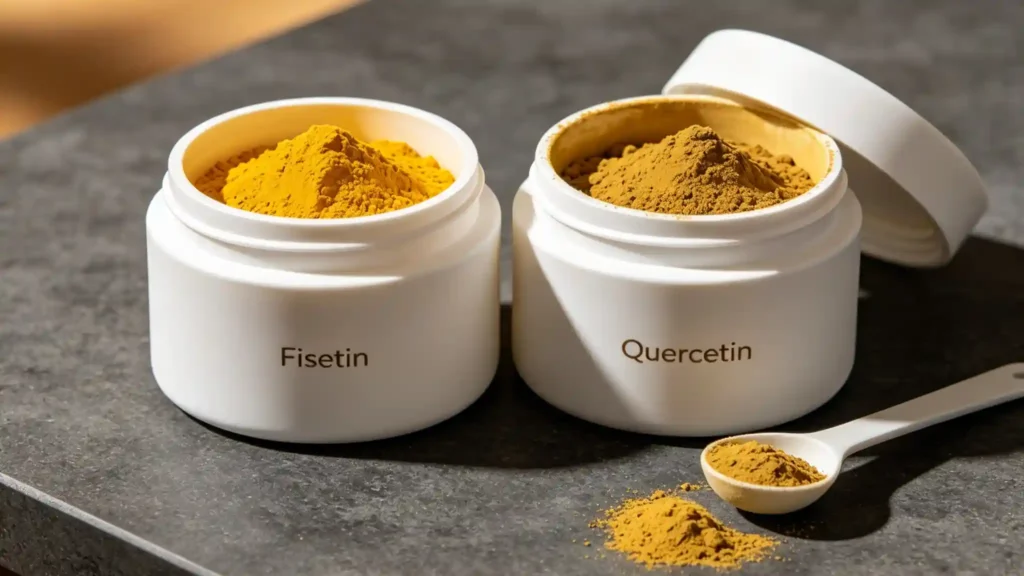
- Fisetin: High-purity grade (HPLC ≥98%) appears as a bright yellow, uniform crystalline powder with pure, consistent color, ideal for customized high-end finished products.
- Quercetin: Yellow acicular crystalline powder with a duller yellow tone. As a conventional bulk raw material, it meets the demands of large-scale industrial manufacturing.
Solubility
Fisetin is poorly soluble among flavonoids, nearly insoluble in water, and sparingly soluble in oils, with slight solubility in long-chain triglycerides. It dissolves readily in organic solvents such as ethanol and dimethyl sulfoxide (DMSO).
Quercetin, a flavonol compound, is almost insoluble in water at room temperature. It dissolves in polar organic solvents, including ethanol, methanol, and acetone, but is only slightly soluble in oils.
Stability and Processing Tolerance
Fisetin boasts moderate stability; it oxidizes and discolors easily under strong light or high temperatures, requiring airtight, low-temperature, light-proof storage.
Quercetin delivers excellent thermal stability and acid-base resistance, tolerating high-temperature processing in food and cosmetics with low processing loss, and is better suited for large-scale continuous industrial production. Note that it is sensitive to alkaline environments and oxidation, and that it maintains optimal stability in neutral or weakly acidic formulations.
Taste Characteristics
Quercetin has an extremely low bitter taste threshold and a prominent lingering bitter aftertaste, imposing stringent requirements on sweeteners and flavor-masking agents and increasing the difficulty of flavor formulation for oral products.
Fisetin demonstrates superior compatibility with mainstream flavor systems, significantly lowering sensory barriers for end products and improving long-term consumption experience for users.
Biological Functions and Mechanisms: Core Value of Formulations
Though both exert basic antioxidant and anti-inflammatory effects, their distinct core functions create completely different product-positioning and market-segmentation tracks.
Shared Functions
Both fisetin and quercetin scavenge free radicals, counteract oxidative stress, protect healthy cells and assist in regulating bodily metabolism—fundamental core attributes of flavonol active raw materials.
Fisetin: High-End Anti-Aging Track
- Targeted senescent cell clearance
As a natural potent senolytic agent, fisetin fundamentally alleviates chronic low-grade inflammation and bodily aging triggered by accumulated senescent cells, marking its primary competitive advantage. - Superior neuroprotective capacity
With favorable blood-brain barrier permeability, fisetin upregulates brain-derived neurotrophic factor (BDNF) levels to facilitate neural cell repair and regeneration, applicable to brain health and premium anti-aging formulations. - Advanced anti-aging and anti-glycation effects
It delays telomere attrition and inhibits the generation of advanced glycation end products (AGEs).
Quercetin: General Health Stabilization Track
- Broad-spectrum anti-inflammatory activity
It helps mitigate inflammation in the respiratory tract, mucous membranes, and other tissues. - Anti-allergy and immune stabilization
It stabilizes mast cells to relieve skin redness, itching, and other allergic reactions and is widely incorporated into anti-allergy and immune-regulating formulations. - Vascular protection and metabolic regulation
It improves microcirculation, mitigates oxidative vascular damage, and helps regulate blood lipids and blood pressure, serving as a core ingredient in vascular health products. - General immunity enhancement
It boosts the body’s resistance with auxiliary antibacterial and antiviral effects, suitable for daily mass health care products.
Summary of Functional Positioning
- Fisetin: Targeted high-end anti-aging raw material addressing the root causes of cellular aging in the human body
- Quercetin: General health stabilization raw material resolving daily inflammation, allergies, immune imbalance, and vascular health concerns
Industrial Application Scenarios: Segmented Market Track Differences
Driven by disparities in physicochemical traits and functional benefits, fisetin and quercetin occupy clearly segmented niches in global end-use applications with distinct formulation positioning directions.
Dietary Supplements & Functional Foods
- Fisetin: Focuses on high-end anti-aging, longevity support, cognitive improvement, and customized premium formulas for middle-aged and elderly populations. Often compounded with ergothioneine, PQQ, and urolithin A to create high-value anti-aging complex formulations.
- Quercetin: Primarily for mass daily health care, applicable to allergy conditioning, respiratory maintenance, vascular stabilization, and general immune health products, boasting broad consumer groups and massive market demand.
Cosmetic Raw Materials
- Fisetin: Deployed in premium anti-aging skincare targeting mature skin, focusing on photoaging resistance, fine line fading and repair of aged skin damage.
- Quercetin: Centered on sensitive skin stabilization, with core effects of anti-inflammatory soothing, redness relief, barrier strengthening and daily skin maintenance.
Pet Nutrition Sector
- Fisetin: Used in premium pet anti-aging products for senior pet care to delay organ and bodily aging in pets.
- Quercetin: A universal pet nutritional additive extensively adopted in pet anti-inflammation, skin allergy relief, and immune conditioning products with extremely high market penetration.
Raw Material Sources, Production Capacity & Costs: Core Reference for B2B Purchasers
For raw material buyers and manufacturing brands, production complexity, market output, and procurement costs determine end-product pricing and profit margins.
Natural Content in Raw Materials
Fisetin occurs at extremely low concentrations in natural fruits and vegetables, with levels generally below 0.01% in smoke tree leaves, strawberries and apple peels—far insufficient to meet human health dosage requirements. Commercial-grade material relies on specialized plant extraction and high-purity purification processes that entail significant technical barriers.
Quercetin is abundant in natural edible ingredients such as onions, apples and broccoli, ensuring ample raw material reserves and low natural sourcing thresholds.
Industrial Production & Capacity
Fisetin requires complex purification procedures and high manufacturing technical standards. Global supply of high-purity grades is limited, with production capacity concentrated in Europe, America, China, and Japan; high-standard premium raw materials remain scarce.
Quercetin features mature industrial production processes equipped with large automated production lines, delivering sufficient global output with no risk of supply shortages.
Market Pricing & Profit Positioning
- Fisetin: Premium high-margin raw material with high unit prices, offering ample profit margins for end products, ideal for developing differentiated high-end customized consumer goods.
- Quercetin: Bulk commodity raw material with low transparent market unit prices, suited for mass-market low-margin consumer products with high sales volume.
Global Regulatory Compliance
Cross-border market compliance is a prerequisite for raw material export and end-product sales. Both materials hold complete overseas cosmetic safety certifications, yet notable differences exist in oral food compliance.
Compliance in China’s Market
Quercetin monomer is not yet listed in China’s general food or health food raw material catalogs and cannot be directly used to manufacture domestic food/health food finished products. Multiple Chinese raw material manufacturers have initiated safety filings for quercetin as a novel food ingredient.
High-purity fisetin monomer also lacks qualification as a food or health-food raw material, thereby restricting its direct oral use in domestic food and health supplements.
U.S. FDA & EU Compliance
Quercetin has received FDA GRAS safety recognition and is approved for use in dietary supplements by the European Food Safety Authority (EFSA). It boasts a long history of global oral application and wide market recognition.
Fisetin has not yet secured FDA GRAS certification; it is regulated under legacy dietary ingredient rules based on its historical consumption as a natural component of fruits and vegetables. It has expanded rapidly in the overseas high-end anti-aging dietary supplement segment over the past decade, with a mature compliance framework for foreign oral supplements.
Cosmetic Industry Compliance
Both materials are included in the EU CosIng and U.S. PCPC raw material databases, permitting legal addition across mainstream global skincare markets.
- Quercetin: For daily skin anti-inflammatory soothing and basic antioxidant stabilization, matching mass-market repair formulations
- Fisetin: Positioned for premium anti-aging and photoaging repair skincare lines
Conclusion & B2B Commercial Matching Recommendations
From the perspectives of molecular fundamentals and industrial commercialization, structural differences between fisetin and quercetin carve out two entirely distinct market tracks. Neither is inherently superior; suitability depends solely on end-product positioning.
As an essential raw material, quercetin is low-cost, abundant in supply, broadly compliant, and highly adaptable in formulation. It is the core ingredient for brands targeting mass-market daily health care, basic anti-inflammation, anti-allergy, and immune-maintenance end products.
As a premium high-value raw material, fisetin leverages its senescent cell clearance and neuroprotective functions to dominate the high-end anti-aging niche. It serves as a core scarce ingredient for brands to develop differentiated high-value products and boost market competitiveness and profit margins.
Formulating fisetin and quercetin together achieves complementary functional effects: quercetin delivers daily anti-inflammatory stabilization and immune regulation, while fisetin conducts deep cellular anti-aging purification, forming a full-cycle health maintenance system of “anti-inflammatory stabilization + senolytic anti-aging”. This is also the mainstream premium formulation solution adopted by high-end global functional health products today.
Further Support
For more services, please feel free to contact us: www.jayoobio.com/
Obtain detailed raw material specifications and COA templates

Apply for samples

Consult regulatory compliance and formula technical support

Request an abstract of the latest market research reports

Contact Us:
Phone:+86 13130678248
Wechat:13130678248
E-mail:info@jayoobio.com 、 sales@jayoobio.com