
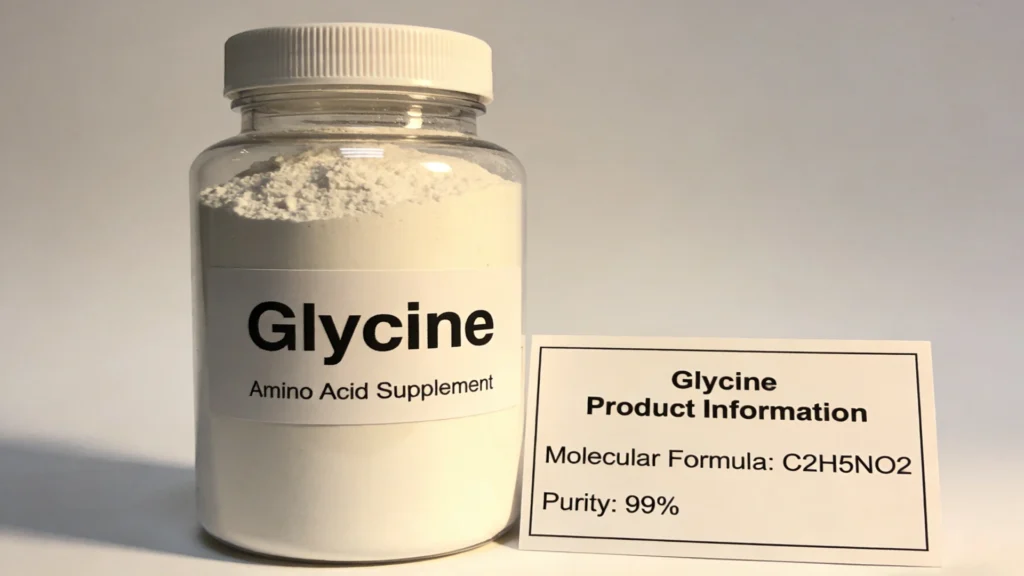
In the field of amino acids, glycine powder is a highly representative product. As the simplest naturally occurring amino acid, it has become an indispensable core raw material across industries such as medicine, food, cosmetics, and agriculture due to its unique chemical properties and wide range of applications. Glycine powder, also known as glycine powder, has a chemical formula of C₂H₅NO₂, a molecular weight of 75.07 g/mol, and a CAS number of 56-40-6. It is a non-essential amino acid—the human body can synthesize it from other amino acids, such as serine —but during specific physiological stages or when the diet is unbalanced, supplementing with glycine powder can effectively fill the nutritional gap and provide multiple health benefits and practical effects.
In terms of physical properties, glycine powder appears as a white crystalline powder, odorless, slightly sweet, with a sweetness about 0.8 times that of sucrose. It has excellent water solubility (249.9 g/L at 25℃), is slightly soluble in ethanol, insoluble in ether, and has a melting point of about 232-236℃ (decomposition). Its unique molecular structure—the only amino acid without a chiral carbon, with both amino (-NH₂) and carboxyl (-COOH) amphoteric characteristics—endows it with flexible application potential in different fields. In industrial production, glycine powder is produced through advanced crystallization and purification processes, with purity usually above 99%. Strict control of heavy metals, residual solvents, and microbial contaminants ensures compliance with quality standards across industries and supports their wide application in various products.
In the field of health, the efficacy of glycine powder has been confirmed by a large number of studies, making it a popular nutritional supplement. Firstly, its effect on improving sleep quality is particularly significant. As an inhibitory neurotransmitter in the central nervous system, glycine powder can regulate neuronal activity, shorten the time to fall asleep, promote slow-wave sleep (deep repair stage), reduce morning fatigue, and will not cause drowsy side effects. It is suitable for people who have long been troubled by sleep, and it is usually recommended to take about 3 grams before bedtime to achieve the ideal effect. Secondly, glycine powder is the core raw material for collagen synthesis, accounting for about 1/3 of collagen components. Sufficient supplementation can promote the renewal of collagen in the skin, bones, and joints, improve dry and rough skin, enhance skin elasticity, and, at the same time, maintain bone and joint health and delay tissue degeneration caused by aging.
In addition, glycine powder also plays an important role in metabolic regulation and health protection. It can stimulate the intestinal tract to secrete GLP-1 hypoglycemic hormone, promote the pancreas to secrete insulin, help stabilize postprandial blood sugar, and have a certain auxiliary improvement effect on patients with pre-diabetes and type 2 diabetes; at the same time, it participates in the synthesis of glutathione (an important human antioxidant), can scavenge reactive oxygen species in the body, reduce oxidative stress, and can also combine with heavy metal ions and drug metabolites to exert a detoxification effect. In terms of heart health, studies have found that people with higher glycine concentrations in the blood have a lower risk of heart attack. It promotes creatine synthesis by regulating the activity of the GNMT enzyme, relieves atherosclerosis, and protects the cardiovascular system. In addition, glycine powder can also assist in improving the negative symptoms of schizophrenia patients, regulate the function of NMDA receptors in the brain, and provide support for neural health.
The application scenarios of glycine powder are far more than health supplements, and it also occupies an important position in many industrial fields. In the food industry, as a food additive, it can be used as a flavoring agent to enhance umami and sweetness, as a preservative to inhibit the growth of microorganisms, and as a buffer to maintain the stability of food pH value. It is widely used in soy sauce, canned food, pastries, sports drinks, and other products. At the same time, it can also be used as a nutritional fortifier to add to infant formula food to supplement amino acid nutrition. In the pharmaceutical field, glycine powder is an important raw material for compound amino acid injections, used to supplement human nutrition, and can also be used as a buffer to adjust the pH value of drugs and stabilize biological agents such as vaccines.
In the cosmetics field, glycine powder has become a high-quality raw material for skin care products due to its small molecule and easy penetration—it is a key component of the skin’s natural moisturizing factor (NMF), which can enhance the skin’s water-locking capacity, improve dry skin, promote collagen synthesis, reduce wrinkles, and also has anti-inflammatory properties, suitable for sensitive skin and acne-prone skin.
In the agricultural field, glycine powder can be used as a plant growth regulator to promote crop photosynthesis, enhance stress resistance (drought resistance, salt-alkali resistance, low temperature resistance). And can also be used as a chelating agent to improve fertilizer utilization rate, improve soil environment, and help the development of green agriculture. In the feed industry, as a feed additive, it can improve the protein utilization rate of livestock and poultry feed, promote animal growth, especially for poultry and aquatic animals.
When using glycine powder, it is necessary to pay attention to the reasonable dosage and the applicable population. The recommended daily supplement dosage for healthy people is 3-10 grams, which can be adjusted according to needs; special groups such as those with renal insufficiency and those taking antipsychotic drugs are advised to use it under the guidance of a doctor to avoid interaction with drugs. In general, as a multi-functional and high-safety raw material, the application value of glycine powder is constantly expanding with in-depth research. From daily health supplements to industrial production, it has always played an irreplaceable role, becoming an important bridge connecting health and industry.