
Rosemary (Rosmarinus officinalis L.), a perennial evergreen shrub belonging to the Lamiaceae family, has been utilized by humans for its medicinal and edible values for thousands of years. With the continuous advancement of modern separation and extraction technologies and pharmacological research, the antibacterial activity of rosemary extract has gradually become a research focus in fields such as biomedicine and food preservation. This article systematically analyzes the antibacterial properties of rosemary extract from four dimensions: active components, antibacterial mechanisms, antibacterial spectrum, and application prospects, aiming to provide theoretical references for its further development and utilization.
1. Core Antibacterial Active Components in Rosemary Extract
The antibacterial activity of rosemary extract is not the result of a single component but a synergistic effect of multiple terpenoids and phenolic compounds. Among them, carnosol, carnosic acid, ursolic acid, and other components have been confirmed as the core substances exerting antibacterial effects. The molecular structures of these components are rich in active groups such as phenolic hydroxyl and carboxyl groups, which lay the chemical foundation for their antibacterial activity. The physicochemical properties and antibacterial advantages of each core component are shown in the following table:
| Core Active Component | Chemical Classification | Physicochemical Properties | Antibacterial Advantages |
| Carnosol | Diterpene phenol | Pale yellow crystal, soluble in ethanol, high stability | Broad-spectrum antibacterial, outstanding inhibitory effect on Gram-positive bacteria |
| Carnosic Acid | Diterpene acid | White powder, strong lipophilicity, easily oxidized to carnosol | Long-lasting antibacterial activity, can inhibit bacterial biofilm formation |
| Ursolic Acid | Triterpenoid | White needle-like crystal, insoluble in water, soluble in organic solvents | Certain inhibitory effect on drug-resistant bacteria, high safety |
| Rosmarinic Acid | Phenolic acid | Pale yellow powder, better water solubility than other components | Synergistically enhances the antibacterial effect of other components, with antioxidant properties |
2. Antibacterial Mechanism of Rosemary Extract: Multi-target Synergistic Effect
Different from traditional antibiotics that act on a single target, rosemary extract exerts antibacterial effects by damaging bacterial physiological functions through multiple pathways and targets. Studies have shown that its antibacterial mechanism mainly focuses on three core links: the bacterial cell membrane, the metabolic enzyme system, and the genetic material replication. The specific action pathways and key targets of each link are as follows:
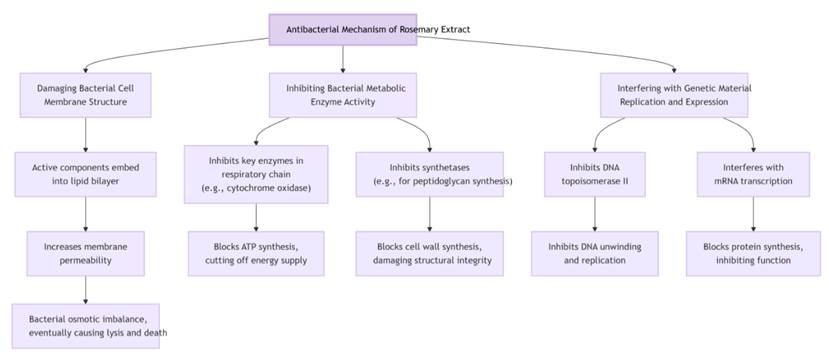
It is worth noting that the multi-target action mechanism of rosemary extract makes it less likely to induce bacterial drug resistance. Traditional antibiotics, due to their long-term single action on a certain target, easily lead to bacteria developing drug-resistant genes through gene mutation; however, the synergistic action mode of rosemary extract makes it difficult for bacteria to avoid the attack of multiple action targets through mutation at the same time. This characteristic provides great potential for its application in the treatment of drug-resistant bacterial infections.
3. Antibacterial Spectrum and Activity Evaluation of Rosemary Extract
A large number of in vitro bacteriostatic experiments and animal model studies have confirmed that rosemary extract has a broad antibacterial spectrum, with inhibitory effects on Gram-positive bacteria, Gram-negative bacteria, and some fungi, especially showing significant activity against pathogenic bacteria commonly found in food processing and clinical infections. The following is the Minimum Inhibitory Concentration (MIC) of rosemary extract at different concentrations against typical microorganisms; the lower the MIC value, the stronger the antibacterial activity:
| Microorganism Category | Typical Strain | Rosemary Extract Concentration (mg/mL) – MIC Value | Antibacterial Activity Level |
| Gram-positive Bacteria | Staphylococcus aureus | 0.312 – 0.625 | Strong |
| Bacillus subtilis | 0.625 – 1.25 | Relatively Strong | |
| Gram-negative Bacteria | Escherichia coli | 1.25 – 2.5 | Moderate |
| Salmonella spp. | 2.5 – 5.0 | Moderate | |
| Fungi | Candida albicans | 1.25 – 2.5 | Moderate |
| Aspergillus niger | 5.0 – 10.0 | Relatively Weak |
From the data in the table, it can be seen that the antibacterial activity of rosemary extract against Gram-positive bacteria is generally better than that against Gram-negative bacteria. This difference is mainly due to the different cell wall structures of the two types of bacteria. The outer membrane of Gram-negative bacteria is rich in lipopolysaccharides, forming a natural barrier that hinders the penetration of lipophilic components in rosemary extract; while the cell wall of Gram-positive bacteria is mainly composed of peptidoglycan, with a relatively loose structure, making it more vulnerable to attack by active components.
4. Application Prospects and Challenges of the Antibacterial Activity of Rosemary Extract
4.1 Expansion of Application Fields
Based on its safe and broad-spectrum antibacterial properties, rosemary extract has demonstrated application value in multiple fields. In the food industry, it is used as a natural food preservative to replace chemical preservatives (such as sodium benzoate) and extend the shelf life of foods such as meat and pastries. In the pharmaceutical field, its extract is used to prepare external antibacterial ointments for the treatment of bacterial infections on the skin surface. In daily chemical products, hand sanitizers, mouthwashes, and other products added with rosemary extract can achieve mild antibacterial effects and reduce the irritation of chemical antibacterial agents to the human body.
4.2 Existing Challenges
Although the antibacterial activity of rosemary extract has been widely confirmed, it still faces many challenges in industrial applications. Firstly, the extraction cost is relatively high. The traditional solvent extraction method has low efficiency and high energy consumption. Although new technologies such as supercritical CO₂ extraction can improve efficiency, the high equipment investment cost limits their large-scale application. Secondly, the stability of active components needs to be improved. Components such as carnosic acid are easily oxidized, affecting the durability of antibacterial effects, which requires improvement through technologies such as microcapsule embedding. Thirdly, the research on in vivo antibacterial effects is insufficient. Most current studies remain in the in vitro experimental stage, and the metabolic rules and antibacterial mechanisms of rosemary extract in animals and humans still need to be further clarified.
5. Conclusion
Rosemary extract has become an important research object in the field of natural antibacterial agents due to its rich active components, multi-target antibacterial mechanism, and broad-spectrum antibacterial effect. Its characteristic of not easily inducing bacterial drug resistance gives it unique advantages in combating drug-resistant bacterial infections. In the future, with the optimization of extraction processes, the breakthrough of stability technologies, and the deepening of in vivo research, rosemary extract is expected to achieve more extensive industrial applications in fields such as food preservation, biomedicine, and daily chemical products, providing a safer and more efficient natural antibacterial solution for human health.