
Introduction: Reduced Glutathione Isn’t Enough!
Glutathione (GSH) is a key endogenous antioxidant essential for redox balance, detoxification, and immunity. However, conventional reduced glutathione exhibits low oral bioavailability due to degradation in the digestive tract, thereby preventing a significant increase in plasma concentrations.
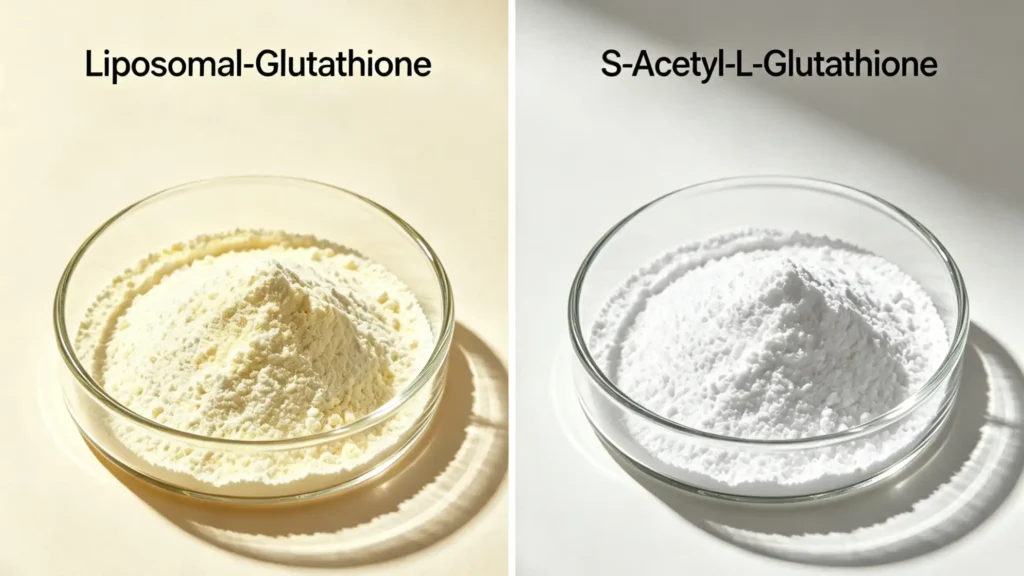
To address this core pain point, two upgraded solutions have emerged: Liposomal-Glutathione (Lipo-GSH) and S-Acetyl-L-Glutathione (SAG). These two innovations overcome the absorption bottlenecks of traditional GSH via physical encapsulation and chemical modification, respectively.
This article provides a comprehensive comparison: Liposomal-Glutathione vs S-Acetyl-L-Glutathione, covering molecular structure, absorption mechanisms, efficacy performance, and commercial application scenarios, to provide a scientific basis for your final procurement decision.
Liposomal-Glutathione & S-Acetyl-L-Glutathione : Structure
What Are Liposomal-Glutathione and S-Acetyl-L-Glutathione?
2.1.1 Liposomal-Glutathione (Lipo-GSH)
Liposomal-Glutathione is a delivery system in which reduced glutathione molecules are encapsulated in nanoscale vesicles (liposomes) composed of phospholipid bilayers. The diameter of these phospholipid vesicles is usually between 50 and 500 nm, which is similar to that of human cell membranes.
The core technology of Lipo-GSH lies in using liposomes as a “protective shell” and “transport carrier”: the phospholipid bilayer effectively shields GSH molecules from degradation by stomach acid, digestive enzymes, and oxidative environments. Meanwhile, liposomes fuse with cell membranes to deliver GSH directly into cells.
2.1.2 S-Acetyl-L-Glutathione (SAG)
S-Acetyl-L-Glutathione (CAS No.: 3054-47-5 )is a chemically modified prodrug formed by attaching an acetyl group (-COCH₃) to the thiol group (-SH) of the cysteine residue in the glutathione molecule.
This seemingly small chemical modification brings profound functional changes: the acetylated thiol group is “protected” from oxidation and enzymatic breakdown, while the overall molecule’s lipophilicity is significantly enhanced, allowing it to cross biological membranes more easily. Once inside cells, intracellular thioesterases rapidly hydrolyze the acetyl group, releasing biologically active reduced glutathione.
Structural Characteristics
| Feature | Lipo-GSH vs SAG |
| Modification | Physical encapsulation vs Chemical modification |
| Molecular weight | Liop-GSH: GSH unchanged; overall encapsulated system larger SAG: GSH molecular weight increased by ~42 Da (acetyl group) |
| Lipophilicity | Liop-GSH: Lipophilic shell provided by phospholipids SAG: Intrinsically enhanced lipophilicity |
| Stability | Liop-GSH: Phospholipid barrier isolates from external environment SAG: Acetyl group protects thiol group from oxidation |
| Active release | Liop-GSH: Released upon liposome–cell membrane fusion SAG: Intracellular deacetylation by thioesterases |
Lipo-GSH and SAG Core Metaphor
Lipo-GSH is like a Trojan Horse: disguised in a phospholipid shell identical to cell membranes, it bypasses the digestive system’s defenses to safely deliver GSH “soldiers” inside cells, then fuses with the membrane to release its cargo quietly.
SAG is like wearing an invisibility cloak: it does not alter GSH itself but covers the vulnerable thiol group with an acetyl “cloak,” allowing it to cross cell membranes undetected. Once inside, it sheds the cloak and regains its active form.
Lipo-GSH vs SAG: Performance & Technical Comparison
Absorption Stability (Temperature & Acid/Alkali Resistance)
Lipo-GSH
Acid resistance: The phospholipid bilayer remains structurally intact in gastric acid (pH 1.5–3.5), effectively protecting encapsulated GSH from degradation. Liposomes may fuse or leak under extreme acidity.
Temperature resistance: Sensitive to heat; above 40°C, phospholipid thermal motion increases, causing vesicle breakdown and ingredient leakage. Usually requires refrigerated and dark storage.
Enzyme stability: Resists degradation by pepsin, trypsin, and other digestive enzymes.
SAG
Acid resistance: The acetylated thiol group is extremely stable in acidic environments, resisting protonation and oxidation. SAG remains intact in stomach acid and is absorbed as a whole molecule.
Temperature resistance: As a small-molecule compound, SAG has significantly better thermal stability than liposomal systems. It can be stored at room temperature with lower logistics and storage requirements.
Enzyme stability: Stable in plasma (not degraded by plasma enzymes); only hydrolyzed by thioesterases after entering cells.
Conclusion: SAG generally offers superior storage stability and environmental tolerance, making it more suitable for commercial scenarios with strict supply-chain constraints.
Water Solubility & Lipophilicity
| Property | Lipo-GSH | SAG |
| Overall water solubility | Moderate | Low |
| Overall lipophilicity | High | Moderately high |
| Membrane crossing | Liposome–cell membrane fusion | Passive diffusion |
| Formulation flexibility | Liquids, softgels, powders | Capsules, tablets, powders |
Lipo-GSH’s phospholipid shell delivers excellent lipophilicity, enabling efficient delivery via membrane fusion. SAG crosses cell membranes via passive diffusion due to its intrinsically improved lipophilicity.
Cellular Penetration
Lipo-GSH mechanism: Upon contact with cell membranes, liposomes deliver GSH into cells via adsorption, endocytosis, or membrane fusion. This “bulk transport” delivers high GSH doses; efficiency depends on liposome size and surface charge. Studies show 100–200 nm liposomes have optimal cellular uptake.
SAG mechanism: With enhanced lipophilicity, SAG crosses the lipid bilayer directly via passive diffusion. Once in the cytoplasm, intracellular thioesterases rapidly convert SAG to GSH. Notably, intact SAG is nearly undetectable in plasma, indicating extremely fast conversion.
Key difference: Lipo-GSH penetrates via bulk transport (relies on liposome integrity); SAG penetrates via individual molecule diffusion.
In Vivo Metabolism & Duration
Lipo-GSH: Circulation time depends on size and surface modification; it typically exhibits sustained release. Bioavailability studies show significantly higher relative bioavailability compared with regular GSH, with a longer time to peak plasma concentration and a longer duration of action. Phospholipids are metabolized, utilized, or excreted.
SAG: Oral SAG significantly raises plasma GSH levels compared to plain GSH, but intact SAG is nearly undetectable in plasma (rapid conversion). GSH levels rise in plasma and red blood cells, then decline due to relatively rapid metabolism. Onset is rapid, but the single-dose duration may be shorter than that of liposomal forms.
Summary
| Parameter | Lipo-GSH | SAG |
| Onset speed | Moderate | Fast |
| Plasma peak | High, long-lasting | Moderate, fast peak |
| Duration | Long | Moderate |
| Bioavailability | Significantly higher than regular GSH | Significantly higher than regular GSH |
Lipo-GSH vs SAG: Efficacy Comparison (Effects & User Experience)
Antioxidant Comparison
As the “mother of antioxidants,” GSH directly scavenges free radicals and regenerates other antioxidants like vitamins C and E.
Lipo-GSH: Liposomal encapsulation ensures a higher proportion of active GSH reaches circulation and target tissues. Sustained release provides long-lasting antioxidant protection, ideal for maintaining high antioxidant status throughout the day. It more comprehensively improves systemic oxidative stress.
SAG: Clinical research shows SAG significantly increases GSH levels in plasma and red blood cells and boosts glutathione peroxidase (GPx) activity. In CCl₄-induced liver injury models, SAG restores superoxide dismutase (SOD) activity and reduces oxidative stress markers. It acts quickly to provide rapid intervention during acute oxidative stress (e.g., post-exercise or late at night).
User experience: Choose Lipo-GSH for all-day antioxidant support; choose SAG for fast-acting recovery in specific situations.
Skin Brightening Comparison
GSH brightens skin by inhibiting tyrosinase, shifting eumelanin to pheomelanin (for a clearer tone), and scavenging free radicals that cause pigmentation.
Lipo-GSH: Higher bioavailability delivers more GSH to skin tissue to inhibit melanin at the source. Sustained release maintains stable GSH levels for long-term brightening and even tone. Ideal as a core ingredient in oral beauty products with collagen, hyaluronic acid, etc.
SAG: Effectively raises GSH levels for skin brightening. Smaller molecule size and faster absorption may improve skin radiance in the short term. High chemical stability makes it easy to formulate with vitamin C, niacinamide, and other actives.
Conclusion: Similar brightening efficacy. Lipo-GSH excels in long-lasting stability; SAG in formulation flexibility. Lipo-GSH carries a stronger “high-tech” premium positioning for oral beauty brands.
Liver Detoxification Comparison
The liver has the highest GSH concentration and is the main organ for GSH-mediated detoxification. GSH binds toxins, heavy metals, and drug metabolites, thereby increasing their water solubility for excretion.
Lipo-GSH: Liposomal delivery targets hepatocytes to directly boost liver GSH stores. Protects against alcohol- and drug-induced liver injury. Sustained release supports continuous liver detoxification.
SAG: Animal studies show oral SAG (30 mg/kg for 8 weeks) significantly restores liver GSH, reduces GSSG (oxidized glutathione), and lowers lipid peroxidation in CCl₄-induced liver injury. It decreases pro-inflammatory cytokines and exhibits strong liver-protective and anti-inflammatory effects, while restoring protein expression in antioxidant pathways.
Conclusion: SAG has more preclinical data supporting liver protection, especially in anti-inflammation and antioxidant pathway activation. Lipo-GSH has theoretical advantages in targeted delivery and sustained action.
Anti-Aging Comparison
Aging is driven by accumulated cellular damage, oxidative stress, and inflammation. GSH fights aging by scavenging free radicals, protecting mitochondrial DNA, and maintaining protein homeostasis.
Lipo-GSH: Sustained delivery maintains long-term GSH levels in cells and mitochondria, with potential advantages in slowing cellular aging. Phospholipids (e.g., phosphatidylcholine) also support cell membrane repair. Suited for premium anti-aging lines.
SAG: Rapidly replenishes intracellular GSH pools to reverse acute aging signs (fatigue, dull skin). Supports mitochondrial function and energy metabolism. Research suggests neuroprotective benefits that may slow neurodegenerative changes.
Conclusion: Anti-aging is long-term; Lipo-GSH’s steady supply fits better. SAG works as a “quick-fix” anti-aging supplement.
Lipo-GSH vs SAG: Application Scenarios & Business
Production Cost Comparison
| Cost Item | Lipo-GSH | SAG |
| Raw material | High | Medium |
| Production process | Complex | Relatively simple |
| Equipment investment | High | Medium |
| Quality control | Complex | Relatively simple |
| Storage/transport | Strict | Lenient |
| Scalability | Medium | Low |
Business advice: Choose Lipo-GSH for premium, tech-differentiated markets (higher costs support premium pricing). Choose SAG for cost-effective, large-scale, or price-sensitive markets.
Formulation Compatibility
Lipo-GSH: Available as liquids, softgels, or specialized powders. Compatible with lipophilic ingredients (vitamin E, CoQ10, Omega-3). May phase-separate with some water-soluble ingredients. Sensitive to pH and ionic strength; requires professional formulation support.
SAG: Free-flowing solid powder, easy for tableting/capsule filling. Compatible with most nutrients (vitamins, minerals, botanical extracts). Chemically stable, low reactivity. Flexible formats: hard capsules, tablets, powders, gummies.
Conclusion: SAG dominates in formulation compatibility and is ideal for multi-ingredient products. Lipo-GSH suits single high-end or professional formulations.
Target Users
5.3.1 Who Should Choose Lipo-GSH?
Consumers seeking maximum absorption efficiency, willing to pay a premium
People needing long-term stable antioxidant support (chronic conditions, late nights, high stress)
High-end oral beauty users are pursuing “tech skincare.”
Professional medical/functional food channels (clinics, premium wellness centers)
People with difficulty swallowing capsules (liquid liposomes are easier to take)
Cost-conscious consumers wanting better-than-regular GSH results
Users preferring flexible dosage forms (tablets, capsules, powders)
Fans of multi-ingredient supplements
Frequent travelers (room-temperature stable for portability)
Brands/manufacturers needing easy-sourcing, stable, flexible core ingredients
Lipo-GSH and SAG Combined Use: Safety, Synergistic Advantages & Precautions
Can Lipo-GSH and SAG Be Taken Together?
Both are GSH delivery formats in which the final active ingredient is reduced glutathione. GSH is naturally present in the human body and is generally considered safe.
No reported toxicity or adverse reactions from combined use.
Different metabolic pathways (Lipo-GSH via fusion; SAG via thioesterase hydrolysis) — no metabolic competition.
Calculate the total GSH equivalent intake to avoid excess.
Benefits of Combining
All-day GSH coverage: SAG in the morning for fast antioxidant defense; Lipo-GSH at night for overnight repair.
Scenario-specific use: SAG before exercise for quick replenishment; Lipo-GSH daily for long-term maintenance.
Optimized cost structure: Lipo-GSH for premium brand image; SAG for mass-market cost control.
Differentiated positioning: Launch a “dual delivery system” to build technical barriers.
Key Considerations
Dosage calculation: Always use GSH equivalents to avoid double-counting.
Dosing interval: 4–6 hours apart to optimize absorption peaks.
Formulation stability: Separate encapsulation or bilayer tablets are recommended when combining in a single product.
Label compliance: Clearly state GSH equivalent content to meet regional regulations.
Special populations: Pregnant, lactating, or severely hepatorenal patients should consult a physician.
Conclusion
| Your Need | Recommended Choice |
| Highest bioavailability & absorption | → Lipo-GSH |
| Long-lasting stable antioxidant protection | → Lipo-GSH |
| Premium market, high-tech positioning | → Lipo-GSH |
| Oral beauty/anti-aging professional lines | → Lipo-GSH |
| Cost-effectiveness | → SAG |
| Flexible dosage forms | → SAG |
| High formulation compatibility (multi-ingredient) | → SAG |
| Limited storage/transport | → SAG |
| Fast-acting “quick-fix” scenarios | → SAG |
| Fast + long-lasting effects (higher budget) | → Combined use |
Final advice:
End consumers: Choose Lipo-GSH for premium results; SAG for value and convenience.
Brands/buyers: Adopt a dual-track strategy — Lipo-GSH for premium technical benchmarking; SAG for mass-market coverage. They are complementary, not competitive.
About JaYoo Biotech
JaYoo Biotech is a biotechnology company specializing in R&D and supply of functional raw materials, committed to providing high-quality, high-bioavailability core ingredients for global nutritional supplement brands.
Our strengths:
Strict quality control: Full GMP management from raw material procurement to finished goods
Comprehensive testing: Complete COA (Certificate of Analysis) and SDS (Safety Data Sheet) for every batch
Flexible supply: Small samples to large-scale stable supply
Professional technical support: Formulation development, stability testing, and regulatory consulting
We understand that choosing the right raw material is the first step to product success. Whether you prefer Lipo-GSH or SAG, we provide international-standard quality products and professional support.
Download Resources (SDS & COA)
Contact our sales team to access:
SDS (Safety Data Sheet)
COA (Certificate of Analysis)
Product Specification
Stability Data
Formulation Guidance
📧 Contact us: Visit the JaYoo Biotech official website or email our sales team at info@jaybo.com/ sales@jayoobio.com for the latest documents.