
Introduction
Methyl Sulfonyl Methane(MSM) is the same as Dimethyl sulfone, which is a natural organic sulfur compound found in plants, animals, and the human body. It is a common dietary supplement, an important source of biological sulfur, and is structurally stable, mainly used to support joint health, alleviate inflammation, and promote skin and hair growth. Its function is to provide the body with readily absorbable sulfur compounds, and it has the characteristics of high solubility in water, mild properties, and high safety.
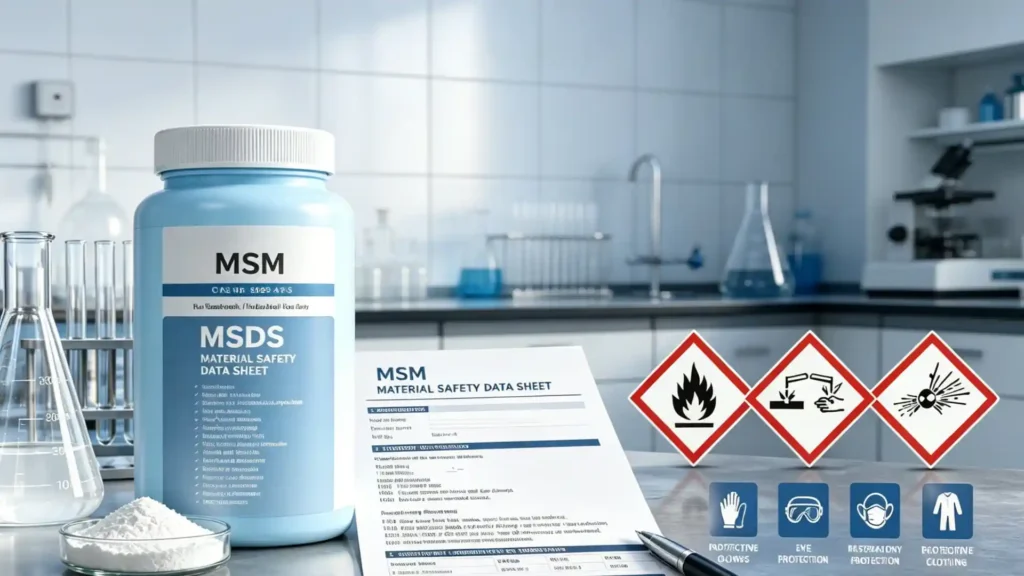
This article is about the Methyl Sulfonyl Methane Material Safety Data Sheet. That is Methyl Sulfonyl Methane MSDS.
Section 1: Identification of the Substance
1.1 Product Identifier
Product Name: Methyl Sulfonyl Methane (MSM)
Synonyms: Dimethyl Sulfone
CAS No.: 67-71-0
Chemical Formula: C₂H₆O₂S
Molecular Weight: 94.13 g/mol
1.2 Identified Uses and Uses Advised Against
Identified Uses: R&D
Uses Advised Against: No restricted uses identified, provided handling and storage guidelines are followed.
1.3 Details of the Supplier
Company name: Shenzhen JaYoo Biotech Co., Ltd
Add.: Unit 7C92B, Building 213, Tairan Technology Park, No. 113 Tairan 4th Road
Tian’an Community, Shatou Subdistrict, Futian District, Shenzhen, China
Contact email: info@jayoobio.com
Section 2 Hazards Identification
2.1 Classification of the Substance
According to Regulation (EC) 1272/2008 (GHS/CLP): Not classified as a hazardous substance
2.2 GHS Label Elements
Signal Word: None
Pictograms: None
Hazard Statements: None
Precautionary Statements:
P261: Avoid breathing dust.
P262: Do not get in eyes, on skin, or on clothing.
P271: Use only outdoors or in a well-ventilated area.
2.3 Other Hazards
May cause mild skin or eye irritation upon prolonged contact. To the best of our knowledge, the toxicological properties have not been fully investigated. Combustion may produce harmful by-products.
Section 3: Information on Ingredients
| Chemical Name | CAS Number | EC Number |
| Methyl Sulfonyl Methane | 67-71-0 | 200-665-9 |
Section 4: First-Aid Measures
4.1 Description of First-Aid Measures
Eye Contact: Immediately flush eyes with plenty of running water for at least 15 minutes, holding eyelids open. Do not use eye ointment. Seek medical attention if irritation persists.
Skin Contact: Wash contaminated skin thoroughly with plenty of water and non-abrasive soap for at least 15 minutes, paying attention to folds and crevices. Remove contaminated clothing and wash before reuse. Apply emollient to irritated skin. Seek medical help if irritation continues.
Inhalation: Move the victim to fresh air. If breathing is irregular or stopped, administer artificial respiration. Keep the victim at rest and warm. Seek immediate medical attention.
Ingestion: Do not induce vomiting. If conscious, rinse mouth with water. Loosen tight clothing (collar, belt). Never give anything by mouth to an unconscious person. Seek medical attention promptly.
4.2 Most Important Symptoms and Effects
Acute Effects: Mild skin/eye irritation, coughing if inhaled in large quantities. Delayed Effects: No known delayed effects reported.
4.3 Medical Attention and Special Treatment Needed
Treat symptomatically. Inform the physician of the product name and SDS details.
Section 5: Fire-Fighting Measures
5.1 Suitable Extinguishing Media
Use water spray, alcohol-resistant foam, dry chemical powder, or carbon dioxide (CO₂). Do not use a direct water jet on solid material to avoid dust dispersion.
5.2 Special Hazards Arising from the Substance/Mixture
Combustion products include carbon oxides (CO, CO₂) and sulfur oxides (SO₂, SO₃), which are toxic and irritating. The product may be combustible at high temperatures (flash point: 143°C open cup).
5.3 Advice for Firefighters
Wear self-contained breathing apparatus (SCBA) and full protective clothing. Ensure adequate ventilation of the fire area. Cool closed containers with water spray until the fire is completely extinguished.
Section 6: Accidental Release Measures
6.1 Personal Precautions, Protective Equipment, and Emergency Procedures
Avoid dust formation. Wear appropriate personal protective equipment (see Section 8). Do not breathe dust, vapors, or mist. Ensure the area is well-ventilated.
6.2 Environmental Precautions
Do not allow the product to enter drains, sewers, or natural water bodies. Prevent contamination of soil and water sources.
6.3 Methods and Materials for Containment and Cleaning Up
Sweep up or shovel the spilled material carefully. Transfer to suitable, closed containers for disposal. Wash the contaminated area with water and detergent. Dispose of waste in accordance with local regulations.
Section 7: Handling and Storage
7.1 Precautions for Safe Handling
Provide appropriate exhaust ventilation at work areas where dust is generated. Avoid contact with eyes, skin, and clothing. Wash your hands thoroughly after handling. Use in a well-ventilated area.
7.2 Conditions for Safe Storage, Including Any Incompatibilities
Store in a tightly closed container in a dry, cool, and well-ventilated place. Recommended storage temperature: 15-30°C. Keep away from heat sources, open flames, and incompatible substances (such as strong oxidizers). Protect from moisture.
Section 8: Exposure Controls
8.1 Control Parameters
No occupational exposure limits (OEL) established for this substance.
8.2 Exposure Controls
- Respiratory Protection: Respiratory protection is not required under normal conditions. For nuisance dust levels, use N95 (US) or P1 (EN 143) dust masks, tested and approved by NIOSH (US) or CEN (EU).
- Hand Protection: Wear chemical-resistant gloves (e.g., nitrile or latex). Inspect gloves before use; replace if damaged. Remove gloves properly to avoid skin contact. Wash your hands after use.
- Eye Protection: Use safety goggles or a face shield tested and approved to NIOSH (US) or EN 166 (EU) standards.
- Body Protection: Wear protective clothing (lab coat or coveralls) appropriate for the work environment.
Section 9: Physical and Chemical Properties
| Property | Value |
| Appearance | White crystalline |
| Odour | Odourless |
| Melting Point | 109-111°C |
| Solubility in Water | Soluble |
Section 10: Stability and Reactivity
10.1 Reactivity
Stable under normal handling and storage conditions.
10.2 Chemical Stability
Stable at room temperature.
10.3 Possibility of Hazardous Reactions
No hazardous reactions known under normal conditions. Avoid contact with strong oxidizing agents.
10.4 Incompatible Materials
Strong oxidizers, strong acids, and strong bases.
Section 11: Toxicological Information
- Acute Toxicity: Oral LD₅₀ (rat) > 5000 mg/kg; Dermal LD₅₀ (rabbit) > 5000 mg/kg. Low acute toxicity.
- Skin Irritation: May cause mild irritation upon prolonged contact.
- Eye Irritation: May cause mild irritation if contacted.
- Inhalation: May cause coughing and respiratory tract irritation in high dust concentrations.
- Carcinogenicity: Not classified as a carcinogen by IARC, EPA, or EU.
- Mutagenicity/Teratogenicity: No data available indicating mutagenic or teratogenic effects.
- Note: This substance has GRAS (Generally Recognized As Safe) status for certain uses, as recognized by the FDA (2008).
Section 12: Ecological Information
12.1 Toxicity to Aquatic Organisms
No data available on aquatic toxicity. Avoid release to aquatic environments.
12.2 Persistence and Degradability
Expected to be biodegradable under aerobic conditions.
12.3 Bioaccumulative Potential
Low bioaccumulation potential due to high water solubility.
Section 13: Disposal Considerations
Dispose of waste and contaminated packaging in accordance with local, state, and national regulations. Do not dispose of in household waste. Contaminated waste should be treated as non-hazardous waste unless mixed with other hazardous substances.
Section 14: Transport Information
Not classified as dangerous goods for transport by road, rail, air, or sea.
Section 15: Regulatory Information
- EU Regulation (EC) 1272/2008 (CLP): Not classified.
- US FDA: GRAS status for certain applications (2008).
- REACH: Exempt from registration or not requiring registration based on tonnage.
Section 16: Other Information
This SDS is prepared based on available data and is accurate to the best of our knowledge as of the revision date. It is the user’s responsibility to comply with all applicable regulations and safety practices. For additional information, contact the supplier.
Disclaimer: The information provided herein is intended for safety guidance only and does not constitute a warranty or guarantee of any kind, expressed or implied.
Shenzhen JaYoo Biotech is committed to providing high-quality MethylSulfonylMethane for industrial and research applications. Adhering to the safety guidelines outlined in this MSDS ensures proper handling and usage of MSM bulk powder. JaYoo Biotech emphasizes safety and quality, offering reliable support and high-grade Dimethyl sulfone materials to meet your needs.