
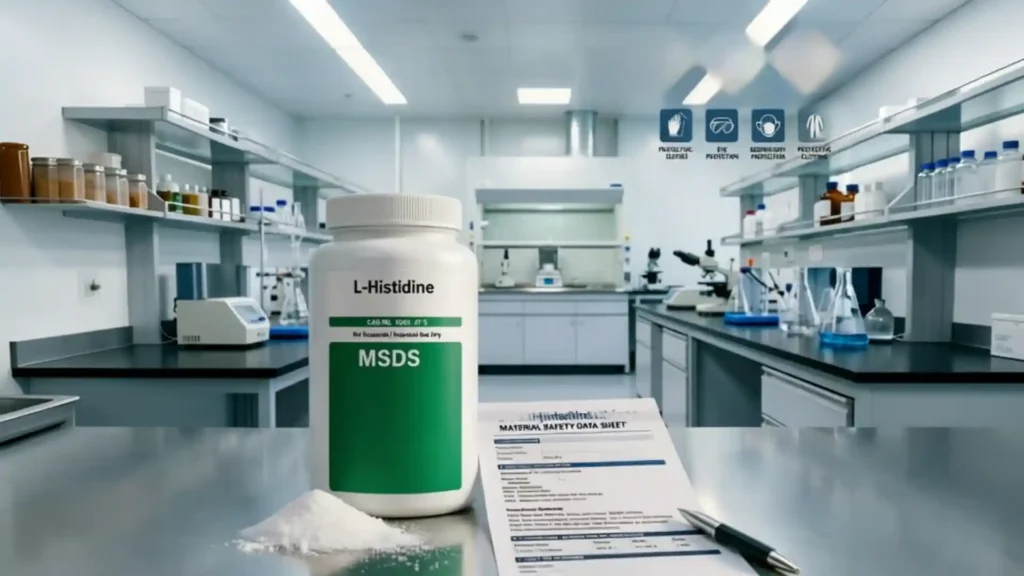
This article offers an in-depth examination of the L-Histidine MSDS, providing essential insights for your reference.
Introduction
L-histidine is an amino acid containing an imidazole ring, which is a semi-essential amino acid for the human body. It participates in key physiological processes, including protein synthesis, hemoglobin and histamine production, immune regulation, and maintenance of acid-base balance.
It has good water solubility and high bioavailability. Widely used in dietary supplements and animal health products.
Identification
Product Identifier
- Common Name: L-Histidine
- CAS No.: 71-00-1
- Synonyms: (S)-2-Amino-3-(1H-imidazol-4-yl)propanoic acid; L-2-Amino-3-(4-imidazolyl)propionic acid
- Application: Pharmaceutical intermediate, food additive (nutritional supplement), feed additive, laboratory reagent
- 1.2 Details of the Supplier of the L-Histidine Safety Data Sheet
- Company Name: Shenzhen JaYoo Biotech Co., Ltd
- Address: Unit 7C92B, Building 213, Tairan Technology Park, No. 113 Tairan 4th Road, Tian’an Community, Shatou Subdistrict, Futian District, Shenzhen, China
- Telephone: 13870773083
- Emergency Contact: 13870773083
Hazards Identification
Classification of the Substance or Mixture
According to GHS (Globally Harmonized System):
- Not classified as hazardous (Acute toxicity, Skin corrosion/irritation, Eye damage/irritation: No category).
- No specific GHS hazard statements apply.
GHS Label Elements
- Pictograms: None
- Signal Word: None
- Hazard Statements: None
- Precautionary Statements:
- P264: Wash hands thoroughly after handling.P270: Do not eat, drink, or smoke when using this product.P301 + P312: IF SWALLOWED: Call a POISON CENTER or doctor/physician if you feel unwell.
- P330: Rinse mouth.
Other Hazards
- No known acute or chronic hazards at normal use concentrations.
- Dust may cause mild respiratory irritation in sensitive individuals.
Composition/Information on Ingredients
| Component | Weight % | Hazard Classification |
| L-Histidine (pure) | ≥98.0% | Non-hazardous |
| Water (max) | ≤2.0% | Non-hazardous |
First-Aid Measures
Description of First-Aid Measures
- Inhalation: Remove to fresh air. If breathing is difficult, give oxygen. Seek medical attention if irritation persists.
- Skin Contact: Remove contaminated clothing. Rinse skin thoroughly with plenty of water for at least 15 minutes. If irritation occurs, consult a doctor.
- Eye Contact: Immediately flush eyes with plenty of water for at least 15 minutes, holding eyelids open. Seek medical advice if irritation remains.
- Ingestion: If a large amount is swallowed and adverse effects occur, call a poison control center or doctor. Rinse mouth with water. Do not induce vomiting unless directed by medical personnel.
Most Important Symptoms and Effects, Both Acute and Delayed
- Acute Effects: Mild gastrointestinal discomfort (nausea, diarrhea) if ingested in excessive quantities; rare allergic reactions (rash, itching) in sensitive individuals.
- Delayed Effects: No known delayed toxic effects.
Indication of Any Immediate Medical Attention and Special Treatment Needed
- No specific antidote. Treat symptomatically. Inform the physician of the product name and composition.
Fire-Fighting Measures
Extinguishing Media
- Suitable Extinguishing Media: Water spray, dry chemical, foam, carbon dioxide (CO2).
- Unsuitable Extinguishing Media: None known.
Special Hazards Arising from the Substance or Mixture
- Hazardous Combustion Products: Carbon monoxide (CO), carbon dioxide (CO2), nitrogen oxides (NOx) if burned at high temperatures.
- Fire Behavior: Not flammable under normal conditions. Dust clouds may be combustible in confined spaces (risk of dust explosion at high concentrations).
Advice for Fire-Fighters
- Wear self-contained breathing apparatus (SCBA) and full protective clothing.
- Ensure adequate ventilation to avoid dust accumulation during firefighting.
Accidental Release Measures
Personal Precautions, Protective Equipment, and Emergency Procedures
- Wear appropriate protective equipment (gloves, safety glasses, and a dust mask) to avoid skin or eye contact and to prevent inhalation of dust.
- Isolate the spill area and prevent unauthorized personnel from accessing it.
Environmental Precautions
- Prevent entry into waterways, sewers, or soil. If spilled into the environment, contain and clean up promptly.
Methods and Materials for Containment and Cleaning Up
- Small Spills: Sweep or vacuum up carefully. Transfer to a closed container for disposal.
- Large Spills: Collect using mechanical equipment (e.g., industrial vacuum). Avoid generating dust. Dispose of in accordance with local regulations.
Handling and Storage
Precautions for Safe Handling
- Avoid dust formation and inhalation. Use in a well-ventilated area.
- Wash your hands and face after handling. Do not eat, drink, or smoke in the work area.
- Use appropriate tools to avoid dust dispersion (e.g., closed transfer systems).
Conditions for Safe Storage, Including Any Incompatibilities
- Store in a cool, dry, well-ventilated area. Keep the container tightly closed when not in use.
- Recommended Storage Temperature: 15-30°C (59-86°F).
- Protect from moisture, heat, and direct sunlight.
- Incompatibilities: Strong oxidizing agents, strong acids/bases (may cause decomposition).
Exposure Controls/Personal Protection
Control Parameters
- No occupational exposure limits (OELs) established by OSHA, ACGIH, or EU EH40.
- Recommended exposure limit: None (product is non-hazardous at normal use).
Exposure Controls
- Engineering Controls: Provide adequate ventilation to minimize dust levels.
- Personal Protective Equipment (PPE):
- Respiratory Protection: Dust mask (N95 or equivalent) if dust generation is excessive.
- Hand Protection: Nitrile or latex gloves.
- Eye Protection: Safety glasses or goggles.
- Skin Protection: Long-sleeved clothing to avoid skin contact.
Physical and Chemical Properties
| Property | Value |
| Appearance | White to off-white crystalline powder |
| Odor | Odorless |
| Solubility in Organic Solvents | Slightly soluble in ethanol; insoluble in ether, chloroform |
Stability and Reactivity
Reactivity
- Stable under normal handling and storage conditions.
Chemical Stability
- Stable at room temperature; decomposes at high temperatures.
Possibility of Hazardous Reactions
- No hazardous reactions known under normal use.
Conditions to Avoid
- Excessive heat, open flames, and contact with strong oxidizing agents.
Incompatible Materials
- Strong acids, strong bases, and oxidizing agents.
Hazardous Decomposition Products
- Carbon monoxide, carbon dioxide, nitrogen oxides.
Toxicological Information
Information on Toxicological Effects
- Acute Toxicity:
- Oral LD50 (rat): >5000 mg/kg (non-toxic).
- Dermal LD50 (rabbit): >2000 mg/kg (non-irritating).
- Inhalation LC50 (rat): >5 mg/L/4h (non-toxic).
- Skin Corrosion/Irritation: Rabbit, 4-hour exposure: No irritation (GHS Category 0).
- Eye Damage/Irritation: Rabbit: No irritation (GHS Category 0).
- Sensitization: No known skin sensitization (OECD 406 test: Negative).
- Mutagenicity: Ames test: Negative (no mutagenic activity).
- Carcinogenicity: IARC Classification: Not classified as carcinogenic.
- Reproductive Toxicity: No adverse effects on reproduction in animal studies (rat, mouse) at doses up to 1000 mg/kg/day.
- Chronic Toxicity: No chronic toxicity reported in long-term studies.
Ecological Information
Toxicity to Aquatic Organisms
- Fish (Zebrafish) LC50: >1000 mg/L (96h, static test).
- Daphnia EC50: >1000 mg/L (48h).
- Algae (Selenastrum capricornutum) EC50: >1000 mg/L (72h).
Persistence and Degradability
- Biodegradable: Readily biodegradable in aerobic conditions.
Bioaccumulative Potential
- Low bioaccumulation potential (log Koc 1).
Mobility in Soil
- Moderate mobility in soil.
Results of PBT and vPvB Assessment
- Not classified as PBT (Persistent, Bioaccumulative, Toxic) or vPvB (very Persistent, very Bioaccumulative).
Other Adverse Effects
- No adverse effects on terrestrial organisms at environmentally relevant concentrations.
Disposal Considerations
Waste Treatment Methods
- Disposal: Dispose of in accordance with local, state, and federal regulations.
- Unused Product: Can be disposed of as non-hazardous waste if unused and uncontaminated.
- Contaminated Product: If contaminated with hazardous substances, classify and dispose of as hazardous waste.
- Packaging: Empty containers should be rinsed and disposed of as non-hazardous waste or recycled where possible.
Transport Information
UN Number
- Not regulated (no UN number assigned).
UN Proper Shipping Name
- Not applicable (non-hazardous for transport).
Transport Hazard Class(es)
- None.
Packing Group
- None.
Environmental Hazards
- Not a marine pollutant.
Special Precautions for User
- No special transport precautions required. Transport in closed containers, protected from moisture and heat.
Transport in Bulk According to Annex II of MARPOL 73/78 and the IBC Code
- Not applicable (non-hazardous).
Regulatory Information
Safety, Health, and Environmental Regulations/Legislation Specific to the Substance or Mixture
- US Regulations:
- FDA: Generally Recognized as Safe (GRAS) for use in food (21 CFR 184.1223).
- OSHA: Not regulated as a hazardous chemical (29 CFR 1910.1200).
- EU Regulations:
- REACH: Registered under REACH (EC No. 200-745-3); no restrictions.
- Food Additives: Approved as a food supplement (EEC 1333/2008).
- Other Countries: Comply with local regulations for food/pharmaceutical ingredients.
Chemical Safety Assessment
- A chemical safety assessment has been conducted and confirms that the product is non-hazardous under normal use conditions.
Other Information
- This MSDS is prepared based on available data and is intended to provide safety information for proper handling, use, and disposal of the product.
- The information contained herein is accurate to the best of our knowledge as of the preparation date, but no warranty is expressed or implied regarding its completeness or accuracy.
About JaYoo Biotech :
JaYoo Biotech is committed to providing high-quality L-histidine for industrial and research applications.
Adhering to the safety guidelines outlined in this MSDS ensures proper handling and usage of L-histidine bulk powder. JaYoo Biotech emphasizes safety and quality, offering reliable support and high-grade materials for your needs.