
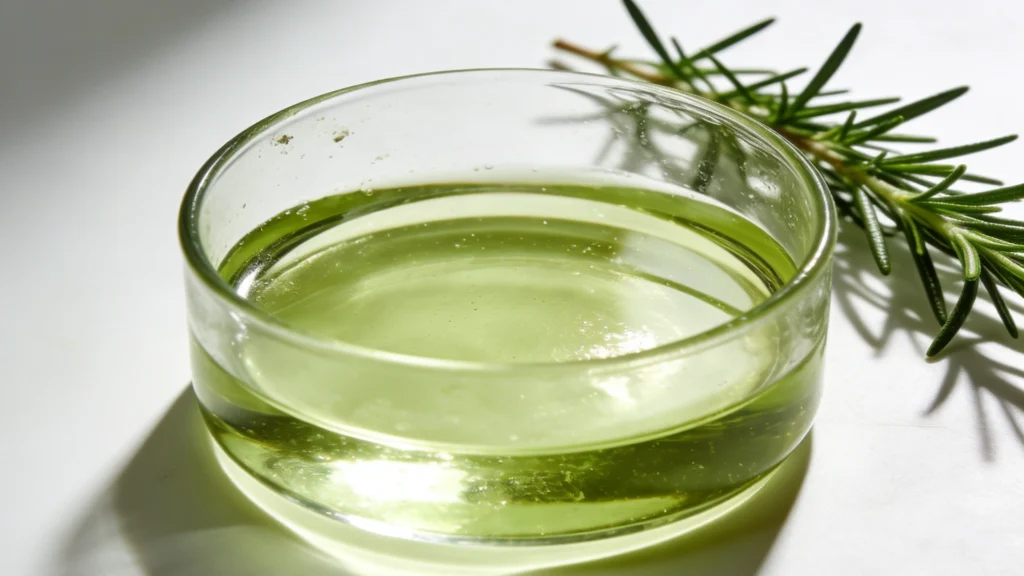
Rosemary (Rosmarinus officinalis), a traditional herb native to the Mediterranean coast, its extract has become a “star product” in the field of natural functional ingredients.
This is due to its rich content of multiple active components such as rosmarinic acid, carnosic acid, and ursolic acid, as well as its multiple biological properties, including antioxidant, anti-inflammatory, and antibacterial effects.
With the upgrading of consumers’ demand for green and safe products and the breakthrough of scientific research technology, the application scenarios of rosemary extract have been continuously expanded.
It has extended from the food industry to cosmetics, medical and health care, animal feed, and other fields, forming a diversified industrial pattern.
This article will systematically analyze its application status, core advantages, and development trends based on the latest research results and market data.
1. Core Active Components and Functional Basis of Rosemary Extract
The excellent performance of rosemary extract stems from its complex system of active components. The differences in solubility and functional characteristics of different components determine their application directions in various fields.
According to solubility, it can be divided into fat-soluble and water-soluble categories. Various components work synergistically to form the core competitiveness of “safety and high efficiency”.
| Component Type | Core Components | Main Functions | Applicable Fields |
| Fat-soluble | Carnosic acid, Ursolic acid | High-temperature stable antioxidant, promoting skin regeneration, anti-inflammatory and analgesic | Fried/baked food, skin care products, medicine |
| Water-soluble | Rosmarinic acid | Free radical scavenging, antibacterial, improving cognition | Beverages, aquatic products, health food |
| Volatile components | 1,8-Cineole, Camphor | Aromatic flavoring, soothing nerves, repelling insects | Condiments, daily chemical products, pet food |
2. Panoramic View of Multi-field Applications: From Basic Needs to High-end Innovation
2.1 Food Industry: The Mainstream Choice of Natural Antioxidants
The food industry is the most mature application field of rosemary extract, with core demands focusing on antioxidant preservation and natural antiseptics. Compared with synthetic antioxidants (BHT, TBHQ, etc.), it has significant safety advantages.
At present, Japan, the United States, and other countries have imposed restrictions on some synthetic antioxidants. Rosemary extract, however, has passed the safety assessment of FAO/WHO and been included in China’s GB1886.172-2016 food additive standard, which has further accelerated its application with international market recognition.
In May 2024, the Australian Federal Gazette issued an announcement, clearly expanding the food application scope of rosemary extract to cover anhydrous edible oils, fancy bread, fermented meat products, and other foods. It also specifies specific maximum addition amounts, such as 50mg/kg in anhydrous edible oils and up to 100mg/kg in dry sausages.
This standard revision provides a compliance basis for its promotion in the Oceanian food market and confirms its global safety recognition.
Its prominent advantage lies in its high-temperature stability (withstanding 190-240℃), making it perform excellently in high-temperature processing scenarios such as frying and baking. Research shows that after adding rosemary extract to soybean oil, its oxidation induction period is 1.7 times longer than that of samples added with BHT; when applied in linseed oil, its antioxidant activity is as high as 97.66%, far exceeding similar natural extracts. At present, it has been widely used in edible oils, meat products, dairy products, baked goods, etc. For example, Haitian Flavoring & Food Co., Ltd. and Qianhe Condiment & Food Co., Ltd. use it to extend the shelf life of condiments such as soy sauce and vinegar.
In the field of beverages and flavored foods, rosemary extract is becoming an innovative direction. NOL rosemary water, launched by French Rosemary Water, only contains extract and mountain spring water. Research by Northumbria University has confirmed that it can improve cognitive ability by 15%; Foods Alivet adds it to flax biscuits to achieve dual upgrading of flavor and nutrition.
2.2 Cosmetics and Personal Care: From Basic Care to Scar Repair
The application of rosemary extract in the cosmetics field has extended from basic skin care to functional products. Its antioxidant properties can delay skin aging, and its antibacterial effect can improve acne problems. The latest research has further revealed its breakthrough value in scar repair – a 2025 study by the University of Pennsylvania found that carnosic acid can activate the TRPA1 nerve sensor in the skin, switching the wound healing mode from “scarring” to “regeneration”, and its safety is better than that of mustard oil and other similar active substances.
Current market products show diversified characteristics, with outstanding performance in the field of hair care. For example, brands like Petal Fresh have launched silicone-free shampoos containing rosemary extract, which can both improve dandruff and stimulate hair growth.
Rene Furterer’s oil-controlling and repairing shampoo is more representative. It uses rosemary extract with a purity of 96.5% as the core oil-controlling component, combined with flaxseed extract, to achieve long-lasting oil control for 38 hours. Among 200 testers with sensitive skin after perming and dyeing, 97% reported no discomfort.
In the field of high-end skin care, product innovation is also active. Himalaya’s organic massage oil combines rosemary extract with eucalyptus oil, which has both muscle relaxation and anti-aging effects. In segmented categories such as sun protection and makeup removal, new products combining rosemary extract with lycopene and lavender essential oil have also emerged.
A brand created by Lin Yanling, a post-2000s youth from Macao, has become an industry benchmark. Its model of “Guangzhou R&D headquarters + Guizhou planting base + Macao production base” is highly representative: 50 mu of rosemary was trial-planted in Bijie, Guizhou, in 2022, and the planting scale has expanded to 1,300 mu by 2024, with a production base certified by China, the European Union, and the United States.
The high-end daily chemical products made in Macao by this brand not only cover more than 20 local supermarkets and pharmacies, but also won a large order of 20 million yuan from Malaysian buyers at the 2024 Asia Cosmetic Ingredients Exhibition, becoming a typical case of rural revitalization and coordinated development of the Greater Bay Area.
2.3 Medical and Health Care: Release of Medicinal Potential of Natural Active Components
The medicinal value of rosemary extract has long been recorded in traditional medicine, and its medicinal history can be traced back to cuneiform records in 5000 BC. It is detailed in the “Natural History” by the ancient Roman scholar Pliny and “De Materia Medica” by Dioscorides, and has been introduced to China for more than 1,800 years.
Modern pharmacological research has further expanded its medicinal boundaries. In addition to the traditionally recognized anti-inflammatory and neuroprotective effects, the latest research confirms its significant potential in the treatment of cardiovascular diseases. Active components such as rosmarinic acid can exert effects by regulating blood pressure, combating myocardial ischemia, enhancing heart function, and preventing atherosclerosis.
This provides a new direction for the auxiliary treatment of common cardiovascular diseases such as hypertension and coronary heart disease, and its safety is far superior to that of some traditional chemical drugs. As a core water-soluble component, rosmarinic acid has an inhibition rate of 60%-75% on respiratory tract infections and digestive system inflammation.
In the field of neuroprotection, its terpenoid components can cross the blood-brain barrier to improve mitochondrial function. Research by Northumbria University confirms that rosemary extract can improve cognitive ability by 15%, providing a new path for the auxiliary treatment of Alzheimer’s disease.
At present, its application has extended from traditional herbal medicine to the development of modern preparations, and it is widely added to over-the-counter drugs such as cold granules and anti-inflammatory ointments. Some enterprises are promoting clinical research in the fields of arthritis and skin disease treatment. At the same time, as a raw material for health food, rosemary extract is used in the production of antioxidant capsules and cognitive improvement drinks, which conforms to the consumption trend of “natural health preservation”, and the market demand grows at an annual rate of more than 8%.
2.4 Animal Feed: Innovative Application of Green Additives
Driven by the “antibiotic prohibition and restriction” policy in the animal husbandry industry, rosemary extract has achieved rapid breakthrough as a natural feed additive. Its antibacterial and anti-inflammatory properties can replace antibiotics to prevent intestinal diseases in livestock. The feed additive combining rosmarinic acid with bamboo fiber can not only reduce the diarrhea rate of pigs, but also improve the meat flavor, and the cost is 30% lower than that of traditional antibiotics. Taojiang Zhiziyuan Biotechnology Co., Ltd. in Hunan Province has obtained the feed additive production license from the Ministry of Agriculture and Rural Affairs by virtue of such innovative products, with an annual production capacity of 120,000 tons, and its products are exported to the Southeast Asian market.
In the field of pet food, rosemary extract also has obvious advantages. Its volatile component, 1,8-cineole not only has a natural insect repellent effect, but also can improve the palatability of pet food, so it has been included in the core raw material list by many international pet food brands.
A major policy breakthrough has further promoted the explosive growth of this field. In April 2024, the European Commission issued Regulation (EU) 2024/1068, officially approving rosemary extract as a feed additive for cats and dogs, classified as an “antioxidant” among “technical additives”, with a validity period until May 5, 2034.
This regulation has cleared the obstacles for rosemary extract to enter the European pet food market, directly driving the annual growth rate of this segmented market to more than 15%, an increase of 3 percentage points from the previous growth rate.
3. Market Scale and Development Trend Analysis
3.1 Current Status of Global and Chinese Market Scale
The rosemary extract market shows a steady growth trend, and China has become a core global producer and consumer. Relevant data shows that the market scale of rosemary extract in China reached 596 million yuan in 2023.
In the first quarter of 2024, the single-quarter market scale reached 901 million yuan, an increase of 22% compared with the same period last year. The global market scale is expected to grow from 1.82 billion yuan in 2023 to 2.431 billion yuan in 2029, with a compound annual growth rate of 4.28%.
In terms of demand structure, the food industry remains the largest demand end, accounting for 58%; the demand for cosmetics and medical fields accounts for 25% and 12% respectively; the animal feed field accounts for only 5% but has the fastest growth rate. The following are the global market scale forecast trend and China’s market demand structure charts:
3.2 Core Development Trends
1. Technological upgrading promotes product quality improvement: The application of supercritical fluid extraction, microwave-assisted extraction, and other technologies has increased the purity of extracts from 60%-70% of traditional processes to more than 95%. The breakthrough of precise extraction technology for monomer components such as carnosic acid and rosmarinic acid has laid a foundation for high-end medical applications.
2. Accelerated industrial chain integration: The full-chain layout from planting to end products has become a trend. For example, the model of “Guizhou planting base + Guangzhou R&D headquarters + Macao production base” created by Lin Yanling’s team realizes the integration from organic raw materials to high-end products. The products have obtained organic certifications from China, Europe, and the United States, enhancing international competitiveness.
3. Continuous expansion of application scenarios: Research in emerging fields such as biological pesticides and environmental protection materials has made progress. The antibacterial properties of rosemary extract have enabled its application in fruit and vegetable preservatives and natural disinfectants, and the market space will be further expanded in the future.
4. Dual driving forces of policy and demand: The restrictive policies of various countries on synthetic additives, consumers’ preference for natural products, and China’s “rural revitalization” strategy’s support for characteristic planting industries have jointly provided development impetus for the rosemary extract industry. Large-scale planting bases have been formed in Guizhou, Yunnan, and other places, driving the coordinated development of the industrial chain.
4. Conclusion
Rosemary extract has built a diversified application system in food, cosmetics, medicine, feed, and other fields relying on its core advantages of “safety, naturalness, and multi-effectiveness”. From a traditional Mediterranean herb to a globally popular functional ingredient, its industrial development relies not only on technological breakthroughs in the research of active components, but also benefits from the market wave of green consumption upgrading.
At present, China has formed significant advantages in planting scale, extraction technology, and industrial integration. In the future, with continuous technological innovation and the expansion of application scenarios, the rosemary extract industry will usher in a transformation from “scale growth” to “value enhancement”, becoming a benchmark industry in the field of natural functional ingredients.