
1. Introduction
In recent years, the concept of “clean labels” has become deeply rooted in people’s minds, and the demand for natural preservatives has continued to rise. Rosemary extract, with its excellent antioxidant properties, has been increasingly widely used in many industries such as food, cosmetics, and health products, becoming one of the preferred raw materials to replace synthetic antioxidants.
It performs prominently in delaying oil oxidation, protecting active ingredients of products, and extending shelf life. Meanwhile, the safety, stability, and compliance of raw materials are also the basic points that manufacturers need to reasonably control in the application process.
Based on the actual application needs of manufacturers, this article sorts out the core points of safety assessment for rosemary extract, covering key links such as basic cognition, regulatory compliance, supply chain screening, and incoming inspection, providing practical guidance for enterprises to scientifically control raw materials and avoid quality risks.
2. Basic Cognition of Rosemary Extract (Must-Read for Manufacturers)
1. Core Active Ingredients and Functions
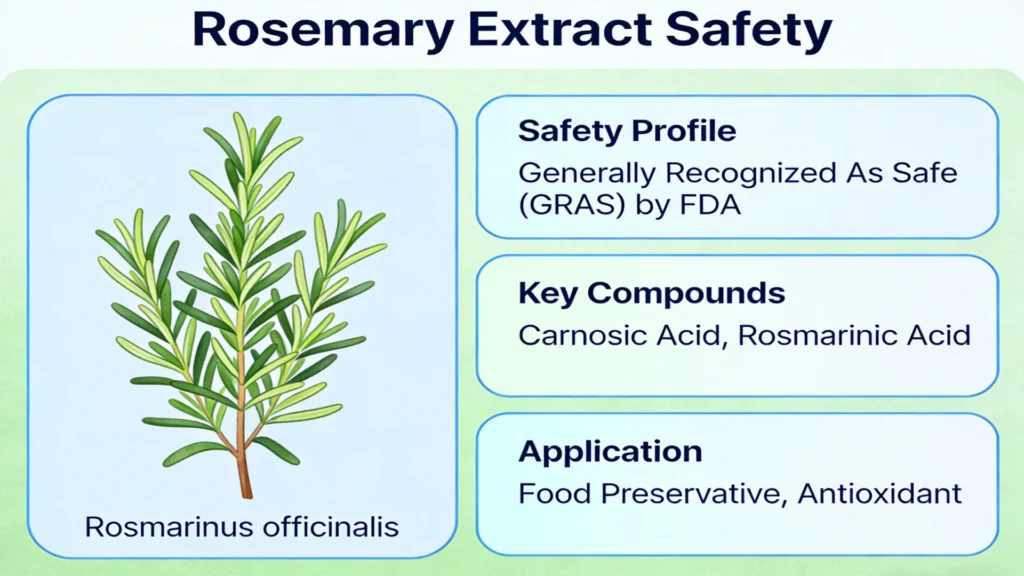
The antioxidant capacity of rosemary extract mainly comes from three phenolic components, and different extraction processes will significantly affect the proportion of these three. For example, supercritical CO₂ extraction can better retain carnosic acid, while solvent extraction may bring in more impurities. The specific component information is as follows:
Carnosic acid: typical content range 5%–20%, a strong antioxidant, and heat-resistant;
Rosmarinic acid: typical content range 2%–10%, with both antioxidant and anti-inflammatory effects, and good water solubility;
Carnosol: typical content range 1%–5%, can synergistically antioxidant, and has antibacterial effect.
2. Application Scenarios of Different Specifications of Products
Oil-soluble powder: mainly used in oils and fats, meat products, fried foods; key safety concerns are solvent residues and heavy metals;
Water-soluble powder: suitable for beverages, health products, water-based formulations; core concerns are microbial control and solubility;
Liquid extract: commonly used in cosmetics, condiments, sauces; need to pay attention to the compatibility of preservative systems and solvent types.
3. Three Safety Details Often Ignored by Manufacturers
Detail 1: Differences in Impurity Profiles Caused by Extraction Processes
For products extracted with different solvents (ethanol, hexane, acetone), the types and limit requirements of residual solvents are different. When exporting to the EU, the residual hexane must be less than 29ppm.
Detail 2: Impact of Storage Conditions on Safety
Under high temperature and high humidity conditions, some phenolic components in rosemary extract will oxidize and degrade, possibly producing unknown by-products. It is recommended to store in a sealed, light-proof and room temperature environment, and use it up within 6 months after opening.
Detail 3: Risk of Batch-to-Batch Stability to Finished Product Safety
Even from the same supplier, the content of active ingredients in different batches may fluctuate by ±20%. If directly put into production without testing, it may lead to unstable antioxidant effect of finished products, and even cause irritation due to excessive content.
3. Industry-Specific Regulatory Compliance Requirements
Overview of Key Regulations in Various Industries
Food industry: Follow the standard GB 2760-2024; it can be used in appropriate amounts according to production needs except for a few categories such as dairy products and infant food; a common violation case is that a meat product enterprise was notified by the State Administration for Market Regulation for over-range use.
Cosmetics industry: Based on the “Cosmetics Safety Technical Specifications” (2022 Edition), there is no clear concentration upper limit, but a safety assessment must be completed; a common violation case is that a brand of facial mask was ordered to be recalled due to excessive impurities.
Health product industry: Implement the standard GB 16740-2014; the usage amount is determined by the product formula, and the specific content must be marked; a common violation case is that a product was removed from the shelves because it did not mark the specific content of rosemary extract.
Special Attention for Export Business: Differences in National Standards
China, the United States (GRAS), the European Union (E392), and Japan all allow the use of rosemary extract, but there are differences in the requirements for pesticide residues and solvent residues. Among them, the EU has the strictest requirements for pesticide residues, following the EU 2018/1037 standard.
Reminder for export manufacturers: The EU’s requirements for pesticide residues are 3–5 times stricter than those in China. If your products are planned to be exported to Europe, you should require suppliers to provide special pesticide residue test reports instead of relying only on regular COA.
4. Supply Chain Safety: How to Select Reliable Raw Material Suppliers
Selecting the right supplier is the first line of defense to control the safety of raw materials. The following standards are for reference by your purchasing department.
1. What a Qualified COA (Certificate of Analysis) Should Contain
Mandatory test items: Content (carnosic acid, rosmarinic acid, etc.), heavy metals (lead, arsenic, mercury, cadmium), microorganisms (total bacterial count, mold and yeast, coliforms), solvent residues (depending on the extraction process).
Recommended additional test items: Pesticide residues (especially for organic planting or export purposes), plasticizers (if plastic packaging or pipelines are used), polycyclic aromatic hydrocarbons (if smoked drying process is adopted).
Warning signs: Lack of batch number or production date on COA, lack of test method description, all items are “qualified” but no specific values.
2. List of Documents to Be Provided by Suppliers
Necessary documents: Specification sheet (specifying physical and chemical indicators and microbial indicators), COA (provided with each batch of goods), MSDS (Safety Data Sheet).
Recommended documents: Allergen declaration (confirming no common allergens such as gluten and soybeans), non-GMO declaration (commonly used for exporting to the EU), third-party test report (updated at least once a year).
3. Five Key Questions to Ask During On-Site Audit
1. Where is the raw material produced? Is there a fixed planting base?
2. What solvent is used in the extraction process? How to control residues?
3. Is each batch sampled and retained? How long is the sample retained?
4. Do you accept third-party testing designated by customers?
5. Have there been any returns or quality complaints in the past year? How to handle them?
4. What Kind of Suppliers Are Worth Long-Term Cooperation
Proactively provide complete documents instead of passively coping; have long-term data accumulation on the stability of product batches; be willing to work with customers to solve technical problems in application; have a clear traceability system that can trace from finished products to raw material origins.
5. Safety Verification After Raw Materials Enter the Factory (Practical Suggestions for Manufacturers)
Even if the supplier provides a complete COA, it is recommended that manufacturers implement the following acceptance process after the raw materials enter the factory.
1. Mandatory Items for Incoming Inspection
Appearance: Visual inspection, which should conform to the description in the specification sheet (such as light yellow to brown powder);
Odor: Olfactory identification, which should have a characteristic rosemary odor and no peculiar smell;
Solubility: Sampling test, which should be consistent with the description in the specification sheet;
Sample retention: Sealed and stored, with no less than 50g of sample retained per batch, stored for 1 year after the shelf life.
2. Scenarios Recommended for Entrusting Third-Party Testing
The first three batches of initial cooperation: Comprehensive testing to establish benchmark data; when changing suppliers or raw material origins: Re-evaluation; when quality abnormalities or customer complaints occur: Used for problem localization.
3. Safety Notes During Storage and Use
After opening: Use it up as soon as possible, preferably within 6 months; Environment: Cool, dry, light-proof, temperature <25℃, humidity <60%; Operation: Seal immediately after taking to avoid moisture absorption; Batch management: Different batches are not recommended to be mixed; if mixing is needed, compatibility test should be done first.
6. Common Industry Problems and Solutions
The following are the practical problems most concerned by manufacturers and corresponding solutions collected by our company in the tracking service of more than 200 batches of products in the past three years:
Problem 1: The product color darkens after addition. Possible cause: Oxidation of certain phenolic components in the extract. Recommended solution: Reduce the addition amount or switch to a more purified specification.
Problem 2: Antioxidant effect is not as expected. Possible cause: Actual content is lower than the marked value on COA. Recommended solution: Test the content after entering the factory and verify with the supplier.
Problem 3: Excessive pesticide residues when exporting to the EU. Possible cause: Different pesticide use habits in the raw material producing area. Recommended solution: Require suppliers to provide special pesticide residue test reports.
Problem 4: Unstable effect between batches. Possible cause: Fluctuations in raw materials or processes of suppliers. Recommended solution: Require a stricter content control range (such as ±5%).
Problem 5: Irritation caused in cosmetic formulations. Possible cause: Impurities in the extract or sensitivity to specific components. Recommended solution: Reduce the concentration or switch to a higher purity extract.
7. Summary and Recommendations
The safety of rosemary extract is verifiable and controllable—the key lies in the selection of suppliers and the establishment of an internal acceptance system.
For manufacturers, the most economical strategy is not to buy the cheapest raw materials, but to establish raw material access standards. The cost of remedying problems after they occur is much higher than that of checking in the early stage.
When selecting raw material suppliers, more important than price are: Document completeness—whether COA, MSDS, and third-party test reports are complete; Batch stability—whether the content fluctuation of consecutive batches is controllable; Problem response capability—whether the supplier is willing to solve problems together when quality abnormalities occur.
It is hoped that this article can provide practical reference for your raw material selection work.
Appendix
Appendix 1: List of Main Regulatory Documents
GB 2760-2024: National Food Safety Standard for the Use of Food Additives, applicable scope: Food;
GB 16740-2014: National Food Safety Standard for Health Food, applicable scope: Health products;
“Cosmetics Safety Technical Specifications” (2022 Edition): Applicable scope: Cosmetics;
FDA 21 CFR 182.20: List of Generally Recognized as Safe (GRAS) Substances, applicable scope: American food;
EU 1129/2011: Food Additive Regulation, applicable scope: EU food.
Appendix 2: Reference for Normal Ranges of Common Test Indicators
Carnosic acid content: 5%–20%, depending on the specification;
Lead: <1.0 mg/kg, food-grade requirement;
Arsenic: <0.5 mg/kg, food-grade requirement;
Total bacterial count: <1000 CFU/g, stricter for cosmetic grade (<100 CFU/g);
Solvent residue (ethanol): <5000 ppm, which can be lower according to customer requirements.