
1. Introduction
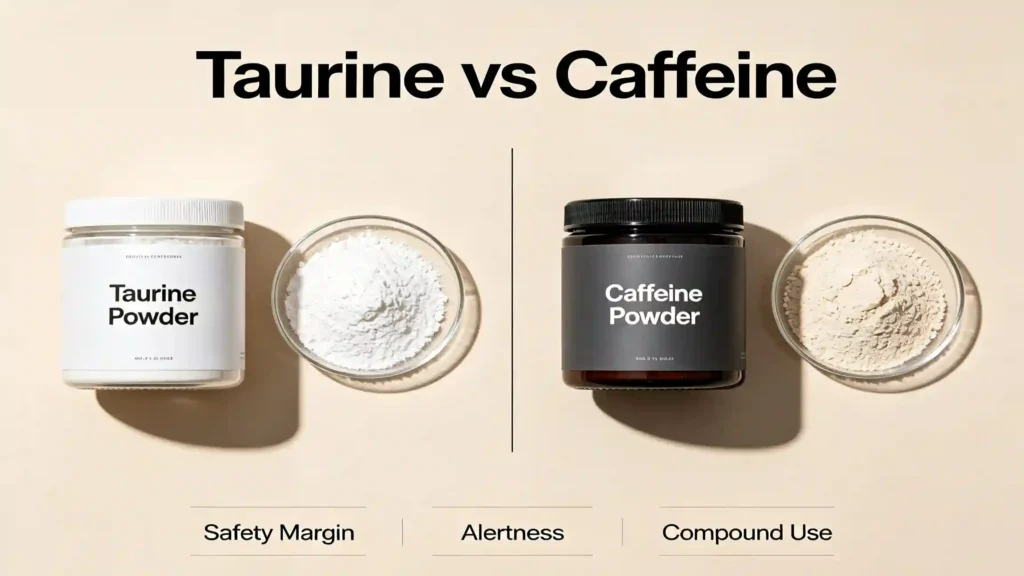
This paper systematically compares taurine vs caffeine from four dimensions: mechanisms of action, safety, regulatory restrictions, and compounding value.
Meanwhile, it aims to provide objective and actionable reference information for readers from an industrial perspective.
2. Separate Analysis: Understanding Caffeine and Taurine Respectively
2.1 Effects of Caffeine: A Fast and Potent Central Nervous System Stimulant
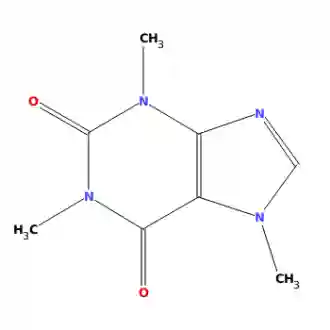
Caffeine is a methylxanthine alkaloid naturally found in coffee beans, tea leaves, and cacao pods.
Its mechanism of action is well-defined: competitive antagonism of adenosine receptors. Adenosine is a key signaling molecule that induces drowsiness in the human body.
By preemptively occupying adenosine receptors, caffeine blocks inhibitory signals to the nervous system, thereby delivering refreshing effects and boosting alertness.
Its core advantage lies in rapid onset: blood concentration peaks 30 to 60 minutes after oral administration, delivering instant wakefulness.
However, it also has prominent limitations:
- Half-life ranges from 3 to 5 hours in healthy adults (varies significantly among smokers, pregnant women, and people with liver dysfunction); intake in the afternoon may severely disrupt nighttime sleep.
- Tolerance develops rapidly; long-term users need to continuously increase dosage to achieve the same refreshing effect.
- Overdose triggers palpitations, anxiety, and hand tremors; high doses may raise risks of arrhythmia.
- Clear physical dependence is formed; sudden cessation causes withdrawal symptoms such as headaches and fatigue.
Clear authoritative intake recommendations have been established for caffeine regarding safety.
The European Food Safety Authority (EFSA) advises healthy adults to consume no more than 200 mg in a single serving and a maximum of 400 mg per day to avoid adverse reactions including palpitations and anxiety.
2.2 Effects of Taurine: A Broad-Spectrum Cytoprotective Agent
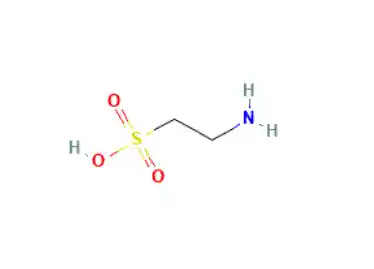
Taurine is a sulfur-containing β-amino acid that does not belong to the standard 20 proteinogenic amino acids, meaning it does not participate in protein synthesis.
It functions primarily as a functional small molecule and exists in free form at high concentrations in the human body, especially in the myocardium, retina, and skeletal muscle.
Unlike caffeine’s stimulating effect, taurine acts mainly through regulation and protection:
- Regulates cellular osmotic pressure to maintain intracellular water balance;
- Stabilizes cell membranes and alleviates oxidative stress damage;
- Modulates calcium homeostasis to support normal myocardial contraction rhythm;
- Scavenges free radicals to exert antioxidant and anti-inflammatory effects.
The most notable feature of taurine compared with caffeine is its extremely wide safety margin.
Extensive animal experiments and human clinical studies have failed to identify a clear toxicological threshold for taurine. No severe adverse events have been reported at conventional addition levels in energy drinks (typically 1,000 to 2,000 mg per can) or even higher doses. Neither the U.S. FDA nor EFSA has set an acceptable daily intake (ADI) upper limit for taurine.
Natural taurine is abundant in seafood, meat, and mammalian milk, while commercial taurine is almost entirely produced via chemical synthesis. Its purity, impurity control, and crystal form stability directly determine the taste and quality of end products.
3. Head-to-Head Comparison: Taurine vs Caffeine
Table 1
Core Differences Between Taurine and Caffeine
| Comparison Dimension | Caffeine | Taurine |
| Functional Property | Stimulant | Protective Agent |
| Onset Profile | Fast-acting | Sustained regulation |
| Duration of Effect | Short (several hours) | Long-term protection |
| Safety Profile | Clear upper intake limit | Wide safety margin |
| Dependence Risk | Yes | No |
| Impact on Sleep | Disruptive | Negligible influence |
| Regulatory Control | Strict | No ADI ceiling |
| Primary Application Scenario | Mental alertness & wakefulness | Physical maintenance, recovery and cell protection |
The comparison between taurine and caffeine is essentially the difference between an “accelerator” and a “shock absorber”: one drives rapid mental arousal, while the other stabilizes bodily function for sustained performance.
4. Synergistic Compounding: Why Energy Drinks Combine Both Ingredients
This raises a critical question: given their stark differences, why are they formulated together?
The answer is simple: they are not competitors, but ideal complementary partners.
The design logic of energy drinks is never an “either/or” choice, but a combination that leverages the strengths of each component. Caffeine delivers immediate, perceptible wakefulness — the core sensory benefit consumers seek from the product. Taurine, by contrast, provides background buffering and bodily protection.
Taurine effectively relieves caffeine-induced tachycardia, nervousness, and anxiety. Meanwhile, its antioxidant and cytoprotective effects accelerate physical recovery after intense mental or physical exertion. Combined use outperforms caffeine alone in improving focus, reaction speed, and athletic endurance.
For functional beverage formulators, the priority is not determining which ingredient is superior, but identifying an optimal compounding ratio. Based on statistics of commercially available products, the typical mass ratio of taurine to caffeine ranges from 2:1 to 5:1. Exact ratios must first comply with local regulations and be comprehensively optimized according to target consumer groups and product positioning.
5. Supplier Perspective: High-Quality Taurine Raw Materials Determine Formulation Success
While the industry widely debates whether taurine or caffeine delivers better effects, experienced formulators recognize a more practical reality: taurine powder from different suppliers can vary drastically in quality despite bearing the same name.
Though taurine has a simple chemical structure, its purity, heavy metal residues, moisture content, and crystal form consistency directly affect:
- Solubility and taste of finished products;
- Compatibility with other auxiliary materials;
- Long-term storage stability;
- Completeness of compliance documentation for global export markets.
As a professional supplier of taurine powder raw materials, we fully understand how these details impact brand clients. Our products feature the following core advantages:
- Purity ≥ 99.5%, complying with pharmacopeia standards of China, the United States, the EU, and other regions;
- Strict batch-to-batch consistency control to guarantee predictable raw material performance across production runs;
- Complete compliance documentation including COA, MSDS, Halal and Kosher certifications to support clients’ market access worldwide;
- Custom formulation optimization technical support for various dosage forms (liquid beverages, solid drinks, compressed candies).
6. Conclusions and Recommendations
The above analysis leads to a definitive conclusion:
Taurine and caffeine are not opposing alternatives, but a synergistic golden combination. Caffeine addresses the demand for instant alertness, while taurine delivers stability and sustained bodily support. A well-balanced blend ensures immediate sensory effects while safeguarding safety and long-lasting performance.
We offer the following recommendations based on differentiated product positioning:
- For products focusing on rapid wakefulness and short-term concentration: formulate around caffeine, supplemented with taurine to mitigate its side effects;
- For products targeting athletic endurance, daily energy replenishment, and gentle mental arousal: center formulations on taurine, with caffeine as a minor auxiliary ingredient.
Regardless of your product positioning, premium raw materials are the cornerstone of consistent quality. If you are seeking stable, high-purity taurine raw material suppliers, please contact us for samples and detailed technical data. We look forward to developing market-ready, high-quality products alongside you.
Contact Us
Jayoo Biotech
Phone: +86 15817492830
WeChat: 15817492830
E-mail:
info@jayoobio.com
sales@jayoobio.com
(Disclaimer: This document is for industry reference only and does not constitute medical advice. All formulation design and dosage levels shall comply with applicable local regulatory standards.)