
I Introduction
(S,S)-EDDS ((S,S)-Ethylenediamine‑N, N’-disuccinic acid) is among the best biodegradable aminopolycarboxylate chelating agents known (OECD 301B: >80 % biodegradation within 28 days).
Compared with EDTA and DTPA, its core advantage lies in high‑selective complexation capacity for Ca²⁺ and Mg²⁺ under alkaline conditions (pH 9‑11). Its complex stability constants toward transition metals (Fe³⁺, Cu²⁺, Mn²⁺, Zn²⁺) are comparable to or slightly lower than those of EDTA, while its degradation products are completely non‑toxic.
II Household & Industrial Cleaning Care
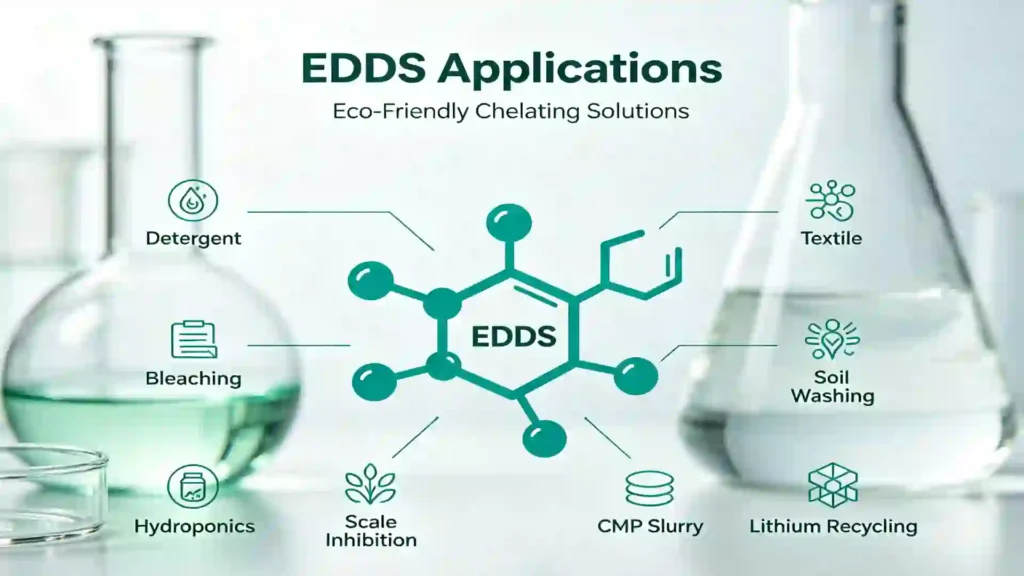
2.1 Automatic Dishwashing Detergent (ADW)
Functions: Water‑hardness sequestration, anti‑redeposition, glass‑corrosion inhibition
Mechanism: Within pH 9‑11, the log K stability constants of (S,S)-EDDS for Ca²⁺ and Mg²⁺ are 4.8 and 6.0, respectively. The molecular conformation of this isomer better matches the coordination geometry of Ca²⁺, delivering approximately 15 % higher complexation efficiency than EDTA at equal molar concentration. During dishwashing cycles, (S,S)-EDDS preferentially sequesters hardness ions to prevent deposition of CaCO₃/CaSiO₃ on tableware, while protecting glassware against iridescent corrosion.
Typical dosage: 1.5‑3.0 % (active substance basis) for liquid ADW; 2.0‑4.0 % for powder ADW.
Synergistic effects:
- When combined with polyacrylate (PAA) dispersant, (S,S)-EDDS enables 20‑30 % reduction in PAA dosage while improving anti‑scaling performance.
- Blended with MGDA (methylglycine diacetic acid), the two agents complement each other in hardness‑ion complexation, achieving 100 % EDTA substitution at pH 10.5.
Regulatory compliance: EU Ecolabel (Resolution 2017/1218) explicitly permits (S,S)-EDDS for ADW applications, with an emission limit of 0.8 g active substance per washing cycle. The resolution specifies that only the (S,S) isomer is allowed.
2.2 Concentrated Liquid & Powder Laundry Detergents
Functions: Removal of metal‑originated soil on textiles; fluorescent whitening agent stabilization
Mechanism: (S,S)-EDDS controls two sources of metals in laundry systems:
- Hard‑water‑derived Ca²⁺ and Mg²⁺;
- Transition‑metal ions adsorbed onto fabrics (especially Fe³⁺ from rust or industrial wastewater contamination).
Fe³⁺ catalyzes the decomposition of peroxide bleaching agents and causes fabric yellowing. By forming Fe‑EDDS complexes (log K = 27.7), (S,S)-EDDS sequesters Fe³⁺ and shields stilbene‑derived fluorescent whitening agents from metal‑induced quenching.
Typical dosage: 0.5‑1.2 % (active substance basis). For liquid laundry detergents (typical pH 7.5‑8.5), complexation efficiency of (S,S)-EDDS drops moderately; co‑formulation with sodium citrate is recommended for supplementary performance.
Degradation behavior: Aerobic biodegradation half‑life of (S,S)-EDDS in laundry effluents is 1.5‑2.5 days (OECD 301F). Its degradation products are aspartic acid and fumaric acid (naturally‑occurring metabolites). By contrast, EDTA shows a half‑life >60 days under identical conditions.
2.3 Bleach‑activator Stabilization Systems
Applicable products: Oxygen‑based bleaches containing sodium percarbonate or sodium perborate
Mechanism: Trace Fe²⁺ (>0.5 ppm) and Cu²⁺ (>0.1 ppm) trigger Fenton‑like reactions generating hydroxyl radicals (·OH), leading to rapid loss of available oxygen. (S,S)-EDDS forms Fe‑EDDS complexes and shifts the Fe³⁺ redox potential negatively (E° decreases by ca. 0.3 V), greatly suppressing the Fe³⁺/Fe²⁺ redox cycling and catalytic peroxide decomposition.
Recommended dosage: Molar ratio of (S,S)-EDDS: H₂O₂ = 1:50 ~ 1:100 for effective stabilization.
Isomer‑specific performance: (R,R)-EDDS achieves only 60‑70 % of the stabilizing efficiency of (S,S)-EDDS, as differing Fe³⁺‑binding conformations alter redox‑potential modulation.
III Pulp & Paper Industry
3.1 Transition‑Metal Control in Hydrogen‑Peroxide Bleaching (P‑Stage)
Applicable processes: Mechanical pulp (TMP / CTMP), deinked pulp, final‑stage bleaching of chemical pulp
Mechanism: Mn²⁺ originating mainly from wood is the strongest catalyst for H₂O₂ decomposition (ca. five‑fold higher catalytic activity than Fe). Under bleaching conditions (pH 10.5‑11.5, 70‑90 °C), Mn²⁺ can decompose over 30 % of H₂O₂ within 30 min. The Mn²⁺‑(S,S)-EDDS complex (log K = 13.2) is sufficiently stable under alkaline conditions and, unlike Mn‑DTPA complexes, does not adsorb onto fiber surfaces, so it can be efficiently removed in subsequent washing.
Process parameters:
- (S,S)-EDDS dosage: 0.1‑0.3 % based on oven‑dry pulp (active substance basis)
- Addition point: Pre‑treatment stage, 5‑10 min prior to H₂O₂ dosing
- Temperature window: 50‑90 °C (>95 % thermal retention of (S,S)‑configuration within this range)
Performance data: Under identical conditions, (S,S)-EDDS delivers 2‑3 % ISO higher brightness and reduces H₂O₂ consumption by 15‑20 % compared with DTPA.
Wastewater impact: Aerobic activated‑sludge half‑life of (S,S)-EDDS in paper‑mill effluents is merely 1.5‑3 days. DTPA is barely biodegradable under these conditions (half‑life >200 days), which elevates dissolved‑Mn concentrations in discharged water and creates secondary‑pollution risks.
3.2 Chelation Pre‑Treatment (Q‑Stage) for Pulp
Applicable process: Q‑stage within ECF (Elemental‑Chlorine‑Free) bleaching sequences
Mechanism: In ECF bleaching sequences (e.g. D₀‑Q‑D₁‑D₂ or O‑D‑Q‑D), the Q‑stage uses chelating agents under weakly‑acidic conditions (pH 4‑6) to extract transition metals from pulp. (S,S)-EDDS achieves Fe³⁺ and Cu²⁺ extraction efficiencies of 85 % and 78 %, respectively, comparable to EDTA.
Key advantage: (S,S)-EDDS does not induce significant pulp‑viscosity loss during Q‑stage operations. EDTA can promote cellulose degradation under acidic conditions by mobilizing transition‑metal ions that catalyze polysaccharide breakdown. Since (S,S)-EDDS exhibits greatly reduced Ca²⁺ affinity below pH 6 (log K ≈ 3.5), it preferentially extracts transition metals without compromising fiber strength.
Operating parameters:
- Temperature: 60‑80 °C; retention time: 30‑60 min; pulp consistency: 10‑12 %
- (S,S)-EDDS dosage: 0.2‑0.5 % on oven‑dry‑pulp basis
3.3 Hydrogen‑Peroxide Stabilization for Recycled‑Fibre Deinked Pulp
Recycled pulp contains complex metal sources from printing‑ink pigments, fillers and adhesive residues, leading to wide fluctuations in Mn and Fe levels. (S,S)-EDDS offers notable buffering behavior: its complexing capacity changes gently with pH (in contrast to the steep response curve of EDTA). It maintains reliable metal control across pH 9‑11 and accommodates batch‑to‑batch variability in recycled‑pulp quality.
IV Textile Dyeing & Finishing
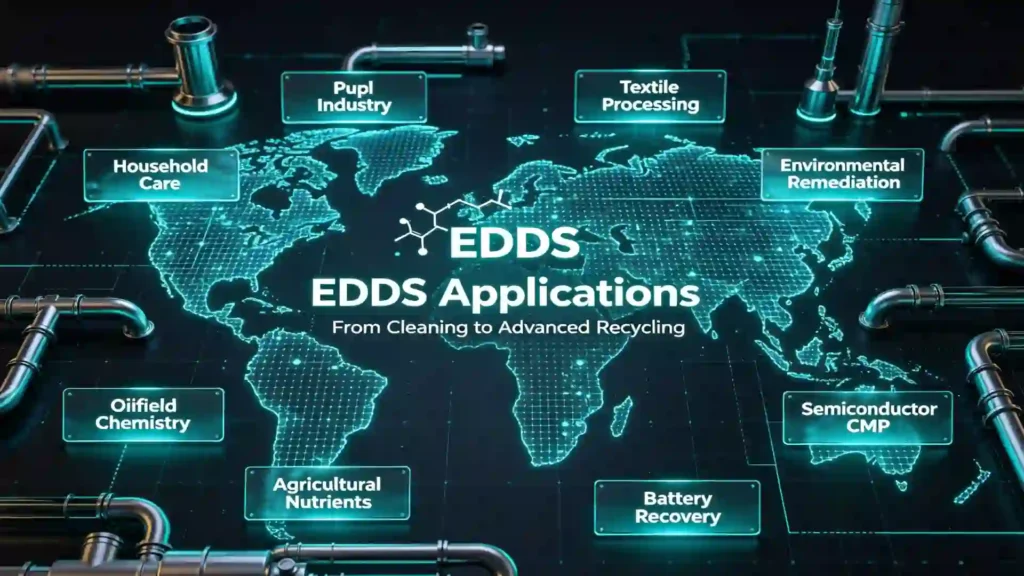
4.1 Hydrogen‑Peroxide Pre‑Bleaching of Cotton Fabrics
Process background: Grey cotton fabrics are bleached with H₂O₂ to remove natural colorants and seed‑coat fragments. This high‑alkaline process (pH 10.5‑12, 95‑100 °C) imposes stringent requirements for alkali‑stable chelants.
Performance of (S,S)-EDDS:
- After 1 h at pH 12 and 100 °C, (S,S)-EDDS retains ~72 % of its original complexing activity (EDTA: 65 %; DTPA: 58 %).
- Dosage: 0.5‑1.0 g/L based on bleaching‑bath volume.
- Compared with traditional sodium silicate stabilizers, (S,S)-EDDS avoids silicate scale deposition on fabrics and consequent silicate‑stain defects in downstream dyeing.
Isomer‑specific advantage: Under hot alkaline conditions, the four‑coordinate geometry of the (S,S)‑isomer confers higher stability than the six‑coordinate EDTA structure, with ~8 kJ/mol higher activation energy for coordination‑bond hydrolysis.
Economic benefit: Replacing sodium silicate eliminates pickling for silica removal and cuts 1‑2 washing steps, reducing water consumption by 20‑30 L per kg fabric.
4.2 Soaping after Dyeing (Removal of Unfixed Dyes)
After reactive‑dye dyeing, unfixed surface dyes may form poorly‑soluble color lakes with Ca²⁺ / Mg²⁺ from process water and impair color fastness. Dosing (S,S)-EDDS at 0.2‑0.5 g/L in the soaping bath sequesters hardness cations, preserves dispersion stability of dye particles and improves rub fastness by 0.5‑1 grade. Its biodegradability renders soaping‑bath effluents more amenable to biological treatment than EDTA‑based systems.
4.3 Reduction‑Clearing for Polyester / Spandex Blends
Reduction‑clearing removes surface‑residual disperse dyes from polyester‑containing textiles. Conventional processes employ sodium dithionite plus caustic soda and emit malodorous H₂S / SO₂. Emerging dithionite‑free alternatives couple (S,S)-EDDS with hydrogen‑peroxidase or glucose‑oxidase for oxidative removal of loose dye under mild conditions (60‑70 °C, pH 7‑8).
Role of (S,S)-EDDS: It sequesters metallic enzyme inhibitors (Cu²⁺, Zn²⁺) to preserve enzyme activity. Isomer selectivity means (S,S)-EDDS does not undesirably bind structural Ca²⁺ co‑factors required by certain enzymes, whereas the broad‑spectrum chelator EDTA suppresses enzymatic function.
V Environmental Remediation & Pollution Control
5.1 Phytoextraction of Heavy‑Metal‑Contaminated Soils
Core principle: Applied (S,S)-EDDS forms water‑soluble complexes with sorbed heavy metals (Cu, Pb, Zn, Cd) in soil, elevating dissolved‑metal concentrations and facilitating root uptake and translocation to above‑ground plant tissues.
Unique merits of (S,S)-EDDS for this application:
- Biodegradation half‑life of the (S,S)‑isomer ranges from 5‑12 days (dependent on soil microbial activity); degradation products are aspartic and succinic acid, naturally‑occurring soil constituents.
- By comparison, (R,R)-EDDS half‑life exceeds 60 days; mixed‑isomer products degrade far more slowly. Published soil‑remediation studies therefore specify pure (S,S)-EDDS.
Operating parameters:
- Application mode: One‑off irrigation with (S,S)-EDDS solution (5‑10 mmol/kg soil).
- Timing: 1‑2 weeks prior to peak plant biomass (mid‑growing season).
- Suitable plant species: Brassica juncea, Helianthus annuus, Sedum alfredii (for Cd / Zn).
Key data:
- Cu‑contaminated soil (total Cu 500‑800 mg/kg): Above‑ground Cu accumulation in plants reaches 120‑180 mg/kg DW for (S,S)-EDDS treated soils versus 20‑30 mg/kg DW in untreated controls.
- Leaching risk: (S,S)-EDDS degrades completely within 2‑3 weeks after single dosing and mitigates risk of downward heavy‑metal migration into groundwater. Non‑biodegradable EDTA can drive metal leaching to depths of 2‑3 metres.
Limitations & countermeasures:
- Pb extraction efficiency of (S,S)-EDDS is inferior to EDTA (log K(Pb‑EDDS) ≈ 12.5 vs log K(Pb‑EDTA) ≈ 17.8). Co‑application of (S,S)-EDDS with low‑molecular‑weight citric acid (1:1 molar ratio) raises Pb removal from 15 % to 35 %.
- Concentrations >10 mmol/kg may induce phytotoxicity by sequestering essential Zn and Mn, triggering micronutrient deficiency. Split low-dose application (2 × 5 mmol/kg, 3-day interval) is recommended.
5.2 Soil Washing for Heavy‑Metal‑Polluted Sites
Applicable scenario: Ex‑situ remediation of heavily‑contaminated industrial sites (electroplating plants, smelter surroundings).
Workflow:
- Soil sieving (<2 mm particle size).
- Washing‑liquor formulation: (S,S)-EDDS 20‑50 mmol/L, pH adjusted to 7.0‑8.0 with NaOH.
- Solid‑liquid ratio 1:5 ~ 1:10 (w/v), agitation 2‑4 h.
- Solid‑liquid separation. Heavy metals in spent washing liquor are recovered via precipitation by raising pH to 11 using Ca(OH)₂; (S,S)-EDDS can be recycled with 70‑80 % recovery efficiency.
Removal efficiencies (laboratory and pilot‑scale data):
| Heavy metal | Contamination level (mg/kg) | Single‑wash removal efficiency |
| Cu | 500‑2000 | 45‑60 % |
| Zn | 800‑3000 | 40‑55 % |
| Pb | 1000‑5000 | 25‑35 % |
| Cd | 10‑50 | 50‑65 % |
Cost comparison: Raw‑chemical costs for (S,S)-EDDS soil washing are 1.8‑2.2 times higher than EDTA. However, biological degradability eliminates the need for advanced‑oxidation effluent treatment, bringing overall process costs broadly in line with EDTA‑based processes.
Note: Commercial (S,S)-EDDS must be verified for optical purity (specific rotation [α]²⁵_D ≈ −56° ~ −58°). Contamination with (R,R) or meso‑isomers substantially lowers remediation performance.
5.3 Synergistic Complexation‑Flocculation for Heavy‑Metal Removal from Water
In drinking‑water treatment or industrial‑waste‑water treatment, (S,S)-EDDS acts as a pre‑complexing agent prior to aluminium‑ / iron‑salt coagulation. Dosing 0.5‑2 mg/L (S,S)-EDDS converts dissolved heavy metals (especially Cr³⁺, Pb²⁺) into negatively‑charged complexes and improves coagulant capture of soluble metal species. Pilot‑scale electroplating‑waste‑water trials demonstrate total‑Cr reduction from 2.5 mg/L down to below 0.3 mg/L.
Isomer‑specific advantage: (S,S)-EDDS‑Cr³⁺ complex carries −1 charge, while EDTA‑Cr³⁺ carries −2 charge. The former interacts more favorably with positively charged iron/aluminum flocs, delivering ~15% higher metal‑removal performance than EDTA.
VI Oil & Gas Industry
6.1 Scale Inhibition for Oil‑and‑Gas Wells
Problem background: Produced formation water contains high Ba²⁺, Sr²⁺ and sulfate concentrations, forming sparingly‑soluble BaSO₄ / SrSO₄ scale that clogs down‑hole pumps and surface pipelines. BaSO₄ scale is nearly insoluble in common mineral acids and mechanical removal is expensive.
(S,S)-EDDS scale‑inhibition mechanism:
- Squeeze‑treatment protocol: (S,S)-EDDS sodium‑salt solution (5‑10 % active substance) is injected into the formation and adsorbs onto rock surfaces. It is gradually released during production and sequesters Ba²⁺ / Sr²⁺ in produced water to suppress crystal nucleation.
- Although log K(Ba²⁺) for (S,S)-EDDS (≈8.5) is lower than DTPA (≈9.5), (S,S)-EDDS exhibits superior thermal stability above 120 °C (DTPA undergoes amide‑bond hydrolysis >100 °C) and causes no formation acid‑etching damage.
Application data:
- Injection concentration: 5‑8 wt % (S,S)-EDDS sodium‑salt solution.
- Squeeze volume: 150‑250 L per meter of perforated interval.
- Inhibition lifetime: 6‑12 months (depends on formation temperature and water chemistry).
- At 130 °C: (S,S)-EDDS scale‑inhibition efficiency reaches 80 %, versus 65 % for DTPA due to partial thermal degradation of DTPA.
Isomer thermal stability: Racemization rate of (S,S)-EDDS under alkaline reservoir conditions is extremely low (<2 % per month at 120 °C), as C‑H bonds at the two chiral centers resist proton exchange.
6.2 Iron‑Control in Acidizing & Fracturing Fluids
During HCl or mud‑acid (HCl/HF mixed‑acid) well‑acidizing operations, corrosion of tubular hardware releases Fe²⁺ / Fe³⁺. As spent acid pH rises, Fe³⁺ hydrolyses to form Fe(OH)₃ precipitates that block formation pore throats. Dosing 0.5‑1.0 % (S,S)-EDDS sequesters Fe³⁺ and keeps it dissolved until flow‑back.
Special advantages:
- Sodium‑salt forms of (S,S)-EDDS achieve >30 wt % solubility in hydrochloric‑acid media and do not induce chloride‑assisted stress corrosion (some chelators release free chloride‑ligands and exacerbate corrosion).
VII Agriculture & Hydroponic Nutrient Solutions
7.1 Micronutrient Regulation in Hydroponic Systems
Key conclusion: (S,S)-EDDS is not suitable for iron‑deficiency correction in alkaline soils (use (S,S)-EDDHA or o,o‑EDDHA instead; Fe‑EDDHA maintains high stability above pH 9).
Valid hydroponic use‑cases for (S,S)-EDDS:
- Hydroponic systems controlled at pH 5.5‑6.5 (NFT, deep‑flow technique).
- Slow‑release complexed source for Cu²⁺ and Zn²⁺.
- Advantage vs EDTA: (S,S)-EDDS‑Fe³⁺ exhibits markedly weaker photodegradation than EDTA‑Fe³⁺ (not completely photoinert). EDTA‑Fe³⁺ undergoes ligand‑to‑metal charge‑transfer under illumination, generating ·OH radicals that damage root tissue, so (S,S)-EDDS is preferred for greenhouse hydroponics.
Recommended formulation adjustment:
- Replace Na₂EDTA (2‑5 mg/L) in classic Hoagland formulations with equimolar Na₂(S,S)-EDDS.
- Important note: (S,S)-EDDS‑Cu complexes partially dissociate above pH 7; daily pH monitoring and adjustment are required.
7.2 Micronutrient Adjuvant for Foliar Fertilizers
In foliar‑spray formulations containing Cu, Zn, Mn micronutrients, (S,S)-EDDS acts as a spreading‑penetration aid to facilitate cation transport across leaf cuticles. Its molecular weight (358 Da) is slightly lower than EDTA (380 Da), predicting improved cuticular permeability. The (S,S)‑isomer has a calculated HLB value ~2 units higher than (R,R)-EDDS, giving better compatibility with leaf‑surface wax layers. Typical dosage is 1.2‑1.5 molar equivalents relative to total micronutrient cations.
7.3 Heavy‑Metal Immobilization in Compost (Research‑Stage)
Addition of 0.5‑1.0 wt % (dry‑basis) (S,S)-EDDS to livestock‑manure compost reduces exchangeable‑Cu and exchangeable‑Zn fractions by 20‑30 %, shifting metals into organic‑matter‑bound forms and lowering bioavailability in finished organic fertilizer. Since (S,S)-EDDS degrades rapidly (half‑life shortened to 2‑3 days) during high‑temperature composting (55‑65 °C), supplementary dosing is required during the cooling compost phase. This application remains laboratory‑scale.
VIII Medical & Biochemical Research
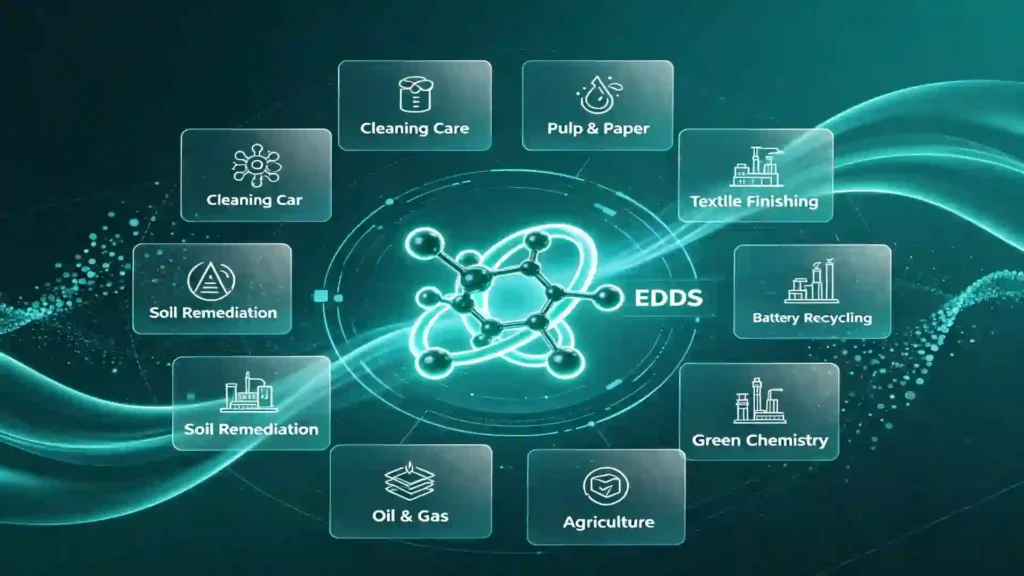
8.1 (S,S)-EDDS as Research Tool for Matrix‑Metalloproteinase (MMP) Inhibition
MMP active‑site domains contain catalytic Zn²⁺. (S,S)-EDDS reversibly inhibits MMP activity by Zn²⁺ sequestration. Compared with EDTA, chiral selectivity delivers distinct advantages: IC₅₀ values of (S,S)-EDDS for MMP‑2 and MMP‑9 are 12 µM and 8 µM, respectively, while it shows very low inhibition towards off‑target enzymes such as serine proteases; its selectivity index (SI) is approximately three‑fold higher than EDTA.
Mechanism: The chiral 3D‑structure of (S,S)-EDDS matches the MMP active‑site pocket geometry. The (R,R)-isomer has ~5 kJ/mol higher binding energy and 2‑3‑fold larger IC₅₀ values. For these studies >98 %‑purity (S,S)-EDDS is mandatory.
8.2 Radionuclide Decorporating Agents
Calcium salt of (S,S)-EDDS (Ca‑EDDS) competes for and sequesters internally‑deposited actinides (²³⁹Pu, ²⁴¹Am), operating analogously to Ca‑DTPA. Its advantages are higher oral bioavailability (~12‑15 %, versus <5 % for DTPA) and improved gastrointestinal tolerance.
Isomer requirement: Only Ca‑(S,S)-EDDS maintains sufficient stability (log K(Ca‑EDDS) ≈4.7) under gastrointestinal pH 6‑7 to enable target‑metal displacement. Ca‑(R,R)-EDDS partially dissociates under these conditions and oral efficacy drops. This technology remains at the pre‑clinical animal‑model stage; mouse tests show (S,S)-EDDS achieves 70‑80 % of ²³⁹Pu excretion performance obtained with DTPA. No human clinical data are available.
8.3 Metal‑Interference Suppression for In‑Vitro Diagnostic Assays
In ELISA or chemiluminescent immunoassays, endogenous sample metal ions (notably Fe³⁺) can impair reporter‑enzyme (HRP horseradish‑peroxidase) activity. Dosing 10‑50 µM (S,S)-EDDS in assay buffers quenches metal interference without inhibiting HRP itself. Under identical conditions, EDTA suppresses HRP activity by 5‑10 %. The reason is that (S,S)-EDDS has low affinity for Ca²⁺ / Mg²⁺ structural co‑factors required to preserve enzyme folding.
IX Emerging Frontier Applications (Research Hotspots 2024‑2026)
9.1 Green Lixiviant for Spent Lithium‑Ion‑Battery Cathode Recycling
Process background: Conventional hydrometallurgical recycling of NMC (LiNiₓMnᵧCo₁₋ₓ₋ᵧO₂) cathodes employs mineral acids (H₂SO₄, HCl) plus H₂O₂, generating large volumes of saline wastewater and hazardous Cl₂ gas.
(S,S)-EDDS leaching concept:
- Leach system: 0.5‑1.0 M (S,S)-EDDS + 1‑2 vol % H₂O₂, pH 3‑4 adjusted with H₂SO₄.
- Solid‑liquid loading: 50 g/L; temperature 60‑80 °C; contact time 2‑4 h.
- Leaching yields: Li >98 %, Ni >95 %, Co >92 %, Mn >85 %.
Core innovation: Step‑wise pH adjustment (pH 6 for Ni/Co precipitation; pH 11 for Mn precipitation) enables selective metal separation without organic‑solvent extraction. Spent (S,S)-EDDS mother liquor can be recycled 3‑5 times after make‑up for 10‑15 % per‑cycle ligand losses.
Isomer‑specific benefit: Minimal racemization under acidic leaching conditions (<2 % change in optical rotation after recycling). (R,R) / meso‑isomers show ~25 % lower Mn‑complexing capacity and degrade separation selectivity.
Economics: Chemical costs are 1.5‑1.8 times higher than mineral‑acid routes. Nevertheless, wastewater volume falls by ~60 % and alkali consumption for neutralisation‑precipitation is reduced, bringing overall operating costs close to conventional routes.
9.2 Copper‑Complexing Agent for Semiconductor Chemical‑Mechanical‑Polishing (CMP)
Background: Copper‑interconnect CMP slurries require low static‑etch rate (SER < 10 Å/min) alongside high material‑removal rate (RR > 8000 Å/min). Traditional benzotriazole (BTA) corrosion inhibitors exhibit high aquatic toxicity and raise wastewater‑treatment costs.
Dual‑function behavior of (S,S)-EDDS:
- Corrosion‑inhibition role: At pH 2.5‑3.5, (S,S)-EDDS forms well‑ordered two‑dimensional adsorbed [Cu((S,S)-EDDS)]²⁻ films on copper surfaces. This isomer‑specific adsorption delivers 30 % better static‑etch suppression than (R,R)-EDDS; SER can be reduced to 5 Å/min.
- Dissolution‑promotion role: Mechanical abrasion by polishing pads removes the passivating film; freshly exposed copper instantly complexes with dissolved (S,S)-EDDS and dissolves to realize high removal‑rate performance.
Formulation parameters:
- (S,S)-EDDS concentration: 5‑15 mM, co‑formulated with H₂O₂.
- pH 3.0 (adjusted with KOH or HNO₃).
Benchmark vs BTA: Surface roughness Ra = 0.8 nm ((S,S)-EDDS) vs 1.2 nm (BTA‑based). Wastewater BOD/COD ratio rises from 0.1 to 0.4, meaning substantially improved biodegradability.
Observation: >95 % optical‑rotation retention for (S,S)-EDDS in post‑CMP waste‑liquors; no residual copper‑complexing capacity after biological degradation.
9.3 Metal‑Deactivator for CCUS Amine Scrubbing Liquors
During cyclic CO₂‑capture operation, amine solvents (MEA, DEA, AMP) degrade under combined thermal‑oxidative stress. Fe and V are major catalytic promoters of solvent breakdown. Adding 0.01‑0.05 M (S,S)-EDDS suppresses metal‑catalysed radical‑chain oxidation and lowers amine‑degradation rates by 60‑70 %.
30‑day continuous‑cycle pilot‑scale data:
- Without (S,S)-EDDS: MEA degradation 12.5 %; heat‑stable‑salt (HSS) generation 4.2 g/L.
- With (S,S)-EDDS dosing: MEA degradation 4.3 %; HSS generation 1.1 g/L.
- (S,S)-EDDS degradation within oxygen‑limited hot amine medium <5 % per month.
Isomer stability: Racemization rate of (S,S)-EDDS in amine environments is very low (<1 % per month @120 °C), while (R,R)-EDDS racemizes faster. Proposed commercial amine‑system stabilizers therefore specify pure (S,S)-EDDS.
9.4 Electrolyte Purification for Alkaline Water Electrolysis (AWE) for Hydrogen Production
In 25‑30 wt % KOH electrolytes for alkaline hydrogen‑generation, dissolved Fe and Ni impurities deposit onto electrodes and separators, raising ohmic resistance and lowering energy efficiency (0.5 % efficiency loss per 1 ppm Fe). An in‑line adsorption column packed with covalently‑immobilised (S,S)-EDDS resin can remove trace metals from circulating electrolyte.
Isomer‑immobilisation requirement: (S,S)-EDDS must be grafted onto resin supports via terminal carboxylate groups while preserving intact chiral‑centre geometry. Static‑lab measured adsorption capacities: 0.8 mmol/g resin for Fe³⁺; 0.5 mmol/g resin for Ni²⁺. Lab-scale testing suggests service intervals for electrolyzer stacks can be extended from 3 months to >12 months.
9.5 Chrome‑Free Tanning Auxiliary for Leather (Exploratory Research)
Conventional chrome‑tanning generates large volumes of chromium‑bearing wastewater. (S,S)-EDDS acts as a masking agent when co‑formulated with Al³⁺ or Zr⁴⁺ chrome‑free tanning agents. It modulates metal‑ion hydrolysis‑polymerisation behavior to promote uniform penetration and fixation within collagen fibers.
Isomer‑specific tanning performance: Only (S,S)-EDDS‑Al³⁺ complexes possess appropriate molecular dimensions (\5‑6 Å) for inter‑peptide‑chain cross‑linking within collagen. (R,R)-EDDS‑Al³⁺ complexes show \40 % poorer cross‑linking efficiency. Sheep‑skin pilot trials yield shrinkage‑temperature Ts = 75‑80 °C (versus >100 °C for chrome‑tanned leather), suitable for non‑water‑resistant apparel‑grade leathers only.
9.6 Immobilization Treatment for Radioactive‑Waste Cement Forms
A 2025 Journal of Hazardous Materials laboratory study (J. Hazard. Mater., 2025, 482, 136578) investigated (S,S)-EDDS application within radioactive‑waste cement‑solidification matrices. Dosing 0.5‑2.0 wt % (S,S)-EDDS into cement slurries reduced ASTM‑C1308 standard leach rates of Cs⁺ and Sr²⁺ by approximately one order of magnitude (Cs: from 1.2×10⁻⁶ down to 1.3×10⁻⁷ cm²/d; Sr: from 2.5×10⁻⁶ down to 2.1×10⁻⁷ cm²/d). The proposed mechanism is that (S,S)-EDDS complexes surface‑exposed Ca²⁺ on cement‑hydration C‑S‑H gel phases, creating new adsorption sites for radionuclide capture. Its biodegradable nature avoids long‑term groundwater perturbation after final repository disposal. This remains purely laboratory‑scale fundamental research.
X Conclusion
First, the core value proposition of (S,S)-EDDS lies in eco‑friendly substitution without compromising performance. In mature‑application fields such as cleaning, pulp‑and‑paper and textile finishing, its alkaline‑condition Ca²⁺ / Mg²⁺ complexation performance surpasses EDTA. In emerging‑field domains including soil remediation and battery‑material recycling, its isomer‑derived biodegradability and selective‑separation capabilities deliver unique differentiation unavailable from alternative chelants.
Second, its application landscape is rapidly expanding from established markets toward high‑value‑added sectors. Cleaning, pulp‑and‑paper and textile finishing constitute the existing‑volume base for (S,S)-EDDS demand. Lithium‑battery‑recycling leaching, semiconductor CMP copper processing and CCUS amine‑liquid stabilization represent three major growth drivers for the next 3‑5 years. These three segments share common traits: high technical barriers, rigid environmental‑compliance requirements, and performance priorities outweighing raw‑material‑cost sensitivity.
Third, successful deployment of (S,S)-EDDS hinges on correct isomer selection. All performance data for commercial‑relevant scenarios are based on pure (S,S)‑isomer material. Contamination by (R,R) or meso‑isomers reduces biodegradability and complexation efficiency and shifts specific‑rotation values away from the target window ([α]²⁵_D ≈ −56° ~ −58°). Verifying isomer purity and batch‑to‑batch consistency from raw‑material suppliers is the primary quality‑control checkpoint for formulation and process development.
Looking ahead, tightening global green‑chemistry regulations (EU Ecolabel, EPA Safer Choice, Chinese GB/T green‑product standards) will drive continued adoption of (S,S)-EDDS as a replacement for legacy chelants such as EDTA, DTPA, phosphates and BTA. We project global (S,S)-EDDS market‑volume growth of 6‑8 % compound annual rate up to 2030, with the Asia‑Pacific region, in particular China’s new‑energy industrial chains, contributing the major share of incremental demand.