
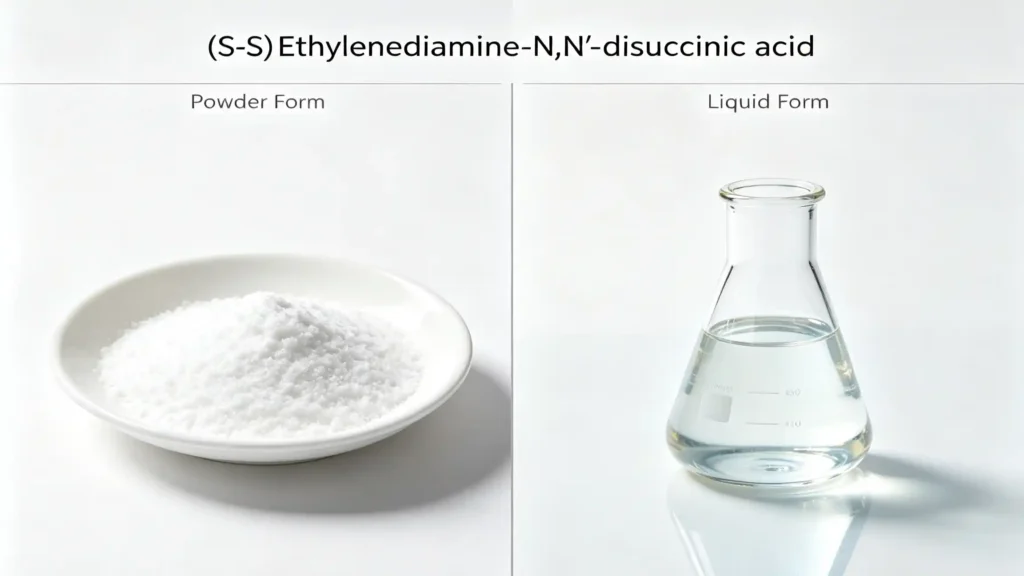
(S,S)-Ethylenediamine-N,N’-disuccinic acid, commonly abbreviated as (S,S)-EDDS, is a high-performance, fully biodegradable green chelating agent widely adopted across global industrial, agricultural, and environmental protection fields, serving as the most reliable eco-friendly alternative to traditional non-biodegradable chelants like EDTA.
I. Standard Nomenclature & Basic Information of (S,S)-EDDS
| Item | Details |
| Full English Name | (2S,2′S)-Ethylenediamine-N,N′-disuccinic acid |
| Official Chinese Name | S,S-Ethylenediamine-N,N′-disuccinic acid |
| Free Acid CAS No. | 20846-91-7 |
| Trisodium Salt CAS No. (Main Commercial Grade) | 178949-82-1 |
| Molecular Formula of Free Acid | C₁₀H₁₆N₂O₈ |
| Molecular Formula of Trisodium Salt | C₁₀H₁₃N₂Na₃O₈ |
| Molecular Weight of Free Acid | 292.24 g/mol |
| Molecular Weight of Trisodium Salt | 358.19 g/mol |
EDDS has four stereoisomers: S,S / R,R / S,R / R,S. Only the S,S configuration is rapidly biodegradable, while the R,R and S,R isomers are extremely recalcitrant in the environment. Therefore, qualified industrial raw materials on the market exclusively refer to high purity (S,S)-EDDS; optical purity must be verified during procurement of biodegradable (S,S)-EDDS chelating agent.
II. Physicochemical Parameters of (S,S)-EDDS
| Parameter | Value |
| Melting Point | 220–222℃ |
| Water Solubility (20℃) | Free acid: ~150 mg/L only; Trisodium salt: highly water-soluble |
| Applicable pH Range for Chelation | Stable chelation performance at pH 3–11, excellent acid & alkali resistance |
| Appearance | High-purity grade: white crystalline powder, odorless |
| Density (35% aqueous solution, 20℃) | ~1.1 g/cm³ |
- OECD 301B standard: Biodegradation rate >80% within 28 days, reaching up to 99% in partial research datasets
- Half-life in soil environment: merely 3.8–7.5 days
- Degradation products: non-toxic small molecules including aspartic acid and ethylenediamine, no secondary pollution
- Environmental fate: no long-term accumulation in water bodies or remobilization of heavy metals, unlike EDTA
Industrial formulations adopt different forms of EDDS based on formulation demands:
- (S,S)-EDDS trisodium salt aqueous solution (~36% concentration): superior water solubility, directly applicable to liquid formulations such as detergents and daily care products for convenient use
- Free acid powder: poor water solubility, incompatible with direct aqueous system addition; lower transportation & storage costs for solid formulations or intermediate raw materials
III. Detailed Chelation Performance Comparison: (S,S)-EDDS Green Chelator vs EDTA
Metal Chelation Stability Constant (log K)
| Metal Ion | S,S-EDDS | EDTA |
| Fe³⁺ | 16.5 | 25.1 |
| Cu²⁺ | 18.4 | 18.8 |
| Zn²⁺ | 13.9 | 16.5 |
| Mn²⁺ | 10.6 | 13.8 |
| Ca²⁺ | 4.8 | 10.7 |
| Mg²⁺ | 5.8 | 8.8 |
| Co²⁺ | 14.1 | 16.3 |
Summary of Core Characteristics
1. Selective Chelation (Major Advantage in Hard Water Systems)
EDTA preferentially binds abundant Ca²⁺/Mg²⁺ hard water ions, wasting dosage; S,S-EDDS has very low affinity for calcium and magnesium, and prioritizes capturing transition metal ions such as Fe, Cu, Zn, Mn, Co. It delivers far higher utilization efficiency than EDTA under hard water conditions, making it ideal for fertilizers, daily chemicals and industrial cleaning formulations.
2. Environmental Protection Gap Between Generations
| Dimension | EDTA | S,S-EDDS |
| Biodegradability | <10% within 28 days, persistent pollutant | >80% within 28 days, readily biodegradable |
| Water Residence Time | Several years | Days to weeks |
| Risk of Heavy Metal Remobilization | High | Extremely low |
| EU Regulatory Status | Listed on observation list; Germany restricts its use in industrial detergents | Fully REACH-registered, low-risk substance |
| Aquatic Toxicity | High | Very low |
The EU Water Framework Directive has placed EDTA on the observation list, and Germany has imposed usage restrictions on EDTA in industrial detergents. S,S-EDDS serves as a mandatory eco-friendly (S,S)-EDDS for export alternative in the EU market.
3. Safety Profile of (S,S)-EDDS
- Minimal skin irritation, no bioaccumulation potential
- Approved for feed additives, agricultural fertilizers and maternal & infant care formulations
- US EPA grants tolerance exemption for (S,S)-EDDS as a pesticide adjuvant (40 CFR 180.920)
- FDA approves trisodium salt for food-contact paper & board manufacturing (FCN No. 799)
IV. Global Market Outlook & Scale of (S,S)-EDDS
Overall Chelating Agent Market
- Global chelating agent market size in 2026: approximately USD 9.0–9.37 billion
- Forecast for 2034–2036: reaching USD 14.48–15.8 billion, CAGR 5.6%–5.8%
- Share of green chelating agents: expected to account for 41.0% in 2026 (data source: Chelating Agent Market by Future Market Insights), becoming the largest segment
- Market size in 2025: approximately USD 352.8 million
- 2032 forecast: reaching USD 586.4 million, CAGR 7.6%
(Data source: 24ChemicalResearch)
EDDS is explicitly classified as the fastest-growing category among all green chelating agents.
| Region | CAGR | Growth Drivers |
| South Korea | 6.2% | Wafer cleaning for Samsung/SK Hynix semiconductors, display panel manufacturing, water treatment |
| EU | 6.0% | REACH compliance, Detergents Regulation (EC) No 648/2004, sustainable agriculture policies |
| UK | 5.6% | Tightening environmental regulations, green chemistry transformation |
| United States | 5.5% | Mandatory detergent reformulation in California, upgraded water treatment infrastructure |
| Japan | 4.4% | Precision electronics manufacturing, rising demand for personal care amid aging population |
| (Data source: Chelating Agent Market report published by Future Market Insights (FMI)) |
Application Market Share (2025)
| Application Field | Market Share | Growth Trait |
| Detergents & Cleaners | 35.8% | Largest fundamental segment, steady growth driven by regulations |
| Agriculture | 28.4% | Fastest-growing segment (CAGR 7.9%), rigid demand for chelated trace elements in alkaline soil |
| Water Treatment | 22.1% | Surging demand for heavy metal pollution remediation, CAGR 6.8% |
| Personal Care | 13.7% | Premiumization & natural ingredient trend, CAGR 7.4% |
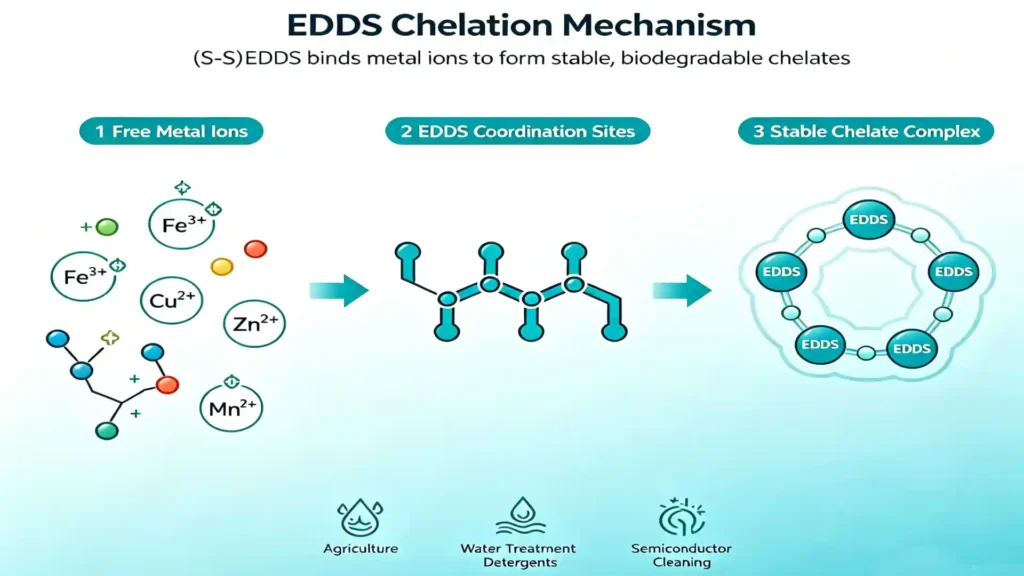
V. Full-Industry Application Breakdown of (S,S)-EDDS
1. Detergents & Cleaners (Largest Segment, 35.8% Market Share)
Core Applications:
- Phosphate-free laundry detergents, cold-water cleaners, dishwasher-specific detergents
- Industrial cleaning agents, hard-surface cleaners
- Eco-friendly chelation solution of industrial grade (S,S)-EDDS cleaner to replace phosphate and EDTA
Market Drivers:
- EU Detergents Regulation (EC) No 648/2004 mandates biodegradability
- Germany restricts EDTA application in industrial detergents
- Mandatory detergent reformulation orders in California and other US states
- Rising consumer environmental awareness; “phosphate-free” and “biodegradable” become selling points
EDDS Advantages:
- Maintains chelation activity across wide pH range (3–11)
- Low affinity for Ca/Mg ions, no waste of efficacy under hard water
- Good compatibility with surfactants, high formulation stability
2. Agriculture & Soil Remediation (Fastest-Growing Segment, CAGR 7.9%)
2.1 Agricultural Water-Soluble Fertilizers, Foliar Fertilizers, Chelated Trace Element Fertilizers
- Compliant with EU standard EN 13368-3
- Fe/Zn ions are readily immobilized and ineffective in calcareous/alkaline soil; S,S-EDDS transports trace elements through soil for root absorption
- Rapid post-application degradation without long-term soil accumulation
- Applicable to fruit trees, flowers and greenhouse crops to correct chlorosis caused by nutrient deficiency
- EDDS-Fe complex delivers equivalent efficacy to EDTA-Fe in Fe-deficient soil, with overwhelming environmental friendliness
2.2 Heavy Metal Soil Remediation (High-Margin Emerging Track)
- Soil washing remediation to extract Pb, Cd, Cu, Ni and other heavy metals
- Equivalent extraction efficiency to EDTA, yet the agent degrades rapidly without long-distance heavy metal leaching into groundwater
- Soil half-life only 3.8–7.5 days, zero secondary pollution post remediation
- Dominant eco-friendly agent for current soil remediation industry
Mobilizes heavy metals in soil to boost plant uptake capacity; compared with EDTA, EDDS improves Cu mobilization by ~192% and Zn mobilization by 8 times.
3. Personal Care & Cosmetics (Premiumization Trend, CAGR 7.4%)
Core Applications:
- Shampoos & conditioners: sequester trace Cu/Mn ions in tap water to prevent catalytic oxidation & rancidity of fragrances and oils
- Skincare products: stabilize antioxidants including Vitamin C & E to extend shelf life
- Hair dyes: inhibit catalytic decomposition of dyes by metal ions to sustain color stability
- Oral care: metal ion stabilizer in toothpaste
EDDS Advantages:
- Low skin irritation, suitable for maternal & infant care formulations
- Biodegradability meets premium brand positioning of “natural/organic”
- Nearly equivalent copper chelation capacity to EDTA (log K: 18.4 vs 18.8) with no performance compromise
- Standard raw material for high-end organic personal care products
4. Water Treatment (Surging Demand, CAGR 6.8%)
4.1 Heavy Metal Removal in Industrial Wastewater
Eliminate Cu, Ni, Zn, Pb from electroplating, metallurgy and electronics manufacturing wastewater; forms stable chelates with heavy metals for convenient precipitation or membrane separation. The agent is biodegradable and does not cause secondary contamination.
4.2 Municipal Drinking Water Treatment
Remove iron & manganese ions in pipe networks to eliminate “red water” and “black water” phenomena; replace traditional phosphate stabilizers with alternatives that pose no eutrophication risk.
4.3 Auxiliary for Photocatalytic-Fenton Reactions
S,S-EDDS forms photoactive complexes with Fe³⁺ under neutral pH to efficiently generate hydroxyl radicals for degrading emerging water pollutants (pharmaceutical residues, endocrine disruptors, etc.). Unlike conventional acidic Fenton processes, pH adjustment is unnecessary, significantly cutting operational costs.
5. Pulp & Paper Manufacturing (Major Industrial Client, 29.5% Share of Chelating Agent Consumption)
Core Application: Hydrogen peroxide bleaching stabilizer
- Sequester Fe, Cu, Mn ions to avoid invalid decomposition of H₂O₂
- Boost bleaching efficiency and reduce hydrogen peroxide dosage by 15–30%
- Lower residual metal ion content in bleaching wastewater
EDDS Advantages:
- Stable performance under alkaline bleaching conditions (pH 9–11)
- Biodegradable, bleaching wastewater discharge exempt from extra treatment
- No long-term accumulation in paper mill circulating water systems compared with EDTA
6. Textile Industry
Core Applications:
- Hydrogen peroxide stabilizer in bleaching procedures (same mechanism as paper manufacturing)
- Dyeing process: eliminate metal ions in water to prevent color stains from metal-dye complexes
- Improve dye uptake rate and color fastness
- Chelate metal ions in printing paste to avoid catalyst deactivation
7. Electronics & Semiconductor Manufacturing (Fastest Growth in South Korea, CAGR 6.2%)
Core Applications:
- Wafer cleaning: remove trace metal ions (Fe, Cu, Ni) on silicon wafer surfaces
- Display panel production: cleaning solution for TFT-LCD & OLED manufacturing
- PCB fabrication: metal ion control in etching solutions
- Post-Chemical Mechanical Polishing (CMP) cleaning
EDDS Advantages:
- Non-corrosive, no damage to precision circuits
- High-purity grade meets semiconductor-level requirements
- Biodegradable, aligns with ESG targets of electronics manufacturers
8. Livestock Feed Additives – Application of (S,S)-EDDS feed additive (High-Barrier Track)
Core Application: Chelated trace elements (EDDS-Fe, EDDS-Zn, EDDS-Mn, EDDS-Cu)
- Far higher gastrointestinal absorption rate for animals than inorganic salts
- Prevent precipitation induced by phytic acid and oxalic acid in feed
- Residue-free & biodegradable, complying with European antibiotic-free & green feed standards
Key Export Note to EU: FAMI-QS certification is the mandatory quality & safety management system for feed additives entering the EU, established under EU Regulation (EC) No 183/2008.
9. Automotive Catalyst Regeneration (Emerging High-Margin Application)
Core Application: Chemical regeneration of Three-Way Catalysts (TWC)
- Remove poisons including phosphorus, lead and zinc from catalyst surfaces
- Recover Platinum Group Metals (PGM: Pt, Pd, Rh)
EDDS Advantages:
- Gentler than traditional pickling (oxalic acid, citric acid), no damage to catalyst coating
- Biodegradable, simple waste liquid treatment post regeneration
- Avoid secondary heavy metal release to the environment vs EDTA
- Research verifies prominent TWC regeneration efficacy with drastically reduced NO emissions
10. Photographic Processing (Traditional yet Stable Demand)
Core Applications:
- Metal ion chelation in developers to retard developer oxidation
- Auxiliary silver ion recovery in fixers
- Stabilize developer pH and extend service life
Despite the prevalence of digital photography, stable demand persists for professional film, X-ray plates and industrial non-destructive testing.
11. Pharmaceutical & Biomedical Industry (Frontier R&D Field)
Core R&D Directions:
- Auxiliary heavy metal detoxification: potential EDTA substitute for adjuvant treatment of heavy metal poisoning with low toxicity & biodegradability
- Drug delivery systems: leverage biocompatibility & metal chelation capacity to develop targeted delivery carriers
- Medical device coatings: suppress inflammatory reactions triggered by leached metal ions
- Antibiotic synergist: enhance membrane permeability similar to EDTA yet with lower toxicity
Current Status: Remains at the pre-clinical & laboratory research stage, with enormous potential due to superior biocompatibility and low toxicity.
12. Food & Beverage Industry (High Compliance Threshold, High Added Value of food grade (S,S)-EDDS)
Core Applications:
- Water quality stabilizer: prevents precipitation and off-odors induced by metal ions in filling water
- Synergistic antioxidant for oils & fats: chelates metal ions to inhibit rancidity
- Fruit & vegetable washing: remove surface heavy metal residues
Compliance Status: FDA approves its use in food-contact paper & board (FCN No. 799); direct food additive approval is still pending review across global jurisdictions, requiring continuous regulatory tracking.
13. Oilfield Chemicals (High-Value Industrial Application)
Core Applications:
- Produced water treatment: scale inhibition, corrosion mitigation and heavy metal removal
- Water injection systems: suppress Ca/Mg/Ba scale formation
- Iron ion control post acidizing to avoid secondary precipitation
EDDS Advantages:
- Retains chelation activity under high temperature & high pressure
- Biodegradable, meets offshore platform eco-discharge standards
- Excellent compatibility with corrosion inhibitors and biocides
VI. Green Chelating Agent Competitor Comparison: S,S-EDDS vs MGDA vs GLDA
| Comparison Dimension | S,S-EDDS | MGDA | GLDA |
| Coordination Capacity | Hexadentate coordination (highest complex stability) | Tetradentate | Tetra/pentadentate |
| Chelation of Fe³⁺/Cu²⁺ | Strongest | Moderate | Weak |
| Chelation of Ca²⁺/Mg²⁺ | Weak (core competitive edge) | Strong | Strong |
| pH Stability Window | pH 3–11 | pH 2–13.5 | pH 2–12 |
| OECD 301B Biodegradation Rate | >80%–99% | >68%–80% | >60%–83% |
| Degradation Half-Life | Shortest (days scale) | Relatively short | Relatively short |
| Raw Material Source | Bio-based (L-aspartic acid) | Synthetic | Bio-based (L-glutamic acid) |
| Industry Recognition for Feed Applications | Highest | Low | Low |
| Suitability for Electronics/Semiconductors | Applicable (high-purity grade) | Limited applicability | Limited applicability |
| Primary Application Scenarios | Feed, soil remediation, peroxide stabilization, premium personal care, electronic cleaning | Dishwashers, industrial cleaners | Personal care, liquid detergents |
| Cost Level | Medium-high | Medium | Relatively low |
- Prioritize S,S-EDDS if maximum transition metal chelation + fastest biodegradation are required
- Select MGDA or GLDA for high-hardness-water chelation at wide pH range & lower cost
- S,S-EDDS is universally recognized as the top choice for feed, electronics and soil remediation sectors
VII. Standard Commercial Specifications Available on the Market
| Grade | Specification | Form |
| Industrial Grade | 35%–38% aqueous solution/powder≥98% | Liquid / Powder |
| Fertilizer & Feed Grade | ≥99% S,S isomer purity (S,S labeling mandatory; racemic mixed isomers have negligible commercial value) | Powder |
| Cosmetic Grade | ≥99% S,S configuration, ultra-low heavy metal content | Powder |
| Electronic & Semiconductor Grade | ≥99.5% S,S configuration, ppb-level trace metal impurity control | Powder / high-purity solution |
- Powder: 25kg woven bags/fiber drums/aluminum foil bags
- Liquid: 200L plastic drums / 1000L IBC tote tanks / bulk tankers
Mandatory QC Indicators on Certificate of Analysis (COA)
| Test Item | Standard Requirement |
| Assay (Trisodium S,S-EDDS) | ≥98% (Industrial Grade) / ≥99% (Fertilizer & Feed Grade) |
| Optical Purity of S,S-Isomer | ≥99% (quantified via chiral HPLC) |
| pH (1% aqueous solution) | 9.0–10.0 |
| Heavy Metals (Pb/As/Cd/Hg) | Meet limit standards for feed & food-grade products |
| Moisture Content | ≤7% (Powder Form) |
| Water Insoluble Matter | ≤0.1% |
VIII. Export Compliance & Logistics Key Points for Trade
1. Mandatory Certifications by Target Market
| Market | Required Certifications / Regulatory Status |
| EU | Fully REACH-registered (trisodium salt); EU Ecolabel compliant; non-SVHC substance |
| EU Feed Sector | FAMI-QS certification (supplier-side mandatory) |
| United States | Listed under active TSCA inventory; EPA tolerance exemption (40 CFR 180.920); FDA FCN No.799 for food-contact paper |
| Global General Certifications | ISO 9001 / ISO 14001 / ISO 45001; Kosher & Halal certifications (value-add for Middle East & Southeast Asian markets) |
2. Customs & Transportation Guidelines
| Item | Details |
| HS Code | Recommended classification: 2922.50 (Other amino carboxylic acids (amino alcohols, amino aldehyde acids and other oxy-substituted amino acids); final confirmation with customs broker required) |
| Hazard Classification | S,S-EDDS powder: non-dangerous goods; 36.5% trisodium S,S-EDDS aqueous solution generally shipped as non-hazardous material (local regulatory verification advised) |
| UN Number | None (non-hazardous cargo) |
| SDS Language | English as standard; Spanish & Arabic versions recommended for additional markets |
| Storage Conditions | 15–25℃, sealed & moisture-proof; segregated storage away from food materials |
IX. Common Industry Pitfalls to Avoid
| Pitfall | Explanation |
| Isomer Purity Fraud | Confirm S,S-isomer proportion ≥99% before procurement; cheap racemic mixed isomers fail EU biodegradability standards and cannot be exported to Europe |
| Confusion Between Free Acid & Trisodium Salt | Trisodium salt is the universal grade for feed, fertilizer and daily chemical industries; free acid has extremely low water solubility and cannot be directly incorporated into aqueous formulations |
| Invalid Purity Testing Method | Identification must rely on chiral HPLC chromatograms; regular HPLC assay reports cannot verify optical purity |
| Unverified REACH Registration | Confirm suppliers hold full REACH registration for trisodium salt (CAS 178949-82-1), not merely free acid registration |
| Ignorance of Electronic Grade Specifications | Semiconductor clients demand ppb-level trace metal impurities; industrial-grade material fails to meet such strict thresholds |
| Competitor Product Misclassification | MGDA & GLDA are also green chelating agents yet receive far lower industry recognition for feed and electronic manufacturing applications |
X. Conclusion: Why S,S-EDDS Is the Most Promising Green Chelating Agent for Current Layout
- Regulatory Window Opportunity: Global restrictions on EDTA are tightening, with the EU, California (USA) and Germany taking the lead in bans & usage limits, forcing downstream clients to switch to alternative eco-friendly chelants
- Fastest-Growing Green Chelant Segment: EDDS records the highest growth rate among all green chelating agents, projected CAGR 5.2%–13.6% for 2025–2034
- Widest Application Coverage: Spans over 10 high-growth industries ranging from detergents to semiconductors, agriculture soil remediation to automotive catalyst regeneration
- Established Technical Barriers: Entry thresholds including S,S optical purity control, FAMI-QS certification and electronic-grade ultra-high purity screening lock in long-term client partnerships for early market entrants
- Optimized Full-Lifecycle Cost: Despite a higher unit price than EDTA, it eliminates hidden costs such as environmental compliance fines, wastewater treatment expenses and brand reputation risks
- Surging Emerging Application Demand: Rapid capacity expansion in cutting-edge tracks including electronic wafer cleaning, automotive catalyst regeneration and photocatalytic water treatment