
I. One Molecule, Three Shapes: The Chirality of EDDS
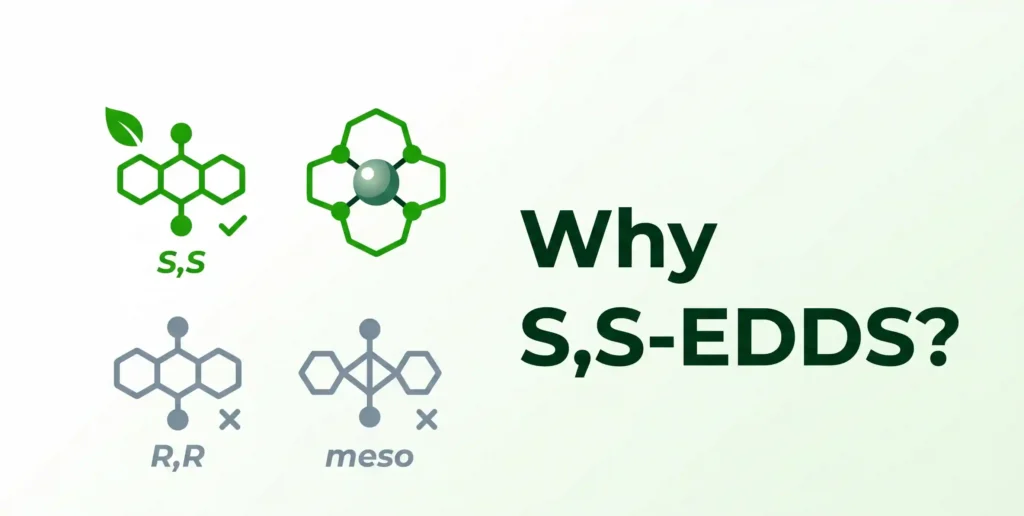
If you purchase EDDS (ethylenediamine-N,N’-disuccinic acid; free acid CAS 20846-91-7, trisodium salt CAS 178949-82-1; molecular weight 292.24) based on nothing more than a “total purity 99%” figure, you may fall into a trap that is completely invisible on a routine certificate of analysis. The EDDS molecule contains two chiral carbon atoms, and it therefore exists as three stereoisomers: [S,S], [R,R] and the achiral meso form ([R,S]). The three isomers share the same elemental composition, the same molecular weight and virtually the same total purity as measured by routine HPLC, yet their environmental behavior is fundamentally different. Existing research consistently shows that only the [S,S] isomer is rapidly biodegraded by microorganisms; the other two persist in the environment much like EDTA[1].
In other words, the trade name “EDDS” actually covers three molecules with very different performance, and which one you receive depends on the manufacturing route behind the product. This article explains, from five perspectives (chiral chemistry, chelation performance, biodegradation, production routes, and regulations and standards), why the industry consensus is clear: when you buy EDDS, specify the [S,S] configuration.
II. Where the Three Stereoisomers Come From
EDDS can be viewed as a green stand-in for EDTA: an ethylenediamine backbone in the middle, with one succinic acid arm attached at each end. Each succinic acid arm carries one chiral (alpha) carbon, and the combination of the two chiral centers determines the configuration:
* [S,S]-EDDS: both chiral carbons in the S configuration; the only isomer with commercial value;
* [R,R]-EDDS: the enantiomer (mirror image) of [S,S];
* [R,S]-EDDS (meso): the two chiral centers have opposite configurations, so the molecule has an internal plane of symmetry, is achiral, and is called the meso isomer.
Why does the isomeric composition of commercial products vary so much? The key lies in the production route.
Chemical synthesis:ethylenediamine is condensed with maleic acid (or fumaric acid) under base catalysis. The reaction itself does not distinguish between configurations, so the product is a mixture of all three isomers in which [S,S] typically accounts for roughly one third; the exact ratio varies with process conditions and should be confirmed by chiral analysis.
Fermentation:EDDS is, in essence, a natural product. Starting in the 1980s, researchers isolated [S,S]-EDDS from the fermentation broth of actinomycetes (such as Amycolatopsis species), where it acts as a siderophore that captures iron from the environment. Strains such as Amycolatopsis japonicum MG417-CF17 have been used for industrial fermentative production[2-3]. Fermentation produces only the [S,S] configuration, a direct consequence of enzymatic stereospecificity.
Chiral chemical synthesis:starting from L-aspartic acid, stereospecific alkylation can yield pure [S,S]-EDDS, but the cost of raw materials and steps is high and the route is rarely used industrially.
Enzymatic synthesis:EDDS lyase catalyzes the condensation of ethylenediamine and fumaric acid in vitro with strict stereospecificity to form [S,S]-EDDS. This is a newer route, with patent activity both in China and abroad.
| Attribute | [S,S]-EDDS | [R,R]-EDDS | meso-EDDS ([R,S]) |
| Chirality | Chiral (single configuration) | Chiral (mirror image of [S,S]) | Achir al (meso) |
| Typical source | Fermentation, enzymatic | Chemical mixture | Chemical mixture |
| Typical share in chemical product | Roughly one third | Roughly one third | Roughly one third to two fifths |
| Rapid biodegradation | Yes | No | No |
| Commercial value | Core isomer | Essentially none standalone | Essentially none standalone |
Table 1. The three stereoisomers of EDDS (shares indicate general industry levels; rely on the supplier’s chiral analysis)
III. Chelation: How Configuration Affects the Way EDDS Grabs Metals
EDDS is a hexadentate ligand: two nitrogen atoms plus four carboxylate oxygens wrap around a metal ion to form multiple chelate rings, enclosing the ion in a stable 1:1 complex. The effect of configuration on chelation performance comes down to three points:
First, [S,S] and [R,R] are mirror images of each other, so their thermodynamic stability constants are identical in an achiral environment such as ordinary aqueous solution. In other words, [R,R] grips metals just as strongly as [S,S]; on chelation strength alone, it is not inferior.
Second, in the meso isomer the spatial orientation of the two succinate arms differs from that of the enantiomeric pair, and the coordination geometry is comparatively unfavorable. Its complexes with Fe(III), Cu(II), Zn(II) and Mn(II) are generally less stable than those of the [S,S] isomer (Orama et al. systematically compared the complexation behavior of [S,S] and mixed configurations)[4]. This means that in a mixed-configuration product, the fraction that chelates effectively and stably is discounted.
Third, on absolute numbers: the reported stability constant (log K) of the [S,S]-EDDS complex with Fe(III) falls in the range of roughly 18.4 to 20.6, depending on the measurement method and conditions[1]. This is below EDTA (25.1) but clearly above MGDA (about 16.5) and GLDA (about 15.3), which is strong enough to lock up transition metals securely in the vast majority of applications. As for the useful pH window, the ferric complex of EDDS is stable over roughly pH 3-9 (EDTA about 2-11)[1], which fully covers detergents, personal care and neutral soil remediation scenarios. In strongly alkaline systems the chelation stability decreases, so check the supplier data against the pH of your own application when selecting.
Another often underestimated property is selectivity: EDDS binds Fe(III), Cu(II) and other transition metals far more strongly than Ca and Mg alkaline earth ions. It captures target metals while leaving hard-water ions alone, which is why it performs well in bleach stabilizers and micronutrient formulations.
| Chelating agent | Fe(III) log K (approx.) | Rapidly biodegradable | Notes |
| EDTA | 25.1 | No | Persistent; restricted by ecolabels |
| DTPA | 28.6 | No | Stronger chelation, even slower degradation |
| [S,S]-EDDS | 18.4-20.6 | Yes | “Yes” applies to the S,S configuration |
| MGDA | 16.5 | Yes | – |
| GLDA | 15.3 | Yes | – |
Table 2. Fe(III) stability constants of mainstream chelating agents (log K values are typical literature figures and vary with conditions)
IV. Biodegradation: Microbes Only Accept S,S, and That Is Why You Must Specify It
This is the heart of the article. The dividing line between EDDS and EDTA is not chelation strength but environmental fate, and the dividing line within EDDS itself is configuration.
Enzymes are chiral catalysts.The enzymes and transport proteins inside living organisms are built from L-amino acids, and their active sites are highly specific about substrate configuration, like a left-hand glove that will not fit a right hand. This principle has been confirmed time and again across pharmaceutical history (the classic thalidomide case), pesticides and food science, and EDDS is no exception.
The chain of degradation evidence is complete:
1. A classic study published by Schowanek et al. in Chemosphere in 1997 systematically compared the biodegradation of [S,S], [R,R] and mixed-configuration EDDS: [S,S]-EDDS degraded rapidly in activated sludge and other test systems, while [R,R] and meso were resistant. In the mixed-configuration product, only the [S,S] fraction was consumed; the remaining isomers stayed behind as non-degraded residues[5].
2. Tandy et al. (2006) further showed that [S,S]-EDDS remains degradable even in heavy-metal-contaminated soils[6].
3. [S,S]-EDDS meets the criteria for “readily biodegradable” in the OECD 301 series of standard screening tests, and an environmental risk assessment of the trisodium salt for detergent applications has been published, supporting its environmental compatibility[7].
At the mechanistic level, bacteria that degrade EDDS in soil and water (such as members of the genus Chelativorans) carry dedicated transport proteins and C-N lyases. These molecular scissors recognize and cut a specific C-N bond only in the [S,S] configuration; they cannot bind [R,R] or meso. Interestingly, running this enzymatic system in reverse is exactly the basis of enzymatic [S,S]-EDDS synthesis: stereospecificity is the same fact viewed from two directions.
What does this mean for procurement? Many brands switch to EDDS precisely to replace EDTA with a “biodegradable green chelating agent”. If the product they buy is a chemically synthesized mixed-configuration material, only about one third of the content actually delivers on that green promise; the rest behaves much like EDTA, persisting, migrating, and potentially carrying complexed heavy metals through waterways. A product that claims to be a “biodegradable EDDS” while using mixed-configuration material represents a genuine compliance exposure under increasingly strict scrutiny.
| Attribute | [S,S]-EDDS | Chemical mixed EDDS | EDTA |
| Rapid biodegradation | Yes (passes OECD 301) | Only the S,S fraction (about one third) | No |
| Environmental fate | Mineralized to carbon dioxide, water and ammonia | R,R and meso fractions persist | Persistent; can mobilize heavy metals |
| Ecolabel / regulatory trend | Favorable | Questionable | Restricted (EDTA and NTA limited by the EU Ecolabel) |
Table 3. Environmental behavior of the EDDS configurations compared with EDTA
V. Regulations and Standards: The Fine Print Names S,S Only
Analytical standards:the European standard EN 13368-3:2017, “Fertilizers. Determination of chelating agents in fertilizers by chromatography. Part 3: Determination of [S,S]-EDDS by ion pair chromatography”, establishes a dedicated quantitative method for the [S,S] configuration[8]. Why does the standard name [S,S] rather than EDDS in general? Because in fertilizer applications, the configuration that actually chelates micronutrients and is accepted by the system is precisely this one.
EU fertilizer regulation:the EU Fertilising Products Regulation (EU) 2019/1009 lists the permitted chelating agents for chelated micronutrient products, and [S,S]-EDDS is included (verify against the official EU text before publication)[9]. Configuration is part of the regulatory identity here, not an optional detail.
Ecolabels and detergent regulation:the EU Ecolabel restricts the use of EDTA and NTA. Because [S,S]-EDDS passes OECD 301 ready biodegradability testing and carries no CMR (carcinogenic, mutagenic or reprotoxic) classification, it has become a common replacement option for formulators. The new EU Detergents Regulation (EU) 2026/405, adopted in March 2026 and fully applicable from summer 2029, tightens the biodegradability requirements for ingredients overall[10]. That regulation does not ban EDTA by name, but the bar for claiming a “biodegradable chelating agent” is rising, and a mixed-configuration EDDS can hardly substantiate such a claim.
For export-oriented formulators, choosing [S,S]-EDDS means aligning with the strictest interpretation in one step. Conversely, a green claim built on mixed-configuration material will find it increasingly difficult to pass review in the EU market.
VI. Procurement in Practice: Read Three Numbers, Ask Three Questions
The three numbers on a certificate of analysis (CoA) that really matter:
1. [S,S] content: this is the core indicator, directly determining how much of the product is the biodegradable, regulator-recognized active component. Note the difference between “S,S content” and “total EDDS content”: a chemically synthesized product may show 99% total purity while [S,S] accounts for only about one third of it.
2. ee value (enantiomeric excess): fermentation products should come with an ee value. An ee of 99.8%, for example, indicates an extremely low level of the mirror-image impurity. The ee value can only be obtained by chiral analytical methods; routine HPLC cannot see this dimension.
3. Total purity and impurity profile: moisture, inorganic salts (such as sodium sulfate or sodium chloride) and residual substrates affect formulation dosing and stability.
Three questions worth asking a supplier before ordering:
* Is the production process fermentative, chemical or enzymatic?
* Can you provide the chiral chromatogram itself, not just a single number?
* What method is used to determine [S,S] content and ee value, and how consistent are they between batches?
[Company Name] specializes in the production and supply of [S,S]-EDDS by fermentation, with 99.8% purity and a 99.8% ee value. Chiral chromatograms and technical documentation are available with every shipment. Contact [Contact Email] for samples and a CoA.
VII. Conclusion: The Green Credentials of EDDS Come From Its Configuration
The three stereoisomers share the same elements, the same name and the same appearance on a routine purity report, yet only [S,S] does all three things at once: it is rapidly biodegraded by microorganisms, it is explicitly recognized by analytical standards and regulations, and it can be obtained at scale through fermentation and enzymatic routes. Chemically synthesized mixtures may carry a lower price, but when cost is normalized to the amount of compliant, effective S,S, the value proposition is not necessarily better, and it carries the compliance and brand risks of non-degradable residues. In one sentence: when buying EDDS, look at S,S first and price second.
VIII. Frequently Asked Questions
Q1: What is the difference between S,S-EDDS and regular EDDS?
“Regular EDDS” usually refers to a chemically synthesized mixed-configuration product containing [S,S], [R,R] and meso isomers. S,S-EDDS specifically denotes a product containing only (or almost only) the [S,S] configuration, produced mainly by fermentation or enzymatic synthesis. Their total purity may be similar, but only the [S,S] fraction is readily biodegradable and recognized by the European standard EN 13368-3 and the EU fertilizer regulation. In a chemical mixture, [S,S] typically accounts for only about one third.
Q2: R,R-EDDS chelates as strongly as S,S. Why not use it?
Thermodynamically, [R,R] is the mirror image of [S,S], so their chelation stability constants are essentially the same. The problem lies on the degradation side: microbial degrading enzymes are configuration-specific, [R,R] is not rapidly degraded, and it persists in the environment like EDTA. As a pure chelating agent it “works”, but as a green chelating agent it does not qualify.
Q3: What is meso-EDDS?
It is [R,S]-EDDS, in which the two chiral centers have opposite configurations, making the molecule overall achiral (a meso compound). It mainly occurs in chemically synthesized mixtures. It is neither rapidly biodegradable nor as chelation-stable as the [S,S] isomer.
Q4: How is the isomeric purity of EDDS tested?
Chiral HPLC (with a chiral stationary-phase column) or the ion pair chromatography method specified in EN 13368-3 is required. Routine HPLC and NMR cannot distinguish the stereoisomers. The ee value (enantiomeric excess) is calculated from chiral analysis results.
Q5: Why does fermentation produce only S,S-EDDS?
Because [S,S]-EDDS is a natural siderophore of actinomycetes such as Amycolatopsis, synthesized stereospecifically by enzymes. Enzymatic catalysis naturally produces a single configuration, just as the human body synthesizes only L-amino acids.
Q6: Chemically synthesized EDDS is cheaper. Can I use it?
It depends on the application. If you only need chelation performance, and the product carries no environmental claims and is not subject to regulatory constraints, a mixed configuration can serve some industrial scenarios. But if the product needs claims such as “biodegradable” or “ecolabel-friendly”, or if you export to strict markets such as the EU, choose [S,S]-EDDS.
Q7: Which biodegradation tests has S,S-EDDS passed?
Published research shows that [S,S]-EDDS meets the readily biodegradable criteria in OECD 301 screening tests and has been shown to degrade under real environmental conditions such as contaminated soils (Schowanek et al., 1997; Tandy et al., 2006). For a specific conclusion, rely on third-party test reports for the product batch in question.
IX. Contact US
Jayoo Biotech
Phone: +86 15817492830
WeChat: 15817492830
E-mail:
info@jayoobio.com
sales@jayoobio.com
References
[1] HandWiki. Chemistry: EDDS [EB/OL]. (2024-02-06) [2026-10-12]. https://handwiki.org/wiki/Chemistry:EDDS.
[2] STEGMANN E, PELZER S, WILKEN K, et al. Development of three different gene cloning systems for genetic investigation of the new species Amycolatopsis japonicum MG417-CF17, the ethylenediaminedisuccinic acid producer[J]. Journal of Biotechnology, 2001, 92(3): 195-204.
[3] TAKAHASHI M, YAMAYOSHI M, et al. Production of (S,S)-ethylenediamine-N,N’-disuccinic acid from ethylenediamine and fumaric acid by bacteria[J]. Bioscience, Biotechnology, and Biochemistry, 1999, 63(7): 1269-1273.
[4] ORAMA M, et al. Complexation of [S,S] and mixed stereoisomers of N,N’-ethylenediaminedisuccinic acid (EDDS) with Fe(III), Cu(II), Zn(II) and Mn(II) ions in aqueous solution[J]. Dalton Transactions, 2002(24): 4644-4646.
[5] SCHOWANEK D, FEIJTEL T C J, et al. Biodegradation of [S,S], [R,R] and mixed stereoisomers of ethylene diamine disuccinic acid (EDDS), a transition metal chelator[J]. Chemosphere, 1997, 34(11): 2375-2391.
[6] TANDY S, et al. Degradability of ethylenediaminedisuccinic acid (EDDS) in metal contaminated soils: implications for its use in soil remediation[J]. Environmental Pollution, 2006, 142(2): 191-199.
[7] OECD. OECD Guidelines for the Testing of Chemicals, Test No. 301: Ready Biodegradability[S]. Paris: OECD Publishing, 1992.
[8] CEN. Fertilizers. Determination of chelating agents in fertilizers by chromatography. Part 3: Determination of [S,S]-EDDS by ion pair chromatography: EN 13368-3:2017[S]. Brussels: European Committee for Standardization, 2017.
[9] European Parliament, Council of the European Union. Regulation (EU) 2019/1009 laying down rules on the making available on the market of EU fertilising products[S]. Official Journal of the European Union, 2019, L 170: 1-114.
[10] European Parliament, Council of the European Union. Regulation (EU) 2026/405 on detergents, amending Regulation (EC) No 648/2004[S]. Official Journal of the European Union, 2026.