
I. What Is Sodium α-Ketoglutarate?
1.1 Chemical Identity and Molecular Structure
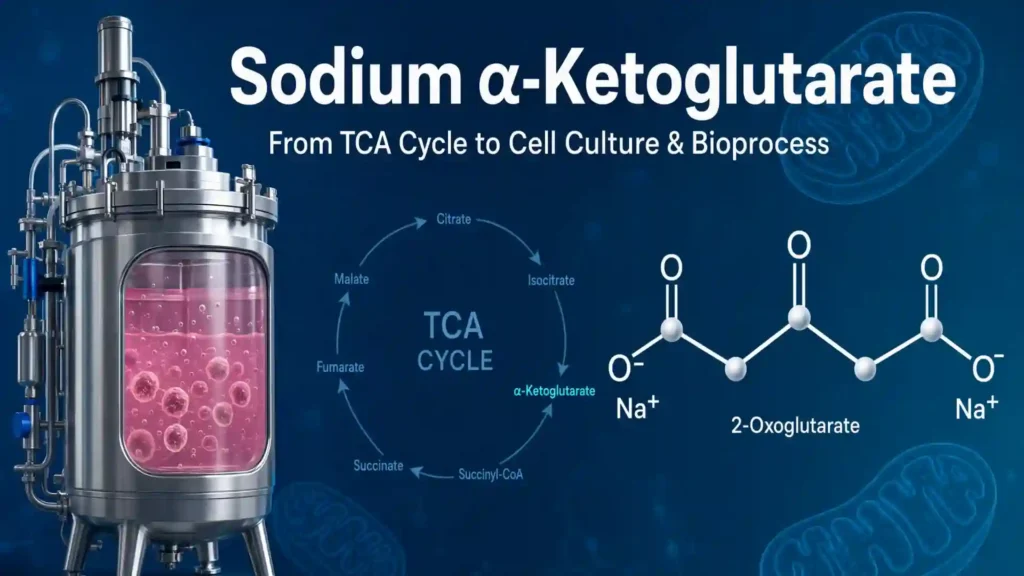
α-Ketoglutarate (AKG; systematic name 2-oxoglutarate, also 2-oxopentanedioate) is a five-carbon dicarboxylic acid intermediate of the tricarboxylic acid (TCA) cycle and a hub molecule linking carbon and nitrogen metabolism. The commercial product “sodium α-ketoglutarate” typically refers to the disodium salt (disodium 2-oxoglutarate). The anhydrous form has the molecular formula C5H4Na2O5 and a molecular weight of 190.06 (anhydrous basis, per Sigma-Aldrich K3752 product data); commercial products are also commonly supplied as the dihydrate (molecular weight approximately 226.1). It appears as a white crystalline powder, is freely soluble in water, and is hygroscopic.
The CAS number is where procurement most often goes wrong: the free acid is 328-50-7, the disodium salt is 305-72-6, and the monosodium salt is 17091-15-5; some suppliers additionally list CAS 1282616-74-3 for the dihydrate. When placing orders, always verify the CAS number and molecular formula on the supplier’s certificate of analysis (COA) to avoid confusing the free acid, the monosodium salt, and the disodium salt, whose molecular weights and stock calculations are completely different.
| Item | Data |
| Common name | Sodium α-ketoglutarate / disodium 2-oxoglutarate |
| CAS (disodium salt) | 305-72-6 (free acid 328-50-7; monosodium salt 17091-15-5) |
| Molecular formula (anhydrous) | C5H4Na2O5 |
| Molecular weight | 190.06 (anhydrous basis); dihydrate approximately 226.1 |
| Solubility | Freely soluble in water; near-neutral solution |
| Primary uses | Cell culture supplementation, biochemical research, clinical nutrition research |
Table 1: Quick reference for the key parameters of α-ketoglutaric acid disodium salt (subject to the supplier’s COA)
1.2 Why the Sodium Salt Rather Than the Free Acid or Other Salts?
The free acid of AKG is distinctly acidic. Adding it directly to a culture system causes a sharp pH drop and requires back-titration with alkali, which introduces operational error and alters ionic strength. The disodium salt gives a near-neutral aqueous solution, dissolves rapidly, and needs essentially no pH adjustment, making it the more controllable form for media preparation and fed-batch processes.
Compared with the calcium salt, the sodium salt introduces no Ca2+: it does not form precipitates with phosphate or carbonate in the medium, does not interfere with assays read through calcium signaling, and leaves the divalent cation balance of the system unchanged. In liquid formulations (concentrated media, feed solutions, and infusion-type formulation research), the sodium salt is in practice the only workable choice.
Compared with the magnesium salt, Mg2+is a cofactor of hundreds of enzymes; if a study does not intend to introduce extra magnesium, the sodium salt is the cleaner option. On cost, the disodium salt delivers a higher fraction of AKG skeleton per unit mass, so the raw material and logistics cost per AKG equivalent is also lower.
1.3 Position in Endogenous Metabolism: The Crossroads of Carbon and Nitrogen Metabolism
In the mitochondrion, isocitrate is oxidatively decarboxylated to AKG, and AKG is then oxidatively decarboxylated by the α-ketoglutarate dehydrogenase complex to succinyl-CoA; this is the core segment of the TCA cycle. At the same time, AKG is a common substrate of several transaminases (such as aspartate aminotransferase, AST) and of glutamate dehydrogenase (GDH): it exchanges amino groups with amino acids to form glutamate, which in turn combines with ammonium to form glutamine.
Rapidly proliferating cells (cultured tumor cell lines and engineered cells such as CHO) depend heavily on the anaplerotic route from glutamine through glutamate to AKG to maintain TCA cycle flux[1]. Supplying AKG directly in the medium delivers the midstream raw material of metabolic flux straight to the cell’s doorstep, bypassing the rate-limiting steps of glutamine transport and breakdown as well as their by-products.
II. Mechanisms: What Sodium AKG Does at the Cell and Medium Level
2.1 An Anaplerotic TCA Cycle Substrate
Once inside the cycle, AKG supports oxidative phosphorylation, and via intermediates such as citrate and oxaloacetate it supplies precursors for lipid and amino acid synthesis; it is a classic anaplerotic substrate[1].
2.2 Ammonia Fixation: Turning an Ammonia-Producing Reaction Around in the Medium
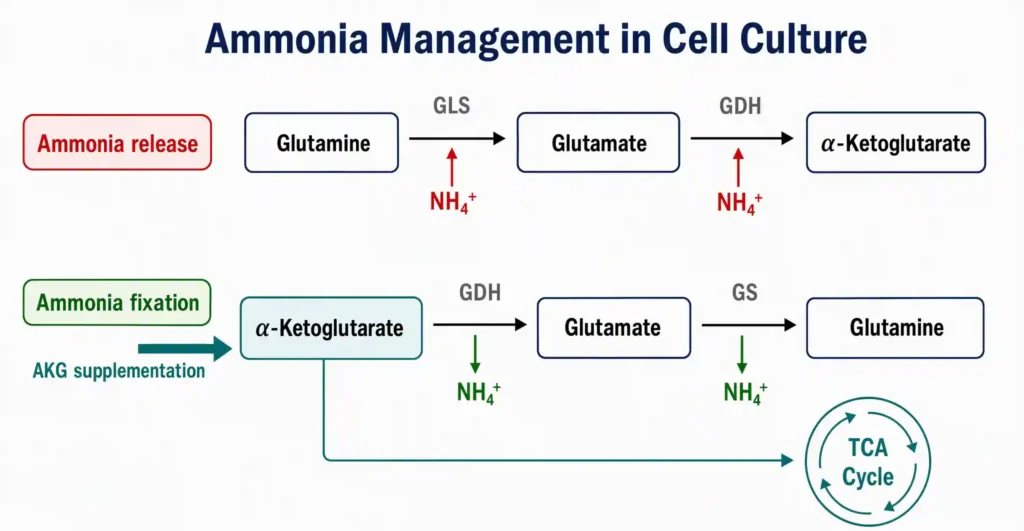
Glutamine metabolism in culture systems generates ammonia, which at millimolar levels inhibits the growth of many mammalian cells and alters the glycosylation profile of recombinant proteins, a classic pain point in upstream processes[2].
When AKG is reductively aminated to glutamate via glutamate dehydrogenase, one ammonium ion is consumed; glutamate then consumes a second ammonium ion through glutamine synthetase to form glutamine. This turns an ammonia-producing reaction into a nitrogen-fixing one[1], which is the core mechanism behind AKG-based glutamine substitution and feeding strategies.
2.3 A Hub of Amino Acid and Nitrogen Metabolism
Using AKG as an amino group acceptor or donor, cells can flexibly adjust their pools of glutamate, aspartate, and alanine, and can further synthesize conditionally essential amino acids such as proline and arginine, supporting protein synthesis and proliferation[1][10].
2.4 A Cosubstrate of Collagen Post-Translational Modification
Prolyl-4-hydroxylase (P4H) uses AKG as a cosubstrate to hydroxylate proline residues in collagen α-chains to hydroxyproline; the reaction also requires ferrous iron and ascorbate. Hydroxyproline is critical for the thermal stability of the collagen triple helix. In collagen-related culture systems such as fibroblasts and chondrocytes, AKG is therefore a nutrient that directly affects extracellular matrix quality[1][5].
2.5 An Antioxidant Buffer in Culture Media: Benefit and Interference in One
Long and Halliwell reminded experimenters that AKG can scavenge hydrogen peroxide generated in culture media by autoxidation of components such as ascorbate and epigallocatechin gallate (EGCG)[9]. For experiments that read out reactive oxygen species (ROS), this is both a confounder to control and a hint that AKG helps stabilize the redox environment of the medium. Studies should be designed with this effect in mind and with appropriate controls included.
2.6 Epigenetic and Oxygen-Sensing Signaling (In Brief)
AKG is a cosubstrate of α-ketoglutarate-dependent dioxygenases such as the TET DNA demethylases and the prolyl hydroxylases (PHD/EGLN), participating in DNA demethylation and HIF pathway regulation. This is one of the most active directions in current AKG research and explains the extensive reporting of AKG in stem cell differentiation and aging studies[1][7].
III. Cell Culture and Bioprocessing: The Home Turf of Sodium AKG
3.1 CHO Cells and Recombinant Protein Production: The Glutamine Substitution Strategy
Ha and Lee reported in the Journal of Biotechnology that substituting TCA cycle intermediates (including AKG) for glutamine in CHO cells expressing an Fc-fusion protein maintained cell growth, product titer, and sialylation levels while reducing ammonia accumulation[2].
For upstream processes of biologics such as monoclonal antibodies and fusion proteins, glycosylation is a critical quality attribute, so ammonia control has direct implications for product quality. AKG supplementation and glutamine substitution are among the commonly used strategies in media optimization and process intensification.
3.2 Hybridomas and Monoclonal Antibody Production
Nilsang et al. examined the effect of AKG on mouse hybridoma cells in both serum-free and serum-containing media: supplementation at 2 mM (pH 7.2) supported the growth and monoclonal antibody secretion of both hybridoma lines, and addition at the start of culture outperformed delayed addition at 72 hours[3], indicating that the effect of AKG does not depend on serum components and is equally effective in serum-free systems.
3.3 Fibroblasts and Collagen-Related Research
Son et al. reported that AKG stimulates procollagen synthesis in cultured human dermal fibroblasts and reduces UVB-induced wrinkle formation in a hairless mouse model[5], which directly echoes the P4H cosubstrate role described in section 2.4. In cosmetic efficacy research and in the skin and cartilage tissue engineering literature, sodium AKG is among the most commonly used supplement forms.
3.4 Myogenic Cells and Metabolic Studies
Yang et al. supplemented AKG (as the sodium salt) at millimolar levels in C2C12 myoblast culture and observed improved cell growth together with rearranged glucose, glutamine, lactate, and ammonia metabolism[4], providing in vitro evidence for the use of AKG in muscle and exercise metabolism research.
3.5 Practical Points for Use and Experimental Design
(1) Concentration: reported effective concentrations are mostly in the millimolar range (approximately 1-10 mM; for example, 2 mM in hybridoma systems[3]); the exact level should be titrated against the cell line, the purpose of the culture, and osmolality tolerance[2][4].
(2) Sodium load and osmolality: millimolar supplementation with the disodium salt introduces sodium ions at the same time; budget for osmolality when designing feeds or concentrated formulations, and include isotonic controls.
(3) Basal media do not contain AKG: common basal media such as DMEM and RPMI 1640 do not include AKG in their formulations; it is an on-demand supplement. A few specialty formulations do contain it, so check the specific medium composition table before use.
(4) Hydrate conversion: the content difference between the dihydrate and the anhydrous form is about 19% (36.03/190.06); convert based on the water content measured on the COA when preparing stock solutions to avoid concentration bias.
(5) Handling: the salt dissolves readily; filter-sterilize (0.22 μm) after preparation, store protected from light under refrigeration, and use promptly. The powder is strongly hygroscopic, so weigh it under dry conditions.
IV. Clinical and Nutrition Research: A Second Line of Evidence (In Brief)
AKG research in clinical nutrition has centered on catabolic states: Wirén et al. discussed in Nutrition the effects of AKG-supplemented enteral nutrition on postoperative nitrogen balance and muscle catabolism[6]; Wu et al. systematically reviewed AKG and its calcium and ornithine salt forms in nutritional support of postoperative, trauma, and burn patients, as well as in bone metabolism and amino acid profile modulation[1].
In aging research, Chin et al. reported that AKG extends the lifespan of C. elegans by about 50% (maximal effect at 8 mM)[7], and Asadi Shahmirzadi et al. reported that dietary calcium AKG extended median lifespan and compressed late-life morbidity in mice[8].
It must be stated plainly: most of this evidence comes from cell and animal experiments and small clinical studies; the human trials involved are limited in sample size, and the long-term effects of AKG as a human supplement still await verification in larger studies (see Appendix C).
V. Specifications, Quality Control, and Procurement
5.1 Key Specification Items
Assay (HPLC or titration, commonly not less than 98% on the anhydrous basis), water content (Karl Fischer, with the hydration state specified), residue on ignition, inorganic impurities such as chlorides and sulfates, and heavy metals; cell culture grade products additionally call for endotoxin and microbial limits, pH, and appearance. For GMP-related uses, documentation support (such as a DMF or ASMF, depending on the target market regulations) should be assessed separately.
5.2 COA Checklist
Whether the CAS number and molecular formula match the purchasing intent (monosodium or disodium, anhydrous or hydrate); the conversion between assay and water content; whether batch release testing covers the items above; the date of manufacture and the retest period.
5.3 Storage and Stability
Store sealed, protected from light, dry, and cool (most suppliers recommend 2-8°C, dry). The powder is strongly hygroscopic; after opening, keep it in a desiccator and use it up promptly.
5.4 Supplier Selection
Prefer suppliers that provide a complete COA and MSDS, can explain their analytical methods and impurity profiles, and maintain independent in-house specifications for cell culture grade material; for bioprocess development, run small-scale comparative trials before scale-up.
VI. Sodium, Calcium, Magnesium, and Arginine Salts: The Differences at a Glance
| Salt form | Representative characteristics | Typical applications | Procurement focus |
| Sodium (disodium, 305-72-6) | Freely soluble, near-neutral solution, no divalent metal ions introduced | Cell culture and media supplementation, liquid formulations, biochemical research | Hydration state, endotoxin, assay conversion |
| Calcium (Ca-AKG) | Delivers calcium; mainly solid dosage forms | Dietary supplements, aging research (ref. [8]) | Calcium content, blend uniformity, disintegration |
| Magnesium (Mg-AKG) | Also supplies magnesium | Sports nutrition formulations | Magnesium content, solubility |
| Arginine AKG (OKG) | Two components: arginine plus AKG | Clinical nutrition (postoperative, burns), sports supplements | Molar ratio of the components, arginine source |
Table 2: Comparison of four AKG salt forms. Note: specific CAS numbers and specifications are subject to each supplier’s COA; this article focuses on the sodium salt; see the other articles in this series for the calcium and magnesium salts.
VII. Frequently Asked Questions (FAQ)
Q1: What is the difference between sodium α-ketoglutarate and free α-ketoglutaric acid, and which should I choose?
A: The chemical skeleton is identical; the difference lies in physicochemical behavior. The free acid is distinctly acidic and will drag down medium pH when added directly, while the disodium salt gives a near-neutral solution, dissolves quickly, and is easy to prepare. Cell culture and liquid formulations favor the sodium salt; certain solid dosage forms or special synthesis uses may call for the free acid.
Q2: What concentration is typically used in cell culture?
A: Reported levels are mostly millimolar (approximately 1-10 mM); for example, 2 mM is common in hybridoma systems[3]. Differences between cell lines are considerable, so refer to the systems in references[2][4]and then titrate.
Q3: Can AKG replace glutamine?
A: As a strategy, yes; the literature on CHO and other systems supports its feasibility[2]. However, glutamine also serves as a nitrogen source for purine, pyrimidine, and amino sugar synthesis, so full substitution should be validated for the specific cell line, and both the extent of substitution and the feeding strategy should be established experimentally.
Q4: Which is better, the sodium salt or the calcium salt?
A: There is no absolute answer; it depends on the use. For cell culture systems or liquid formulations, the sodium salt is the default choice; for solid dosage forms as dietary supplements, the calcium salt has more research support (such as the mouse lifespan study [8]).
Q5: Does adding AKG change medium osmolality?
A: It introduces sodium ions and contributes to osmolality. Millimolar additions are usually within acceptable limits, but concentrated feeds and high-volume supplementation strategies should include an osmolality budget and appropriate controls.
Q6: How safe is sodium α-ketoglutarate?
A: As a laboratory reagent, its acute toxicity is low; the GHS classification is limited to the skin, eye, and respiratory irritation categories (H315/H319/H335), and routine handling per the MSDS is sufficient. Regarding human use, existing clinical studies are limited in scale, and you should not make health-benefit claims on this basis (see Appendix C).
Q7: What matters most when purchasing cell culture grade material?
A: Endotoxin and microbial limits, hydration state and assay conversion, batch-to-batch consistency, and the completeness of the documentation (COA, MSDS, and analytical methods).
References
[1] WU N, YANG M, GAUR U, et al. Alpha-ketoglutarate: physiological functions and applications[J]. Biomolecules and Therapeutics, 2016, 24(1): 1-8.
[2] HA T K, LEE G M. Effect of glutamine substitution by TCA cycle intermediates on the production and sialylation of Fc-fusion protein in Chinese hamster ovary cell culture[J]. Journal of Biotechnology, 2014, 180: 23-29.
[3] NILSANG S, KUMAR A, RAKSHIT S K. Effect of alpha-ketoglutarate on monoclonal antibody production of hybridoma cell lines in serum-free and serum-containing medium[J]. Applied Biochemistry and Biotechnology, 2008, 151(2-3): 489-501.
[4] YANG B, LIU Y, STEINACKER J M. α-Ketoglutarate stimulates cell growth through the improvement of glucose and glutamine metabolism in C2C12 cell culture[J]. Frontiers in Nutrition, 2023, 10: 1145236.
[5] SON E D, CHOI G H, KIM H, et al. Alpha-ketoglutarate stimulates procollagen production in cultured human dermal fibroblasts, and decreases UVB-induced wrinkle formation following topical application on the dorsal skin of hairless mice[J]. Biological and Pharmaceutical Bulletin, 2007, 30(8): 1395-1399.
[6] WIRÉN M, PERMERT J, LARSSON J. Alpha-ketoglutarate-supplemented enteral nutrition: effects on postoperative nitrogen balance and muscle catabolism[J]. Nutrition, 2002, 18(9): 725-728.
[7] CHIN R M, FU X, PAI M Y, et al. The metabolite α-ketoglutarate extends lifespan by inhibiting ATP synthase and TOR[J]. Nature, 2014, 510(7505): 397-401.
[8] ASADI SHAHMIRZADI A A, EDGAR D, LIAO C Y, et al. Alpha-ketoglutarate, an endogenous metabolite, extends lifespan and compresses morbidity in aging mice[J]. Cell Metabolism, 2020, 32(3): 447-456.
[9] LONG L H, HALLIWELL B. Artifacts in cell culture: α-ketoglutarate can scavenge hydrogen peroxide generated by ascorbate and epigallocatechin gallate in cell culture media[J]. Biochemical and Biophysical Research Communications, 2011, 406(1): 20-24.
[10] HARRISON A P, PIERZYNOWSKI S G. Biological effects of 2-oxoglutarate with particular emphasis on the regulation of protein, mineral and lipid absorption/metabolism, muscle performance, kidney function, bone formation, and cancerogenesis: a review from a healthy aging perspective[J]. Journal of Physiology and Pharmacology, 2008, 59(Suppl 1): 91-106.
VIII. Conclusion
Sodium α-ketoglutarate delivers the hub molecule of the TCA cycle to the bench in a near-neutral, freely soluble, divalent-metal-free form: in cell culture and bioprocessing it is the core working substrate of glutamine substitution and ammonia management strategies, and it is likewise a frequently used nutrient in collagen synthesis, metabolism, and aging research.
For purchasers, three details make or break the outcome: verifying the CAS number and hydration state, the endotoxin specification for cell culture grade, and specification documents that match the intended system. Choose the right salt form, and the metabolic value of AKG can genuinely translate into process and product performance.