
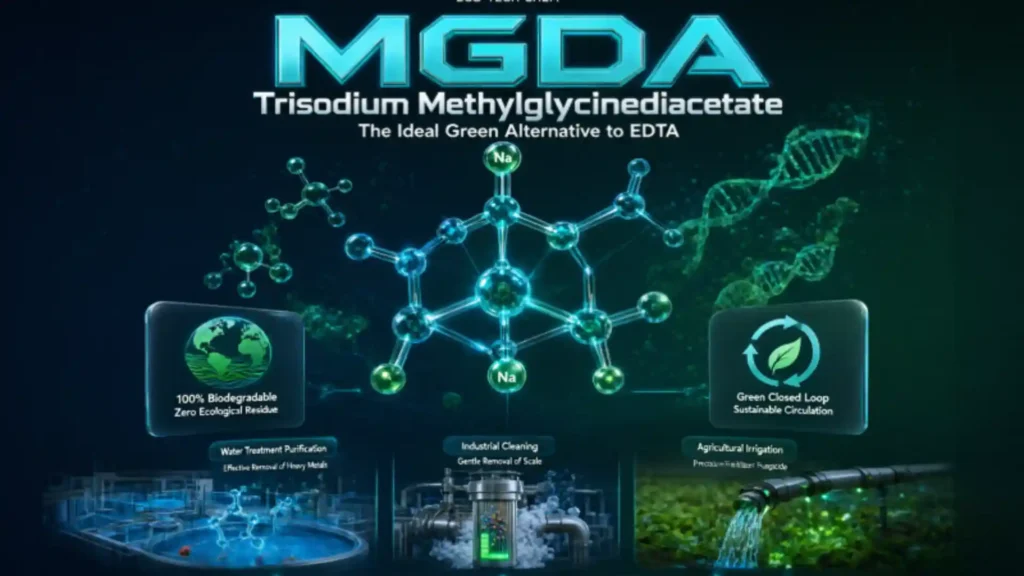
MGDA, short for Methyl Glycinediacetic Acid, is a biodegradable aminocarboxylate chelating agent. In industrial, home care, personal care, and agricultural formulations, it is most commonly used as its trisodium salt: MGDA-3Na, also known as Trisodium Methylglycinediacetate, Trisodium Dicarboxymethyl Alaninate, MGDA trisodium, or methyl glycine diacetate trisodium. Its CAS number is 164462-16-2.
MGDA forms stable, water-soluble complexes with metal ions such as calcium, magnesium, iron, copper, zinc and manganese. Compared with traditional chelating agents such as EDTA, NTA and DTPA, MGDA offers a phosphate-free formulation, ready biodegradability, low ecotoxicity, broad pH stability and good compatibility with surfactants, enzymes and bleaching systems. It is increasingly used as a green chelating agent, eco-friendly sequestering agent, hard water softener, scale inhibitor, and EDTA alternative.

I. What Is MGDA?
MGDA is a low-molecular-weight chelating agent derived from amino acid chemistry. It is commercially available as MGDA-3Na aqueous solution or solid granules, typically appearing as a light yellow transparent liquid or white to light yellow granules.
The MGDA molecule contains carboxylate groups and an amino group, which act as coordination sites to bind metal ions and form stable chelate rings. This structure enables MGDA to support hard water softening, scale inhibition, anti-redeposition, bleach system stabilization, and enzyme protection in complex formulation systems.
In formulation design, MGDA is commonly described as:
- Biodegradable Chelating Agent
- Green Chelating Agent
- Eco-friendly Sequestering Agent
- EDTA Alternative
- Phosphate-free Builder
- Hard Water Softener
- Scale Inhibitor
- Metal Ion Sequestrant
II. Key Advantages of MGDA-3Na
1. Readily Biodegradable and Environmentally Friendly
MGDA shows good performance in OECD 301-series ready biodegradability tests, with high 28-day biodegradation rates under standard test conditions. This helps reduce the risk of long-term environmental persistence compared with some traditional chelating agents.
MGDA is also phosphate-free, supporting formulation strategies aimed at reducing eutrophication risk and meeting stricter environmental expectations for household care, industrial cleaning and export-oriented products.
2. Strong Chelating Capacity Across a Broad pH Range
MGDA effectively sequesters Ca²⁺, Mg²⁺, Fe²⁺/Fe³⁺, Cu²⁺, Zn²⁺ and Mn²⁺, making it suitable for hard water control, metal ion interference management and inorganic scale prevention.
It remains stable over a wide pH range and performs particularly well under alkaline conditions. This makes MGDA-3Na suitable for laundry detergents, automatic dishwashing detergents, alkaline industrial cleaners and heavy-duty cleaning applications.
3. Good Compatibility with Surfactants, Enzymes and Bleaches
MGDA is compatible with anionic, nonionic and amphoteric surfactants. It can also be formulated with enzymes, preservatives, sodium percarbonate, hydrogen peroxide and other oxidative or biological actives.
In detergent systems, MGDA helps reduce metal-ion-induced deactivation of enzymes and bleaching agents, supporting improved cleaning performance at lower temperatures and in hard water conditions.
4. Favorable Safety Profile for Multiple Applications
MGDA generally shows low ecotoxicity and relatively low irritation potential compared with some traditional chelating agents. It can be considered for home care, personal care, institutional cleaning and certain food-contact-related cleaning applications, subject to local regulations and final formulation assessment.
Because MGDA-3Na solutions are typically alkaline, appropriate handling, storage and PPE measures should be followed according to the product SDS.
III. MGDA vs. EDTA, NTA and GLDA
| Comparison Point | MGDA-3Na | EDTA / NTA / GLDA |
|---|---|---|
| Biodegradability | Readily biodegradable; lower environmental persistence risk | EDTA is poorly biodegradable; NTA has environmental concerns; GLDA is also readily biodegradable |
| Phosphate Content | Phosphate-free | Traditional phosphates contain phosphorus; EDTA/NTA are phosphate-free but less biodegradable |
| pH Stability | Stable over a broad pH range; strong performance in alkaline systems | EDTA is widely used; GLDA performs well across acidic to alkaline ranges |
| Typical Applications | Detergents, dishwashing, industrial cleaning, personal care, water treatment, agriculture | EDTA is widely used but under substitution pressure; NTA is increasingly restricted; GLDA is common in liquid and broad-pH systems |
MGDA is not a universal one-to-one replacement for EDTA in every application. However, it is a strong candidate when formulators need biodegradability, phosphate-free performance, hard water tolerance and improved environmental profiles.
IV. Main Applications of MGDA
1. Home Care and Industrial Detergents
MGDA can be used in laundry powders, laundry liquids, laundry capsules, soap-based cleaners, heavy-duty cleaners and automatic dishwashing detergents. It helps soften hard water, prevent calcium soap deposition, improve detergency and reduce water marks or dullness on fabrics and tableware.
2. Automatic Dishwashing Detergents
In automatic dishwashing formulations, MGDA helps prevent film formation on glassware, reduce tea stains and starchy residues, and improve rinsing performance. It is commonly used in phosphate-free dishwashing powders, tablets and liquids.
3. Personal Care and Cosmetics
MGDA can be added to shampoos, body washes, facial cleansers and certain skin care formulations to sequester trace metal ions in raw materials and water phases. This may help improve formula stability and reduce discoloration, odor changes and oxidative degradation.
4. Industrial Cleaning and CIP Systems
MGDA is suitable for boilers, heat exchangers, food and beverage equipment, metal surface cleaning and CIP systems. It can help dissolve and disperse calcium/magnesium scales, rust and certain metal oxides, while maintaining good compatibility with stainless steel, aluminum and other common materials.
5. Water Treatment and Scale Inhibition
In circulating cooling water, industrial process water, and certain water treatment formulations, MGDA can act as a scale inhibitor and metal ion control agent. It helps reduce the formation of calcium carbonate, calcium phosphate, and other inorganic scales.
6. Agriculture and Micronutrient Fertilizers
MGDA can be used in water-soluble fertilizers, foliar fertilizers, and micronutrient formulations to improve the solubility and availability of iron, zinc, manganese and copper. It may also help reduce metal ion fixation in soil or fertilizer systems.
7. Textile Processing and Pulp & Paper
In textile processing, MGDA can be applied during pretreatment, bleaching, and dyeing to reduce metal ion interference with dyes, bleaching agents, and fabric shade. In pulp and paper applications, it may help control metal ions and support bleaching efficiency and brightness stability.
V. Typical Specifications
Specifications may vary by manufacturer and grade. The following values are common reference indicators:
| Item | Typical Specification | Note |
|---|---|---|
| CAS No. | 164462-16-2 | Common CAS for MGDA-3Na |
| Appearance | Light yellow transparent liquid / white to light yellow granules | Depends on grade |
| Active Content | ≥40% liquid; ≥76% solid | Confirm with TDS |
| pH | About 10–12 | 1% aqueous solution; alkaline |
| Density | ≥1.30 g/cm³ | Reference value for liquid grade |
For purchasing decisions, confirm active content, pH, chloride level, heavy metals, color, packaging, and shelf life with the supplier’s technical data sheet.
VI. How to Choose the Right MGDA Grade
When selecting MGDA-3Na, consider the following factors:
- Form: Liquid grades are convenient for dosing; solid grades are easier to transport and store.
- Active Content: Liquid products are commonly around 40%; solid grades may be higher.
- pH Compatibility: MGDA-3Na is typically alkaline and should be evaluated for compatibility with the final formulation.
- Application Scenario: Detergents, personal care, industrial cleaning, water treatment, and agriculture have different performance priorities.
- Regulatory Requirements: For export markets, check biodegradability data, ecotoxicity information, and customer-required certifications.
- Packaging and Stability: Confirm packaging size, storage conditions, shelf life, and whether customized concentrations are available.
VII. Why Choose MGDA as a Green Chelating Agent?
MGDA combines chelating performance, formulation compatibility, and environmental profile. For manufacturers transitioning from EDTA, NTA, or phosphate-based builders to greener systems, MGDA-3Na is a mature and widely discussed alternative in detergent, cleaning, personal care, water treatment and agricultural applications.
If your product requires phosphate-free formulation, hard water tolerance, low environmental persistence, or improved compliance positioning, MGDA is worth evaluating. The recommended dosage should be determined through laboratory trials based on water hardness, soil type, pH system, and cost ta