
Document Version: 1.0
Revision Date: 2026-05-28
Introduction:
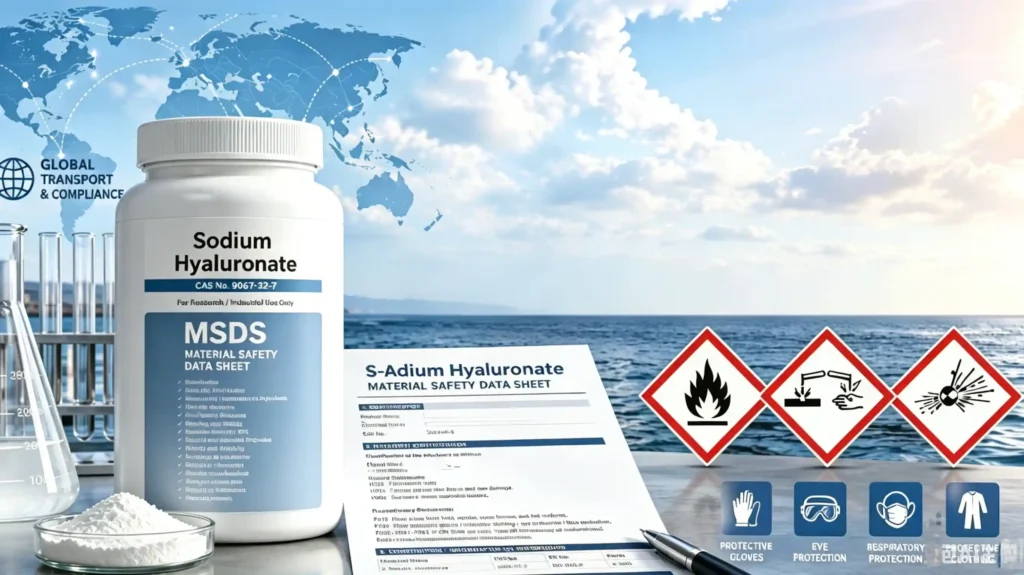
This paper is an article on the Sodium Hyaluronate SDS written by JaYoo Biotech for those who need it.
Sodium hyaluronate is the sodium salt form of hyaluronic acid, a high molecular weight polysaccharide naturally present in human tissues such as skin, joints, and eyes. It exhibits excellent water solubility and high biocompatibility. With remarkable water-locking and moisturizing capabilities, it can absorb hundreds of times its own weight in moisture. It is widely used in skincare products for hydration and repair, as well as to improve skin dryness. Additionally, it is used in medical aesthetics for fillers, joint lubrication, joint health supplements, and ophthalmic care, offering safe, gentle benefits.
SECTION 1: IDENTIFICATION
Product Identifier
Product Name: Sodium Hyaluronate
Synonyms: Hyaluronic Acid Sodium Salt, Sodium Hyaluronate Powder
CAS Registry Number: 9067-32-7
General Formula: (C14H22NO11Na)n
Recommended Use and Restrictions on Use
Recommended Uses: Cosmetic raw material, food additive, pharmaceutical excipient, laboratory reagent, biomedical material
Uses Advised Against: No specific restricted uses identified under normal industrial and commercial application
Supplier Information
Company name: Shenzhen JaYoo Biotech Co., Ltd
Add.: Unit 7C92B, Building 213, Tairan Technology Park, No. 113 Tairan 4th Road
Tian’an Community, Shatou Subdistrict, Futian District, Shenzhen, China
Technical Support Email: info@jayoobio.com
SECTION 2: HAZARDS IDENTIFICATION
GHS Classification (Per OSHA HCS 2012)
This substance is NOT CLASSIFIED as hazardous under US OSHA GHS hazard criteria. No physical or health hazards are identified for normal handling and use.
GHS Label Elements
Hazard Pictograms: None
Signal Word: None
Hazard Statements: None
Precautionary Statements: None required for non-hazardous substance
Unknown Hazards
No unclassified physical, health, or environmental hazards exist under standard operating conditions.
SECTION 3: COMPOSITION / INFORMATION ON INGREDIENTS
Substance Details
Chemical Identity: Sodium Hyaluronate
CAS No.: 9067-32-7
Concentration: ≥99.0% (pure substance, no hazardous impurities)
Impurities and Additives
No hazardous impurities, stabilizers, or additives are contained in this product. All auxiliary components are non-toxic and compliant with US FDA and OSHA regulations.
SECTION 4: FIRST AID MEASURES
Description of First Aid Measures
Inhalation: Remove the victim to fresh air. If breathing is difficult, seek medical attention. No acute inhalation toxicity under normal use.
Skin Contact: Rinse skin thoroughly with clean running water. Wash contaminated clothing before reuse. No skin irritation under normal conditions.
Eye Contact: Immediately flush the eyes with plenty of water for at least 15 minutes, occasionally lifting the upper and lower eyelids. If redness, itching, or discomfort persists, consult a physician.
Ingestion: Rinse mouth with water. Do not induce vomiting. No acute oral toxicity; seek medical help if large amounts are ingested and discomfort occurs.
Most Important Symptoms/Effects, Acute and Delayed
No acute or delayed adverse health effects are known for standard industrial and commercial exposure.
Immediate Medical Attention and Special Treatment
No special medical treatment required; treat symptomatically if adverse reactions occur.
SECTION 5: FIRE FIGHTING MEASURES
Extinguishing Media
Suitable Extinguishing Media: Water spray, dry chemical powder, carbon dioxide (CO₂), foam fire extinguisher
Unsuitable Extinguishing Media: No specific restrictions
Special Hazards Arising from the Substance
Non-flammable solid. No dangerous combustion products under normal fire conditions. Thermal decomposition may produce carbon oxides, nitrogen oxides, and sodium oxide fumes at high temperatures.
Advice for Firefighters
Firefighters shall wear standard protective fire clothing and self-contained breathing apparatus (SCBA). Avoid inhalation of decomposition fumes.
SECTION 6: ACCIDENTAL RELEASE MEASURES
Personal Precautions, Protective Equipment, and Emergency Procedures
Avoid dust inhalation and direct eye contact. Wear a standard dust-proof mask and gloves for cleanup. Keep unnecessary personnel away from the spill area.
Environmental Precautions
Prevent large quantities of spilled material from entering sewers, surface water, and groundwater. No significant environmental toxicity.
Methods and Materials for Containment and Cleaning Up
Collect spilled powder with clean, dry tools and place it into sealed, clean containers. Wipe residual dust with a damp cloth. Clean the area thoroughly to prevent dust accumulation.
SECTION 7: HANDLING AND STORAGE
Precautions for Safe Handling
Operate in a well-ventilated workplace. Avoid generating and inhaling dust. Avoid direct contact with the eyes and broken skin. Keep away from high temperatures and strong oxidants.
Conditions for Safe Storage, Including Incompatibilities
Storage Conditions: Store in a dry, cool, ventilated indoor warehouse. Keep sealed, avoid moisture and direct sunlight. Storage temperature: 10℃-30℃, relative humidity ≤60%.
Incompatible Materials: Strong oxidizing agents, strong acids
Specific End Use
Cosmetic formulation, food processing, and laboratory research
SECTION 8: EXPOSURE CONTROLS / PERSONAL PROTECTION
Control Parameters
No OSHA PEL (Permissible Exposure Limit) or ACGIH TLV (Threshold Limit Value) established for this substance.
Appropriate Engineering Controls
General mechanical ventilation is sufficient for routine handling. Local exhaust ventilation is recommended for large-scale powder operations to control dust concentration.
Individual Protection Equipment (PPE)
Respiratory Protection: No protection required for normal use; wear a disposable dust mask in dusty operating environments
Skin Protection: Wear routine protective gloves and work clothes
Eye Protection: Wear safety goggles if dust may splash
Hand Protection: Disposable nitrile or latex gloves
Thermal Hazards
No thermal hazards under normal handling conditions
SECTION 9: PHYSICAL AND CHEMICAL PROPERTIES
Basic Physical and Chemical Properties
Appearance: White or off-white amorphous powder
Odor: Odorless
Odor Threshold: Not applicable
pH Value: 6.0 – 8.5 (1% aqueous solution)
Melting/Freezing Point: No fixed melting point (polymer compound)
Boiling Point: Not applicable (decomposes before boiling)
Flash Point: Not flammable
Evaporation Rate: Not applicable
Flammability: Non-flammable solid
Upper/Lower Flammability Limit: Not applicable
Vapor Pressure: Negligible at 25℃
Vapor Density: Not applicable
Solubility: Freely soluble in water, insoluble in ethanol, acetone, and organic solvents
Partition Coefficient (Log Kow): Not applicable (water-soluble polymer)
Auto-ignition Temperature: Not applicable
Decomposition Temperature: >200℃
Viscosity: High viscosity in aqueous solution (varies by molecular weight)
SECTION 10: STABILITY AND REACTIVITY
Reactivity
Chemically stable under normal handling and storage conditions, with no dangerous reactivity
Chemical Stability
Stable at room temperature and standard pressure; avoid high temperature, strong light, and strong oxidants
Possibility of Hazardous Reactions
No hazardous polymerization or violent reaction occurs
Conditions to Avoid
High temperature, direct sunlight, humid environment, contact with strong oxidants, and strong acids
Incompatible Materials
Strong oxidizing agents, concentrated strong acids
Hazardous Decomposition Products
High-temperature decomposition produces carbon monoxide, carbon dioxide, nitrogen oxides, and sodium-containing fumes
SECTION 11: TOXICOLOGICAL INFORMATION
Toxicological Effect Data
Acute Toxicity: LD50 (Oral, Rat) >2000 mg/kg (practically non-toxic)
Skin Corrosion/Irritation: No irritation (rabbit skin test, negative result)
Eye Irritation: Mild transient irritation at high concentration, no permanent damage
Respiratory or Skin Sensitization: No sensitization potential
Germ Cell Mutagenicity: No mutagenic effect
Carcinogenicity: Not listed as a carcinogen by IARC, OSHA, NTP
Reproductive Toxicity: No reproductive and developmental toxicity
STOT-Single Exposure: No specific target organ toxicity
STOT-Repeated Exposure: No adverse effects from long-term low-dose exposure
Aspiration Hazard: No aspiration hazard
Other Toxicity Information
Widely used in cosmetics and the food industry, with confirmed safety for human external use and oral intake in regulated doses
SECTION 12: ECOLOGICAL INFORMATION
Ecotoxicity
Low ecological toxicity; no adverse effects on aquatic organisms at conventional environmental concentrations
Persistence and Degradability
Biodegradable in a natural environment, with no persistent pollution risk
Bioaccumulative Potential
No bioaccumulation in organisms
Mobility in Soil
Water-soluble, migrates slightly in soil, no long-term retention
PBT and vPvB Assessment
Not classified as a PBT or vPvB substance per US EPA criteria
Other Adverse Effects
No known adverse environmental impacts
SECTION 13: DISPOSAL CONSIDERATIONS
Waste Treatment Methods
Dispose of waste material in accordance with US federal, state, and local environmental regulations. Small quantities of residual materials can be disposed of as general non-hazardous waste.
Packaging Disposal
Clean empty packaging containers can be recycled; contaminated packaging shall be disposed as general waste
Prohibited Disposal Methods
Do not discharge directly into sewers, soil, or natural water bodies
SECTION 14: TRANSPORT INFORMATION
UN Number: None
UN Proper Shipping Name: Not restricted (Non-hazardous goods)
Transport Hazard Class: No transport hazard classification
Packing Group: Not applicable
Environmental Hazards: No environmental transport hazards
Special Precautions for Transport
Transport as ordinary goods; keep sealed, dry, avoid extrusion, moisture, and high temperature exposure
Bulk Transport
No special bulk transport restrictions under US DOT regulations
SECTION 15: REGULATORY INFORMATION
US Federal Regulations
OSHA 29 CFR 1910.1200 (Hazard Communication Standard): Non-hazardous substance, no mandatory hazard labeling required
FDA Regulation: Approved for use as a cosmetic ingredient, food additive, and pharmaceutical raw material within a specified dosage range
TSCA Inventory: Listed in the TSCA chemical inventory, compliant with US EPA requirements
State Regulations
Compliant with common US state environmental and occupational safety regulations
Chemical Safety Assessment
No chemical safety assessment required for this non-hazardous substance
SECTION 16: OTHER INFORMATION
All content is based on currently available safety data and authoritative industry literature. It is only for safety reference of product handling, transportation, and application. Users shall independently assess the applicability of the information and comply with local regulatory requirements.
Shenzhen JaYoo Biotech is committed to providing high-quality Sodium Hyaluronate for industrial and research applications. Adhering to the safety guidelines outlined in this MSDS ensures proper handling and usage of Sodium Hyaluronate bulk powder. JaYoo Biotech emphasizes safety and quality, offering reliable support and high-grade Sodium Hyaluronate bulk powder to meet your needs.